

Nevertheless, He Persisted
On Pushy Men and Girls Not Wanting It, In Lily Allen’s Hit Album West End Girl and in Alexandre Dumas’s 19th Century Comedy, The Great Lover
By Fable Isaacson

Brit pop star Lily Allen performs in Benicassim, Spain at the FIB Festival
This essay is part of the Stage Raw/Unusual Suspects Youth Journalism Fellowship
Maybe it’s just my algorithm, but it seems like I can’t get a good two scrolls in without seeing something about Lily Allen’s new album, West End Girl, regarding her and David Harbour’s relationship.
For a generation so obsessed with euphemisms and equivocations, Allen’s album gave zero room for interpretation, making West End Girl a breath of fresh air.
Women have historically pseudonymized their stories to protect their male offenders, and it’s not just because of an “inherent empathy” that comes with birthing hips. For as long as our society has been a patriarchy, we have been protecting rapist sons and unfaithful husbands, so when someone breaks that chain, it feels like a cultural coup.
And it kind of is! I’d love to sit around and write about how much we have progressed, but no social movement can rewrite centuries-old coding.
That’s why Allen’s recent release feels like such a huge step in the right direction. She is unapologetic in recounting her experience and has no shame in putting the man who did her dirty on full blast. And unlike the rise of meditated “easter eggs” artists have been imbedding into their music, Allen doesn’t let you decode anything Harbour might have or might not have done. Her lyrics aren’t an elaborate tap dance around what he did wrong in their marriage, they’re actually humorously step by step. From the song, “Madeline”:
“We had an arrangement
“Be discreet and don’t be blatant
“There had to be payment
“It had to be with strangers
“But you’re not a stranger, Madeline”
“I told you all of this has been too brutal
“You told me that you felt the same, it’s mutual…
“But what a line, line, line”
Upon listening to this the first time I got really excited. Like yes, actions do have consequences! But then I processed what she was actually saying and that brief high dipped.
In summary, Harbour had not so gently coaxed Allen into an open relationship she clearly communicated she did not want. Then, on top of that, he broke the rules of the very system he begged for. I mean, what gives the man the audacity?
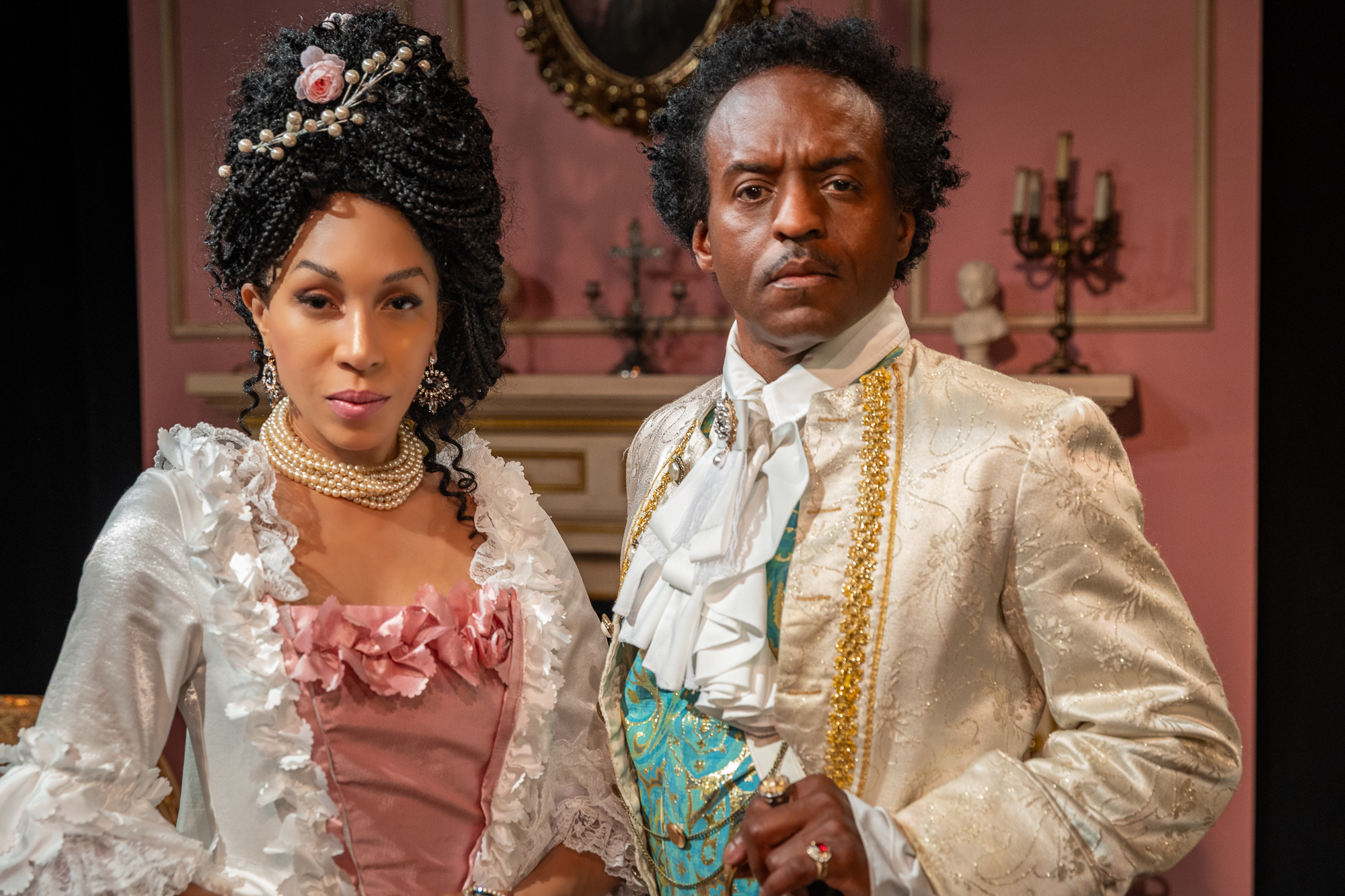
Tiffany Coty-Goines and Julio Hanson in “The Great Lover,” presented by Robey Theatre Company
I was met with this same question upon watching The Robey Theatre Company’s The Great Lover (recently closed). Directed by Ben Guillory, the story follows a man named Duke De Richelieu (Julio Hanson) who makes a bet with Lieutenant Servan (Jason Mimms) that he can successfully seduce the first beautiful woman he sees. Without knowing, the woman he selects just so happens to be the Lieutenant’s fiancé, Gabrielle De Belle-Isle (CJ Obilom).
The show was well executed and contained great performances from the entire cast, one notably being by Tiffany Coty-Goines who portrayed an effortlessly funny and captivating Marquise De Prie. Joel Daavid’s set design elevated the production wonderfully, as well as Naila Aladdin Sander’s costuming which made me feel as if I was in the presence of true royalty.
Now, despite the show’s great charm, I found myself grappling with the central premise of the story. Duke De Richelieu’s character is introduced as a master flirt, infamous for getting intimate with almost all of France. The opening scene reveals the aftermath of one of his many conquests; Marquise De Prie’s unreciprocated love for him after the night they shared together, and his complete indifference to her feelings. He even goes on to seduce her maid, just because he can.
As the plot progresses, it shapes into a comedy of errors centering around unchecked arrogance. Duke De Richelieu convinces himself that he’s seduced Gabrielle De Belle-Isle (without realizing he was with an entirely different woman), turning Gabrielle into a target of her fiancé’s unbridled rage and jealousy. She never invited any of it, yet she was the one who fell victim to the consequences.
By the end of the play, even though every truth surfaced and all was resolved, I still couldn’t shake my unease. Every joke seemed to be at the expense of a woman who didn’t want it.
This famous disregard for women’s feelings continues to parallel that of the famous misconception that a man’s desire automatically equals a woman’s consent. And trust me, the irony is not lost on me that the titular character of the play is referred to as a “great lover,” despite his zero-to-none efforts to foster genuine relationships with the women he brings to bed.
No matter how explicitly a woman draws her boundaries, there will be a man who finds no remorse in crossing them. Gabrielle De Belle-Isle didn’t want sexual relations and Lily Allen didn’t want an open relationship, but that didn’t stop Duke De Richelieu or David Harbour from insisting. The false narrative that a woman’s discomfort is negotiable or rather an obstacle asking to be challenged is dangerously common.
I think that’s why Allen’s album is so necessary. She calls BS on persistence equating to passion. And honestly, so does “The Great Lover.” It forces the audience to home in on a hollow archetype and recognize how harmful it really is. Although from contrasting perspectives, both the play and the album reveal the same sentiment. Women deserve to stop cushioning the impact of a man’s mistakes at the expense of themselves, and say it exactly how it is.
Lily Allen’s new album, West End Girl, was released October 24, 2025 on the BMG Rights Management (UK) Limited label.
The Great Lover by Alexandre Dumas, was presented by Robey Theatre Company at the Los Angeles Theatre Center, 514 S. Spring Street, Downtown Los Angeles, and is now closed.