
All photos by Cameron Rice
Public Assembly Puts the Community Back into Community Theater
A New Model to Counter the Indifference of Traditional Funders
By Catherine Crouch

Photo by Cameron Rice
Theater-makers across California are no strangers to empty coffers, even after a hit show. Professional productions are expensive to mount, even with support from donors and the box office: One third of national arts nonprofits report functional capital equal to less than two months of expenses. Meanwhile, government funding at all levels is shrinking. (One notable exception is California’s restoration of a fund to local arts organizations snared in Assembly Bill 5, which, from 2020, ballooned the production costs of a show with 99-seats or fewer by up to triple.) And even when shows defy the odds to risk an opening night, even well-established theater companies often don’t have a robust marketing team.
Public Assembly, a nomadic “community theater,” didn’t get this memo. At their most recent production, the line to get in wrapped around the block. The crowd was eager for a seat or space in the standing section, and door greeters had to, for the first time in Public Assembly’s history, turn away hopeful folks waiting in the rush line.
Founders Clara Aranovich, Satya Bhabha, and Alex Tavitian established Public Assembly in 2018 to carve out a space for creatives to experiment, collaborate, and produce works that speak to our times in our times (rather than two to five years later –the standard waiting time for a new play produced by our institutional theaters, large and small).
The company programs three, 12-minute plays each month, all formed around a theme selected live at the previous month’s performance. Audience members shout out suggestions, and current Artist Directors Aranovich and Bhabha huddle on stage and take just a handful of seconds to deliberate. Last month’s theme was March Madness. The staged plays were “Mating Rituals,” written by David Clifford Turner and directed by Nitya Vidyasagar; “Before the Verdict,” written by Paolina Acuña-González and directed by Janina Gavankar; and “The Ides of Marching Band,” written by Ben Smith and directed by Brendan Scannell. Musical interstitials by CSU Dominguez Hills’s Toro Pep Band peppered the evening as cast and crew reset the stage between plays.
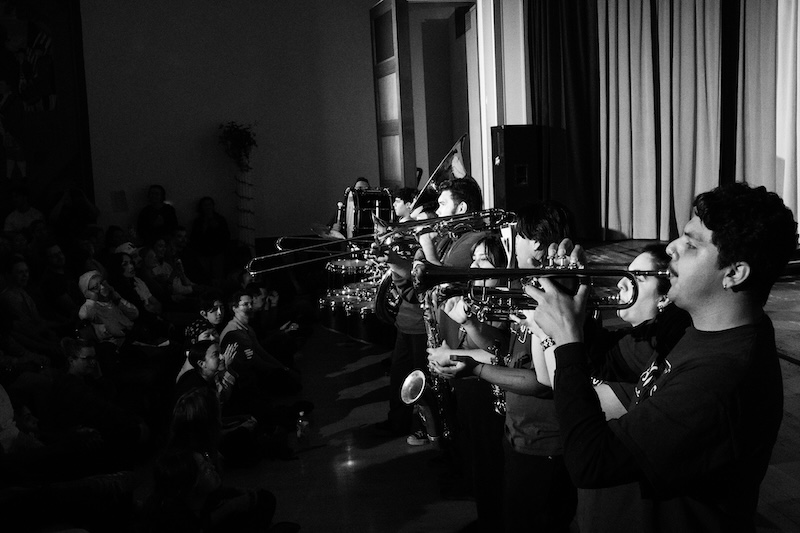
Photo by Cameron Rice
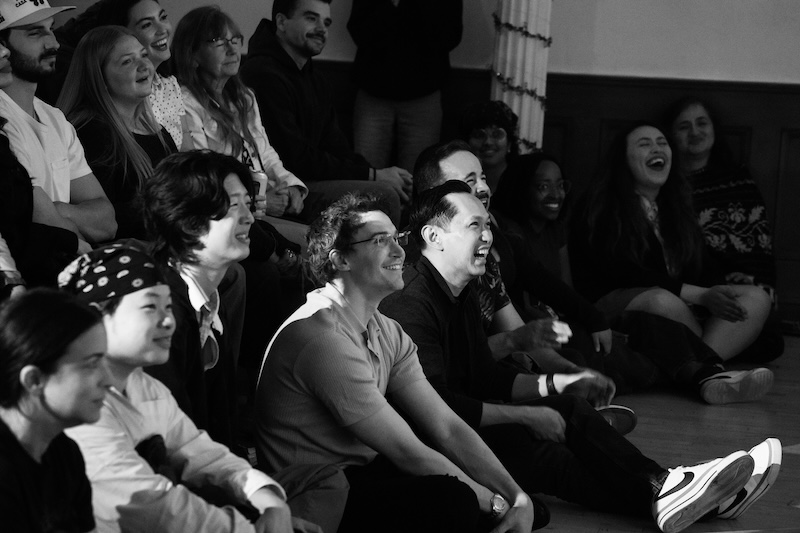
The crowd was young and rowdy. Public Assembly explicitly programs plays, not sketch comedy, yet the audience oohs and aahs like a live audience at SNL. “For better or for worse,” founding member Alana Dietze says, the energy is singular. Strangers talked and laughed amongst themselves before the show started, and when the house lights went down, the screams were deafening.
Had I found myself at a megachurch? Were these theater-makers like priests for the alternative, Millennial and Gen-Z crowd packed into, of all places, the South Pasadena Masonic Lodge?
Public Assembly’s stated mission is to “reinvent community theater.” When asked what needs reinventing, Dietze says Public Assembly aims to get away from the sometimes negative connotation that community theater has of being “amateurish” and “small-town.” Instead of trying to make theater with a limited amount of resources, Public Assembly eschews them altogether, intending to showcase that quality theater-making does not need a host of trappings to enable a full narrative arc and earned catharsis: a “complete theatrical experience.” Public Assembly has no permanent home, choosing instead to pop-up in public spaces, making manifest their belief that theater can happen anywhere.
Thursday night’s audience reaped a new theme: Pick A Lane. Other memorable suggestions include Sandwich, Worms, and May-December. Anyone who has ever attended a Public Assembly show is eligible to submit a play of their own. Be cautioned, though: the turnaround is fast. Writers have about three days to prepare their scripts. A couple days later, selections are chosen and promptly cast.
Unlike many submission-based companies, Public Assembly is free to participate in. There are no fees to submit work and no dues among the organization’s 18-person leadership cohort. Performance tickets are pay-what-you-want (a $5 donation gets you access to an open bar). Bhabha says the company’s “radical accessibility model” has created lower barriers to entry for both unseasoned creatives and those whose voices are often unrepresented in many artistic spaces.
While each month culminates in a performance, Public Assembly sees itself chiefly as a workshop facilitator. Plays are workshopped with actors present, rather than bringing them in once the writing is finalized. This exemplifies what Bhabha calls their “ethos of collaborative improvement,” and it also allows the company to honor their diversity initiatives and retain the accessibility and immediacy of their work.
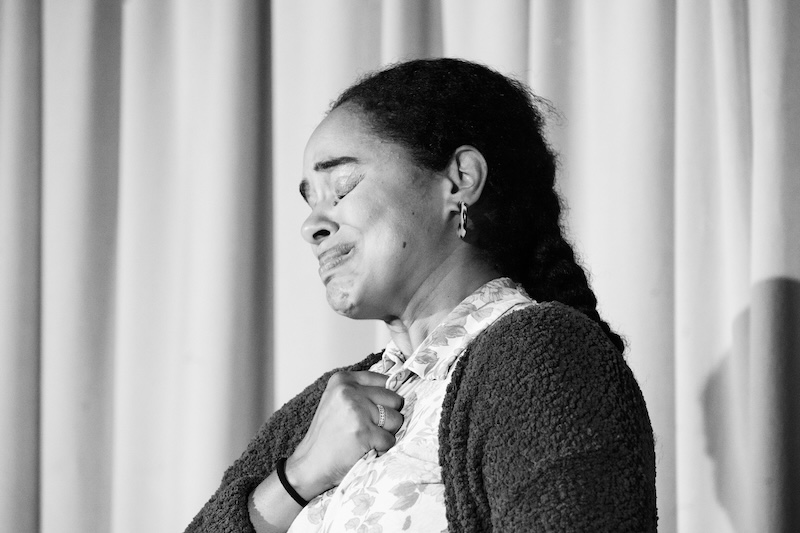
Photo by Cameron Rice
Further, Aranovich says their model ensures works do not “slap the veneer of a diverse performer” onto existing work, instead working as a team to create a piece that is inclusive and will bring audiences a perspective that they might be unfamiliar with. Public Assembly used to read their submissions blindly, but decided to amend their selection process a couple years ago to better understand their demographics and take a more active role in platforming voices from diverse backgrounds that reflect the community.
While Public Assembly aims to hold their commitments to diversity and impartiality equally, by eliminating hurdles to enter for low-income creatives, they can work to ensure the volume of submissions from diverse writers is high. This grassroots mentality is also reflected in their fundraising. The company runs an end-of-year fundraising drive, where they find most of their support comes in the form of smaller donations, supplemented by a few well-endowed benefactors.
Looking to the future, Dietze says what Public Assembly will become is unknown. The work’s immediacy keeps the company largely focused on the present moment, but that they are deeply committed to lifting up their membership from within, developing the team’s skillsets to ensure Public Assembly is always in good hands. They recently held a directing workshop for their members and associated artists to play, practice, and hone new skills. The key, Dietze says, is “not getting too comfortable.” Success and support aren’t givens: “It takes recommitment to fulfill the mission.”
The three plays performed Thursday night will never be performed again, making for, as Aranovich calls it, “a truly once in a lifetime evening.” It’s hard to say what exactly has brought Public Assembly their runaway success. What is clear, however, is Aranovich and Bhabha’s devotion to their work. They’re serious about their work, and they’re serious about fun. And that does feel special.
For more information about Public Assembly and details about their next show, check out their website.