
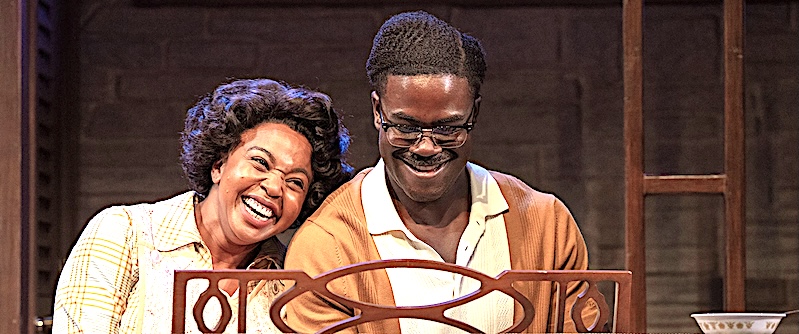
Jerrika Hinton and Bradley Gibson (Photo by Scott Smeltzer)
Reviewed by Joel Beers
South Coast Repertory
Through May 23
RECOMMENDED
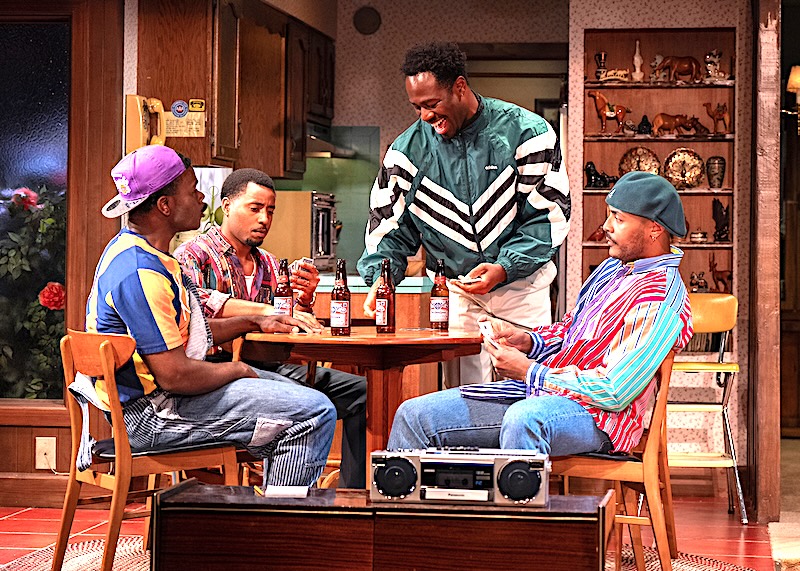
Bradley Gibson, Stanley Andrew Jackson, Wildin Pierrevil and Jeffrey Rashad (Photo by Scott Smeltzer)
A new play written by a Black playwright, featuring 10 Black characters and set in Los Angeles in 1968, 1991 and the 2020s has got to be about race, right?
In the case of Reggie D. White’s Fremont Ave., it absolutely is.
The human race.
Make no mistake: This is a play about three generations of a Black family whose lives are steeped in Black culture — from the clothes they wear and the slang they use to the card game Spades and the influence institutions such as the church and the legal system exert over their lives.
But Fremont Ave. is even more a play about family and home, loss and grief, love and sacrifice, and the burden of memory — of choices made and not made. In that respect, it recalls the great American family dramas of the 20th century.
There are unmistakable echoes of Arthur Miller in the play’s structure and emotional architecture. The conflicts are deeply domestic but carry larger social weight. Characters are haunted by regret, compromised ideals and roads not taken. The past continually intrudes on the present. There’s even a faint nod to August Wilson when Pittsburgh is invoked in the second act.
Yet White’s play is also thoroughly contemporary in its treatment of sexuality, masculinity and emotional inheritance.
The play unfolds in three acts spanning more than 50 years. It begins in 1968 when George (Bradley Gibson), a gifted musician and music therapist newly arrived in Los Angeles, hires Audrey to clean his bachelor home. Attraction simmers beneath restraint, and after we learn her marriage is troubled, romance slowly blooms.
The second act jumps to 1992. Audrey is now a church deacon, and her grown son Robert (Gibson) — essentially adopted by George — spends his nights with a tight-knit group of friends who relentlessly trash-talk one another over marathon Spades games. They are all lawyers except Robert, whose inability to pass the bar exam has left him mired in frustration and self-doubt.
The third act moves to the present day, the day of Audrey’s funeral. Robert’s son Joseph (Gibson), a seemingly successful actor, returns home carrying unresolved tensions surrounding his sexuality, family expectations and the lingering emotional gravity of his grandmother.
Racial turbulence hovers at the edges of the story — the Rodney King verdict and Clarence Thomas are mentioned in the second act — and there are subtle reminders throughout of the additional pressures faced by Black professionals. George notes he must publish three times as often as his contemporaries. Another character is funneled into the drug unit in the district attorney’s office. But the play’s central conflicts are familial rather than racial. These characters are solidly middle class: lawyers, musicians and professionals wrestling less with survival than with expectation, disappointment and identity.
One of the play’s most effective conceits is casting Gibson in three different roles across the decades. In the first act he plays George, the ambitious musician trying to build a life. In the second, he plays Robert, consumed by frustration and a career path he isn’t fully committed to. In the third, he portrays Joseph, burdened by conflicts surrounding sexuality, family and self-acceptance.
Gibson is strong throughout, though his George occasionally feels a bit stiff. Ironically, the younger the characters become, the more natural and fully realized his performances grow.
Other standout performances include Doug Brown as the older George in the third act and Galen J. Williams as the sensual, sarcastic Damon, Joseph’s love interest, also in the third act.
But it is Audrey who dominates the play — even in the third act when she is represented only by a voice on an answering machine. Jerrika Hinton transforms Audrey from a world-weary and cautious — but also whip-smart and sassy — woman in the first act into an empowered mother, partner and church deacon in the second, never lessening the character’s quick wit or emotional sharpness.
The writing is dazzling — at times almost too much so. These characters can be so eloquent in articulating their feelings that it occasionally strains credibility. Few people speak with this degree of precision and emotional fluency in moments of pain. Still, that’s a minor criticism in a work so rich with emotional intelligence and resonance.
The production’s set design, courtesy of Tim Mackabee, is crucial to its effect. Built around a single Southern California home that remains onstage across six decades, the set becomes less a location than a repository of memory. It evolves gradually through furnishings, textures and atmosphere rather than radical redesign; its foundation isn’t material as much as accumulated generational sediment.
That gives the production a remarkable sense of continuity. Families change. America changes. The emotional weather changes. But the house remains, holding decades of arguments, aspirations, secrets and disappointments within its walls. Like the homes in “Death of a Salesman” or “Fences,” it becomes as much a psychological space as a physical one.
Director Lili-Anne Brown successfully balances shifting time periods, tones and conflicts, from the gleeful trash-talking of the second act to the savagely funny yet emotionally bruising exchanges in the third. André Pluess’ original music and sound design deepen the production’s atmosphere, underscoring both the play’s warmth and its undercurrents of longing and regret.
In fact, along with Audrey, music becomes the play’s true throughline, embodied by the piano that remains stage right throughout the production, a quiet visual reminder of continuity, memory and inheritance.
But while music grounds the play, Fremont Ave. is ultimately rooted in something even more elemental: love — messy, enduring, painful, sustaining love, passed from one generation to the next.
South Coast Repertory, 655 Town Center Dr., Costa Mesa. Wed., 7 pm. Thurs. & Fri., 7:30 pm. Sat., 2 & 8 pm. www.scr.org. Runtime: approximately twoå hours and 45 minutes with an intermission.