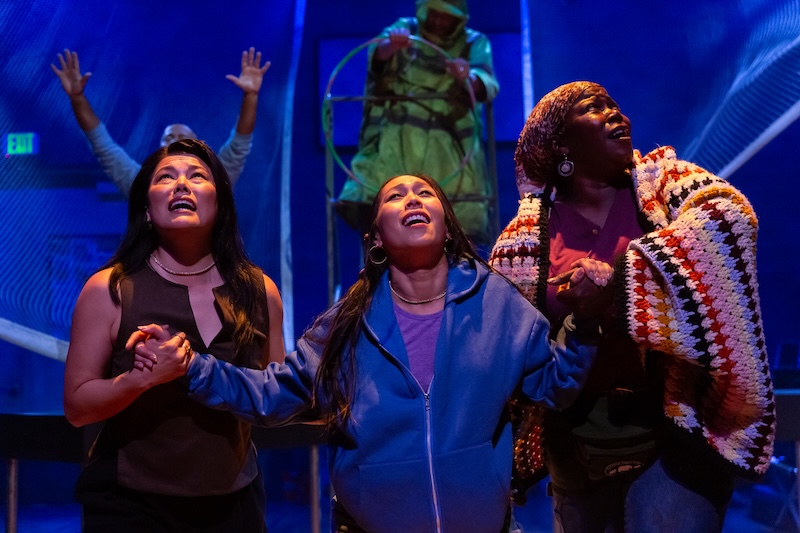

Randolph Thompson, Desirée Mee Jung, Adam J. Smith, Nicole Javier, and Julanne Chidi Hill in “Perilcles” (photo by Brian Hashimoto)
The Magic of it All
Scaling Pericles (at Boston Court) and Mt. San Jacinto
 On occasion, not often enough, I’m reminded of what the adjective “transporting” actually means. I’m a crank, which means that being transported never happens to me on YouTube or Substack, almost never in a movie, sometimes in a poem, and rarely in the theater. But it did this week. In the theater. Thank goodness for the theater. If we’re ever to get out of this mess, this cesspit in which our national character (whatever that is) and its relation to our ideals (whatever they are) have so conspicuously crashed and burned, we’re likely going to need the theater.
Backdrop: This may seem unrelated, but it’s not. I live pretty much attached to a mountain. Mid-level. 5,500-foot elevation adjoining a peak that goes up 10,800 feet. For the past seven months I’ve been training, hiking, steadily increasing length and elevation, with the aim of scaling that mountain: Mt. San Jacinto. It’s disconnected from all the other mountain ranges nearby (much like the theater to the culture at large). Mt. San Jacinto is a giant pimple of granite and sandstone rising out of the San Jacinto Wilderness of the Mojave Desert, with Palm Springs at one base, and Hemet at another. It’s the second tallest peak in Southern California, outflanked only by Mount San Gorgonio around Big Bear.
On one training hike in early September, I was approached by a large stag. Antlers, the whole deal. The animal started to flee, stopped turned and stared. I stared back, for a minute, until I started speaking to him, telling him he was a gorgeous creature and I wished him a long and satisfying life. He flicked one ear, turned his head slightly to see if there were any spies, then fixed his gaze on me once again. For ten minutes we communed in this way. Time froze, as it does in great theater. The outside world simply withdrew, as it does in great theater. If, at long last, I hadn’t bid him farewell, I believe we might still be there.

King Stag, an encounter on the South Ridge Trail of the San Jacinto Wilderness
I saw a play on Saturday night: Pericles (nicely reviewed by F. Kathleen Foley) at Boston Court Theater in Pasadena, in its closing week. What does that have to do with a mountain in Riverside County? Bear with me. There are gods in Pericles. Ancient Roman gods, like Diana, derived from the ancient Greek god, Artemis, goddess of, yes, the wilderness. There are gods all around Mt. San Jacinto, Native American (Cahuilla) gods such as the spirit Tahquitz and his creator Mukat. This is all about gods, and transformations, and becoming transported.
Friday was the day I’d trained for. Seven months. Like with armor in a play by Shakespeare, I wielded two hiking poles, two liters of flavored electrolyte water in a lightweight vest, another liter in a flask, a sandwich wrapped in wax paper, an apple and a banana and trail mix, all zipped within a fanny pack. I’m no warrior and this wasn’t a conquest. I’d no intention of conquering anything except, perhaps, my own limitations. From home to peak to home took 10 hours, traversing about 20 miles round trip, with an ascent of 5,300 feet. Five and half hours up, four and half down. I met three neighbors and a smattering of friendly visitors from O.C. and San Diego, all fellow wanderers on these trails. But mostly it was a day of solitude in the wilderness, with not an internal combustion engine, a hybrid, or an EV (car or bike) within miles — not a house, nor a barn, nor a leaf blower or data center, just miles and miles of trail, sometimes wide and padded with moist dirt and leaves, sometimes narrow and rocky, almost treacherous, no more than three-feet wide looking down sharply onto a forested ravine. Miles and miles of Manzanita and California Oak, soaring Cedars and Sequoias. Lizards and chipmunks galore. Ravens and hawks patrolling the skies, and one coral snake I spotted slithering into a rocky cavern.
I won’t dwell on the vistas but for two details: Near the base of the trail, you look up at a natural monument called Lily Rock. Its face emerges from a carpet of trees as a looming granite castle, a fortress towering into the sky, daunting and dramatic, as though declaring that it can’t be scaled. The Cahuilla tribe who resided here believed that the spirit Tahquitz resided in and around that rock, that when the earth shook from an earthquake, Tahquitz was expressing his annoyance.
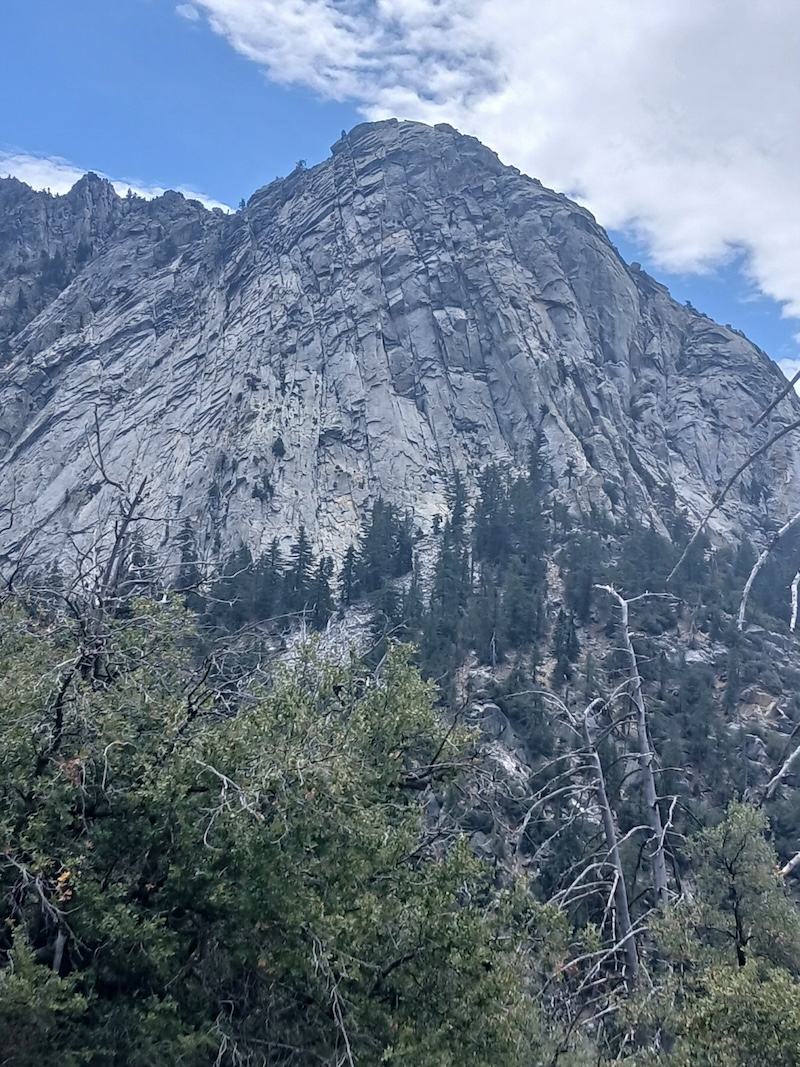
Lily Rock (a.k.a Tahquitz Rock) near the base of Devil’s Slide Trail in the San Jacinto Wilderness
Two hours later, after an incline beyond Saddle Junction, you look down to see Lily Rock, now just a pebble below. A little nothing. This is not an A.I. effect. Nothing digital about it. It’s just perspective, propelled by climbing, and breathing, and gazing retrospectively, reflectively, on where one has been. And how things may not be entirely as they seem, depending on the frame, on where precisely you are along your trail.
This is also, strangely yet coincidentally enough, akin to the story of Pericles, which, like the ascent up Mt. San Jacinto, is almost beyond belief: A princess (Nicole Javier) dies in childbirth on the high seas. Well, it’s presumed by her bereft husband Pericles (Randolph Thompson) that she dies. Pericles despondently approves of the sailors sealing her in a coffin and throwing her overboard, as is the rite on the seas. The coffin washes ashore to be discovered by strangers (the kindness of strangers!) who revive the corpse, all unbeknownst to Pericles. (Those gods. They’re always at it. In Pericles and on Mt. San Jacinto. The earth is always shaking. Miracles unfolding.)
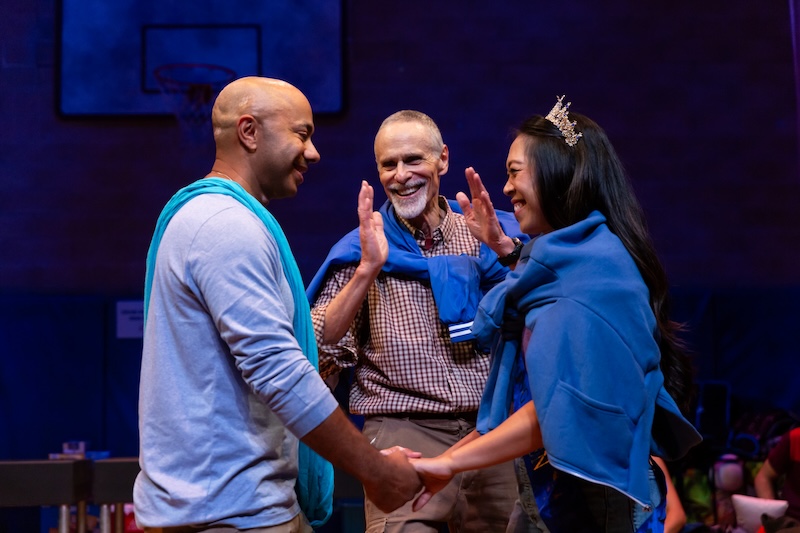
Randolph Thompson, Joel Swetow, and Nicole Javier (Photo by Brian Hashimoto)
In the play, there are vipers running a brothel. A local governor (Alexander Matos), the Prince Andrew of Mytilene, purchases an hour or two of sexual conquest with what would today be called a human trafficking survivor, a virgin, a principled and virtuous woman, who is none other than the princess’s daughter (Troy Leigh-Ann Johnson), also wrongly presumed dead by her grief-stricken father. Her words, her rebukes, arouse in the governor not his lust but his conscience. He transforms himself into something approaching nobility. (Here, the plot diverges from contemporary British royalty.) Yet another miracle. By play’s end, the pair is wedded.
We live by assumptions — that we know what’s real, how the world appears, how it operates. Who is rotten, who is not. Sometimes we’re wrong. We mistake vapors for solid matter. Clouds for sturdy objects. How are we supposed to know the difference?
A hurricane had passed recently off the Pacific Coast. The day before my hike, it had rained in Idyllwild. I got caught in it. Drenched, truth be told. A minor cloudburst, I never saw or felt it coming. On the day of the next day’s marathon hike, wisps of clouds blocked the sun, gathering, as though a tempest might roar in, as happens in Pericles. How are we supposed to know? The trail doesn’t provide answers, but it does provide perspective. Even in Pericles this goofy, fantastical and almost indecipherable play, Shakespeare does the same. The big picture. Just because it’s fantastical doesn’t render it untrue.
One of the points of climbing this mountain is very much related to one of the points in Pericles: We believe we know who we are, and where we are. But we don’t. Not really. The gods play tricks on us.
Southern California, particularly away from the Pacific Coast, has a stark and parched desert landscape. Even in the mountains. There may be shrubs and trees, but they’re affixed to a base of sand and rock. The prevailing colors are gray, tan and rust. It’s not a verdant place. This is how it is on most of the of trails of the San Jacinto Wilderness. Yes, there are stretches where you’re engulfed, nestled in thickets and pines. But the gray and tan and rust are never far away. It’s not the lime green Redwoods of Oregon, Washington State, or of Northern California. Some sections of the wilderness even resemble a scrapyard of dead tree trunks decimated by drought or the bark beetle, finally brought down in ice storms of yore. Pellets of hail. Wrecking balls in miniature.
And yet, and here’s the magical part, a reward for climbing out of Annie Junction, somewhere between 9,000 and 10,000 feet above the sea: The trail slopes down for a spell — and “spell” is the perfect word for it — and you find yourself amidst a huge expanse of fern as far as the eye can see, lining the base of pine and cedar forest, a luminous green carpet on all sides, like neon. I thought I might have died and arrived in heaven. It was muggy and hot when I left Idyllwild. Up in this spell, the air was crisp, those wispy clouds were laughing at me from on high, laughing at me for wondering if they were going to send down a tempest, which the gods just might have, who’s to know? Another mile beyond, the ground was coated in ice, in late September, hail from the hurricane that had yet to melt. It couldn’t have been more than 40 degrees up there.
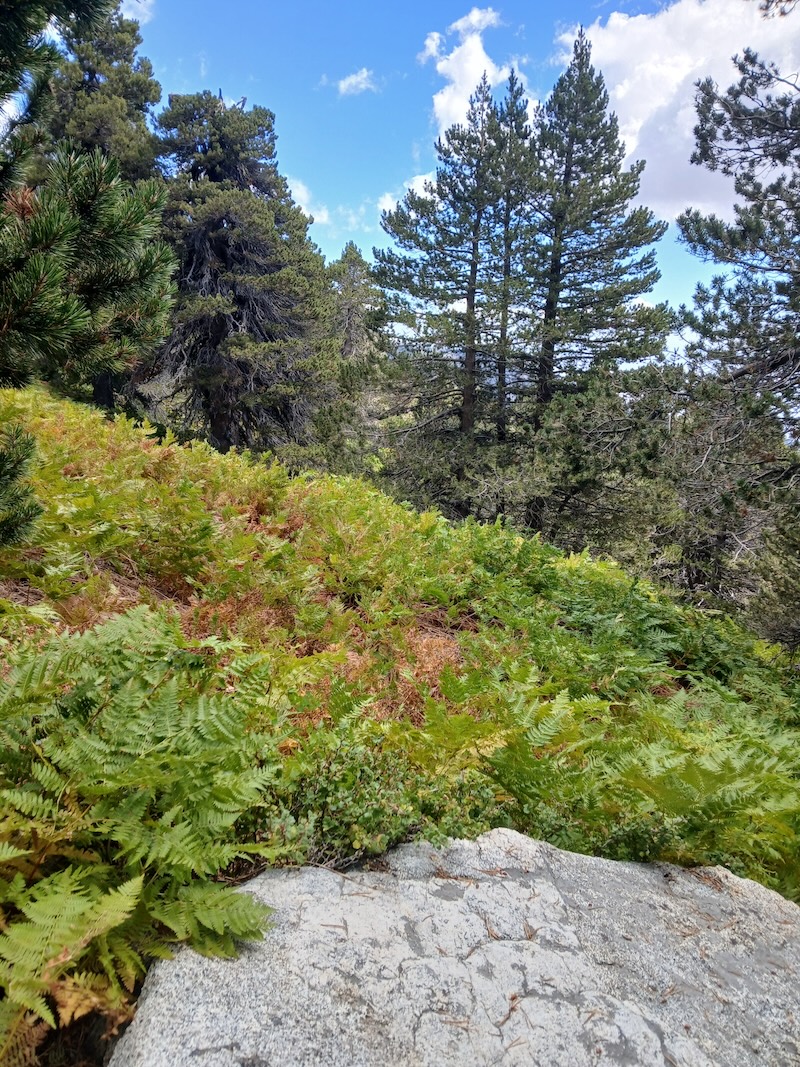
Fern-carpeted meadow alongside the Wellman Divide Trail in the San Jacinto Wilderness
And this is where you realize that it’s possible, and not just an illusion, that your legs and arms and lungs can transport you to another world entirely. And if you don’t have the stamina or the strength or time to train for such a transport, there’s always the theater; with the right artists serving as trail guides, your imagination can do much the same. No, there’s sometimes the theater. No, on rare occasion, the theater can transport you from the world of gray and tan and rust to a primeval fern-coated forest where the air is cool in late summer, where the unimaginable becomes not just imagined but observed and then felt, where daunting boulders turn into marbles, where what appears insurmountable suddenly isn’t, where debauched souls are redeemed by some combination of self-loathing and atonement, where kindness prevails over cruelty. Imagine that!
Because that’s what lies at the heart of Pericles. Shapes and colors and qualities of character that you wouldn’t have believed possible. Good God, how we need that right how.
The production was in partnership with Play on Shakespeare, with a modern verse translation by Ellen McLaughlin, who is akin to those U.S. Forest Service volunteers who maintain the trails in the San Jacinto Wilderness. Where the road becomes indecipherable, McLaughlin takes a couple of those felled tree trunks and sets them on each side of the trail, transforming a path that was unrecognizable into one that becomes manifest, guiding us towards a destination. Modern translations of Shakespeare can be patronizing and insulting to any poetical sensibility, but not here, largely because the play, as written by Shakespeare (we think), is largely incomprehensible. We’re pointed in the direction of the mountain peak, and the closer we get to it, the more enchanting the view.
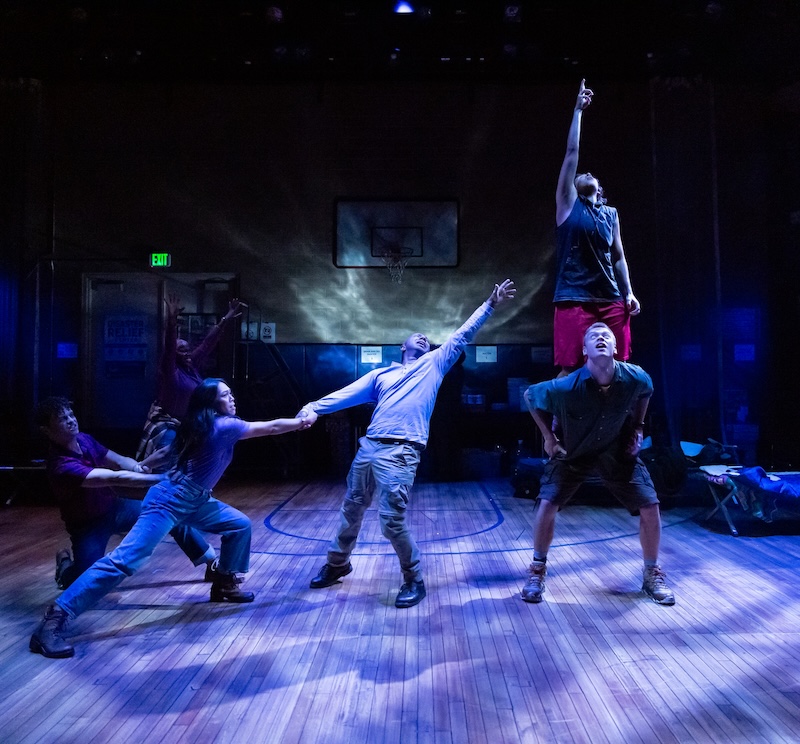
Alexander Matos, Julanne Chidi Hill, Nicole Javier, Randolph Thompson, Jamie Gallo, and Rio Rasch (Photo by Brian Hashimoto)
The production is set in an evacuation center during a flood. A storm rages outside. (sound design is by John Ballinger.) Set designer Michelle Joo creates some high school or college gymnasium, repurposed as a group lodging, with shelter cots downstage and cabinets on the perimeters, presumably containing rudimentary supplies, snacks and whatever else might be needed for a few days’ occupancy. The ensemble of 10 portrays evacuees, battered by the storm but far from indigent. Desirée Mee Jung plays (among her many characters) what appears to be a refugee from Malibu with fashion shades, which she uses to throw shade on everyone and everything around her. An amiable enough evacuee (Joel Swetow) presents himself as a theater guy with a file box containing scripts of Western classics: King Lear, Waiting for Godot. For a reason that only he would know, he zooms in on Pericles and takes it on himself to direct his own production within this gymnasium, using as actors the captive residents seeking shelter from the storm who now have almost no choice but to create art. And we have almost no choice but to watch it. Hardly an inspiring start.
At first, they either overact or can’t act, as though they’ve been flown in as The Mechanicals in a wayward production of A Midsummer Night’s Dream. Is it really going to be two and half hours of this? I wondered. Do they honestly believe that with such tropey devices —styrofoam tubes passing as swords, football shoulder pads as armor, large Mylar blankets as storm clouds that engulf the mortals beneath them (props by Rye Mandel) — that we’re going to be transported? Where are we? In the public library’s kids’ section for story time?
It took half an hour, maybe 45 minutes, under Margaret Shigeko Starbuck’s staging, for the “bad acting” to recede and for the company to show its true colors and talents. It was somewhere between the moments when Princess Thaisa, dead from childbirth, rises like Lazarus from her coffin, and her daughter Marina shows up 18 years later in a brothel surrounded by lechers and profiteers, that the gymnasium and all of its theatrical devices receded, and this production started to glare me down, like that stag in the woods, when all but the animal disappeared, all the cares and woes of the outside world evaporated. Similarly, I found myself staring back at this production in a kind of communion. Despite my heartiest efforts to repel it, this production had wormed its way into my consciousness so that artifice appeared real — no, not real, but true, which is on a different scale of magnitude.
If one dissolute prince can turn his life around, prompted to do so by the words of a trafficked survivor pleading for her dignity, her self-respect, and for his, anything is possible. Lily Rock can be scaled, a daunting boulder can transform into a marble. A battered community of lost souls can find themselves by coming together, by telling a story that ennobles. These are miracles born of perspective, of ascending in spirit. Such an ascent is what can spare us, collectively, as it has in centuries gone by. The tempests appear inexorable, and sometimes they are, but we can’t really know that for certain. Sometimes, on rare occasion, the theater is our spirit guide.
PERICLES Ellen McLaughlin’s modern verse translation of Shakespeare’s play. Boston Court, 70 N. Mentor Ave., Pasadena. Closed.