Fractured Flickers
Kimberly Akimbo and Our Shattered Culture
 Last Sunday afternoon, the packed-house audience at the Odyssey Theatre appeared thoroughly engaged with Cate Caplin’s staging of David Lindsay-Abaire’s dark comedy, Kimberly Akimbo, for Palisades Theatre Company. That company’s venue is in the planning stage of being rebuilt after having burned down in the Palisades Fire. Bless them, and their tenacity.
Kimberly Akimbo premiered at South Coast Repertory over a quarter of a century ago in 2000. Some in the crowd at the Odyssey were moved to tears by the saga of a teenager suffering from a genetic disorder that’s unnamed but inspired by the extremely rare Hutchinson-Gilford progeria syndrome. This syndrome causes children to age four years for every chronological year of their lives.
At the start of the play, the central character, Kimberly Lovato, appears to be about 64 years old, despite her upcoming “sweet 16” birthday. This creates some (deliberate) cognitive dissonance when, in the opening scene with her father (Bradley Holzer) before any of this has been explained, the audience perceives an older woman calling a much younger man “Dad.” But all of this exposition is strategically provocative and sorts itself out.
From South Coast Rep, the play transferred to a successful Off-Broadway (Manhattan Theatre Club) run before Lindsay-Abaire teamed up with composer Jeanine Tesori to adapt the play into a musical some ten years after the SCR premiere. That musical became a Broadway hit in the 2021-2022 season.
So this play, and its subsequent musical adaptation, had legs, and resonance, and, based on the reaction at the Odyssey Theatre, the original play still does. Its run time was two and half hours. Almost nobody fled during intermission, and I saw one woman dabbing empathetic tears a few moments before the highly emotional curtain call, during which I was scratching my head, perplexed. A couple of reviews of this production have appeared, and their enthusiasm for the project is unrestrained.
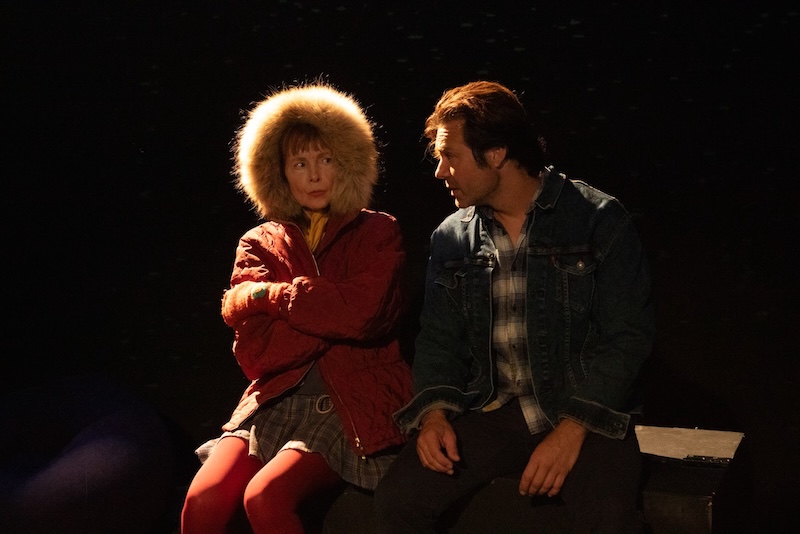
Daughter and dad: Dey Young and Bradley Holzer in “Kimberly Akimbo” presented by Theatre Palisades at the Odyssey Theatre (photo by Nicola Buck)
On occasion, when seeing a theater production, I feel like a visitor from Venus, and that’s what happened to me over the weekend at the Odyssey. I simply could not feel what so many people around me were feeling, nor, perhaps, even experience what they were experiencing. Perhaps, I imagined, I have some kind of genetic disorder that prevents me from being emotionally connected to my peers, from saying off-the-cuff pleasantries like “Have a nice day,” or “I’ve got your back,” or “Peace out” or “Let’s unpack this,” or “Let’s do a deep dive,” or “Let’s give a shout out to . . .” — expressions found on every YouTube clip and Substack created by man and God. We don’t use such expressions on Venus, my home, where things are definitely more cool and less hot.
When I was much younger, there was a very popular playwright, now gone, named Wendy Wasserstein. She was beloved by audiences across the country, and by the critics in that era of the New York Times, the L.A. Times, and so many Times between.
Wasserstein’s plays (Uncommon Women and Others, Isn’t it Romantic, The Heidi Chronicles, The Sisters Rosensweig) actually annoyed me. (I was not annoyed by Kimberly Akimbo, just indifferent.) Wasserstein’s plays annoyed me because they were sitcoms containing glimmers of ideas that critics found important. I found those glimmers to be unexplored, glossed over, all contained in the wrappings of jokes that were really the point. I found myself wishing that Wasserstein had just left the glimmers of her ideas outside of the theater and left us with the jokes. There’s almost nothing better than a good joke. A good joke on its own can expose the folly of something larger, or not. That’s what Waiting for Godot does, or is — an extended vaudeville with, let’s say, cosmic implications. Without those larger implications, the play would be a time-pegged music hall entertainment. With those implications, it becomes a world classic. It doesn’t matter, really. Laughter is medicine. It helps keep us balanced in a world of untethered absurdity, stupidity and cruelty.
Just let the joke speak for itself. But to pad it, as Wasserstein did, with hints of importance, or self-importance, well, I found myself, at that time, becoming annoyed. (We Venusians are easily annoyed.) And then to wrap the whole bundle in the style of a television sitcom? I don’t know — I guess the “thought leaders” of the American theater — Broadway, Off-Broadway,and Regional — must have imagined that having live theater emulate television would contribute to theater’s lasting relevance. In retrospect, with network television’s decline, it’s done just the opposite.
The theater has always been capable of something truer to its classical foundations of dance, poetry and spectacle. Yet so rarely does our theater rise to meet that potential.
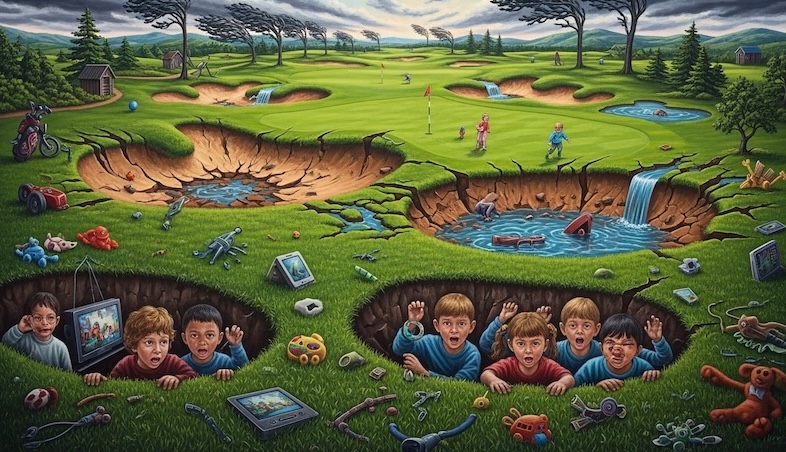
Creating theater to target audiences based on their (fickle) preferences rather than creating theater primarily because an idea is exciting on its own terms leads inexorably (and has lead) to creative sectors governed by marketing. And this dominance of marketing, in multiple fields, this endless pursuit of new buyers, accompanied and buoyed by ever-shifting technologies, has lead to the fracturing of our culture into tribes contained within bubbles, where there’s no such thing as “an audience,” but instead small pockets of audiences who have idiosyncratic and wildly differing tastes, differing enthusiasms, differing belief systems. It was always such to some extent, but the exacerbation of this cultural shattering has exploded exponentially, like the impact of a large bomb, thanks to the combined efforts of legacy media, social media, and now AI. As Pasadena Playhouse’s Danny Feldman recently pointed out to me, unlike when the movie The Sound of Music united teenagers and octogenarians alike, the tastes of the new guard are so wildly different from the tastes of the old guard. “How do we carry all those buckets?” Feldman asked.
Look up any theater production on Google. At the top of the page, you’ll find an AI summation of what the play is about, leaving out many of the original sources that contributed to that analysis. SCR’s current managing director, Suzanne Appel, told me how at New York’s Vineyard Theatre, where she was associate artistic director, they could count on New York Times reviews as a guide for their patrons and potential patrons across that city. Show after show, season after season, their body of work was reported on by human beings working for a newspaper of record. Patrons may have disagreed with The New York Times‘s opinions, but that’s how they heard about a production at the Vineyard. At South Coast Rep, Appel says, there’s no such guide. Local press outlets (including the L.A. Times) show up sporadically, she said, having determined, one would presume, that the economics of theater reviews no longer justifies the costs of covering live theater on the scale of, say, ten years ago.
“Now we have to become content creators [marketers, on top of producing plays] Appel said, making multi-pronged appeals to potential ticket-buyers who may subscribe to Facebook, Instagram, and/or TikTok, all with different subscribers of different generations. No wonder The Sound of Music wouldn’t stand a chance in 2026. How would they even hear about it except through their personal networks, rather than through universal cultural platforms? Even the heralded Gray Lady is exploring replacing its traditional theater reviews with Instagram video reviews recorded by influencers. Give it another decade and AI will be our primary guide for what to see, based on our stated preferences and search histories. Fractured flickers.
A couple a months ago, I attended a performance of three playlets put on in a rented hall adjoining the L.A. River by a company called Public Assembly. They do these shows once a month, soliciting ideas for the next show from audience members at the current one. They then review applications by writers to sculpt one of those ideas into a ten-minute playlet, which they dramaturg and rehearse and finally present in their monthly three-play extravaganza for a one-time showing before an audience of some 200 to 300 people in their subscriber network. The administrators of Public Assembly told me that they’re working actively to make these events “generationally diverse.” That wasn’t in evidence at the performance I saw. What I saw was a kind of college dorm party. I was a rare audience member over the age of 60, in a crowd that peaked at the older edge of Gen Z.
And so, last weekend, I imagined that a number of Public Assembly audience members had gotten on the horn to their grandparents, to tell them about a show put on by Theatre Palisades and being presented at the Odyssey Theatre — a show they would never see themselves. God knows they didn’t show up. The median age of the 100 or so people who showed up to the Odyssey hovered between 75 and 80. Tribes.
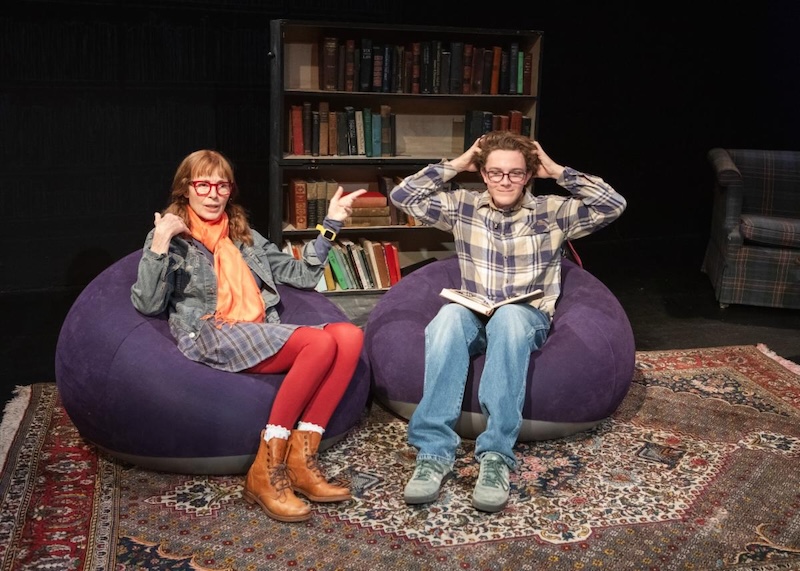
Dey Young and Zakary Risinger, first love in “Kimberly Akimbo” (Photo by Nicola Buck)
The play is kind of a sitcom, a cartoon, wrapped in an overlying absurdism. For readers of my generation, think Dario Fo, think Eugene Ionesco, think Jules Feiffer, think Christopher Durang, think John Guare’s The House of Blue Leaves.
Kimberly Akimbo is the descendant of a theater of cruelty, propelled by family dysfunction, wrapped in jokes, as The Theater of the Absurd so often is.
The cruelty lies in Kimberly’s fate. When you live a life in which time passes year after year, and you look back at photographs from the prior decade, there may be a dull ache, and the recollection by Stephen Sondheim fans of his lyric from A Little Night Music, “Every day a little death.” But when each year ages a person four years per annum, the cosmic joke is beyond vicious. When a 16-year old has long outlived menopause, how can you not feel for this child, who’s feeling a teenager’s first love with her nerdy schoolmate Jeff (the endearing Zakary Risinger) who, with his awkwardness and obsession with anagrams, may be on the spectrum. Not once does Jeff let Kimberly’s aged appearance intervene in his care for and about her. In fact, he doesn’t even bring it up, except in his clinical calculations of how much time she has left. That the life expectancy, or death expectancy, of such a child starts at 16-years-old, is part of fate’s savagery.
This young, platonic love — the soft spot in the midst of a family that is so obliviously self-absorbed and narcissistic — creates a core of American sentimentality constantly battered by some cosmic tempest. So, to the question: If one has any empathy, how can one not feel for such a child?
Let’s just say that rather than feel empathy, I felt manipulated by the trope of two young outcasts finding love, finding each other. Were it in a novel by Charles Dickens, I might have said, well, he invented that trope in his kind of episodic literature, so he has some right to it; and of course, all of literature and theater involves the art of manipulation to some extent. But when one feels, as I did, so very aware of being manipulated, one starts to feel twinges of resentment and then indifference. That’s how things work on Venus, anyway.
To their credit, neither Young’s Kimberly (there’s some irony that the abnormally aging character should be played by an actress named Young), nor Risinger’s Jeff played into the sentimentality. Rather, director Caplin had them run roughshod over it. Still, the goop resides in the play, like soft dough inside a crusty loaf. It’s all taste, I suppose. I stopped chewing quite early on.
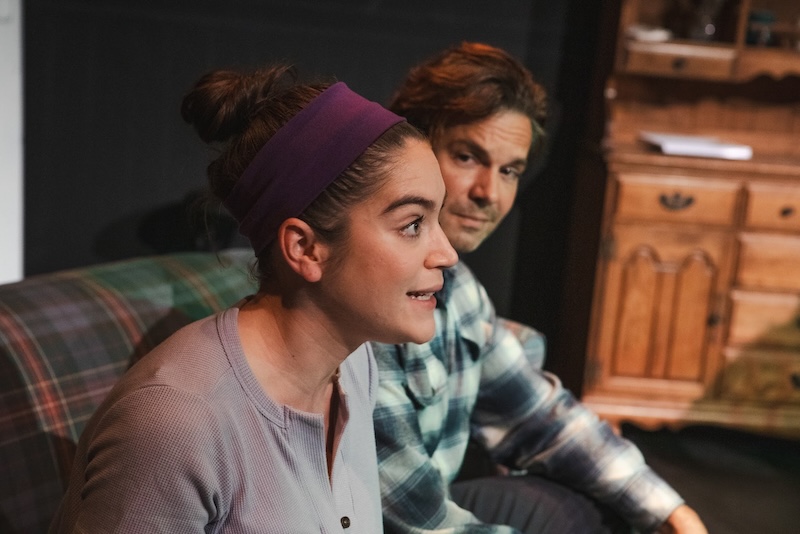
Kimberly’s parents: Abigail Stewart and Bradley Holzer (Photo by Nicola Buck)
Let’s get to the crust. The play is set in New Jersey, and the actors have mastered that dialect. There is perhaps no American dialect crustier than that. Kimberly’s mother, Pattie (Abigail Stewart) is very, very pregnant; she sports a bulging stomach with each wrist wrapped in a cast that runs almost to the elbow, due to carpel tunnel syndrome in both hands. This means she can barely walk and can barely hold anything; more to the point, she can’t even wipe her own ass. This task falls to her blustering husband, Buddy (Holtzer) who, she makes clear with his current employment at the local Chevron station, has turned out to be a disappointment to her. How she behaves towards that disappointment is among the suspense-mysteries to be unveiled. Buddy understandably is out drinking every night. One such night, he completely forgets about Kimberly’s 16th birthday celebration and later performs a feeble atonement, delivering a birthday cake that gets partly crushed on the bumpy drive home from the bakery. That wounded cake is a central metaphor for this entire clan.
Pattie is largely oblivious to the reality of her daughter’s pending death, flinging every ounce of her concern towards herself, to her own imagined illnesses, and to the unborn fetus, for whom she is eager to evict Kimberly from her bedroom to make space for the newcomer.
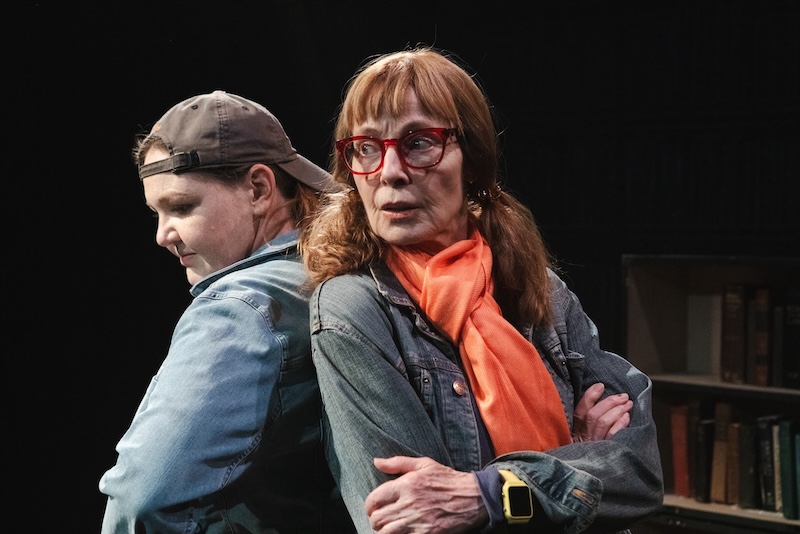
“Aunt Debra” (Sallie Eskins) and Kimberly (Dey Young) (Photo by Nicola Buck)
A fifth character shows up, Pattie’s sister, Debra (a dynamic, chirpy performance by Sallie Eskins), a brash lesbian who defies Pattie and Buddy’s banishment from their home(s), and who has been incarcerated multiple times for a variety of get-rich-quick schemes gone awry. Once she installs herself in the family’s basement, she recruits Kimberly and Jeff for a get-rich-quick forgery scheme, the outcome of which provides the play’s ultimate moments of suspense.
The actors have all the right superficial qualities, the outlines of their cartoons, which they relay skillfully. To ask for texture beneath the veneer of a cartoon might seem like a tall order. It’s hard to find in, say, Ionesco’s Rhinoceros or in any farce by Dario Fo because that’s not really how those plays are built. It would be like asking for texture in a Looney Tunes cartoon or an episode of Popeye, where the outer skin is the point.
Kimberly Akimbo, however, is closer to John Guare’s The House of Blue Leaves, where, similarly, every character seeks escape; they see their lives sailing by, as though without them, and their desperation gets less quiet by the day. In The House of Blue Leaves, a zookeeper/aspiring songwriter in Queens (in that play, the Pope is visiting New York, and a trio of nuns slides into the zookeeper’s apartment from a drainpipe and fire escape) winds up strangling his own gentle, batty wife as a manifestation of his own frustration. The heartache turns to heartbreak, at least in a good production. The comedic veneer gets shattered by tragedy. That each of the characters is a blistering self-parody becomes beside the point, which is the collective pulse of their hearts, sounding out: “I need, I need.”
Such is also true in Kimberly Akimbo, where, in this production, the characters’ veneers don’t melt. And the sentimentality of the innocent love between the misfit duo can’t compensate for the lack of some chisel that might chip away at the play’s icy, cosmic joke about the cruelty of self-absorption. These people are also anguished, and these performances keep flirting with that anguish, then dancing around it.
I’ve seen three productions directed by Caplin in the last couple of years. The first was in 2024, at Torrance Theatre Company — Terrance McNalley’s antique love letter to the theater, It’s Only a Play. That same year, at Palisades Theatre Company, she helmed a solid, moving rendition of Arthur Miller’s A View from the Bridge. Over at Theatre 40 last year, Caplin staged a fine, suspense-driven production of J. B. Priestley’s chestnut, An Inspector Calls.
Caplin is a local stage director with a proven track record of understanding the emotional shifts and balances of a play, and delivering them.
There are two possibilities to explain my ambivalence towards this production. One is that Caplin missed the mark. The other is that she hit the mark, and that I may not belong to my generation.
Theater Palisades at The Odyssey Theatre, 2055 S. Sepulveda Blvd., West LA. Opens Fri., Aug. 14; Fri.-Sat., 7:30 pm, Sun., 3 pm,; thru Aug. 30. https://app.arts-people.com/index.php? Running time: Two hours and 30 minutes, with intermission.