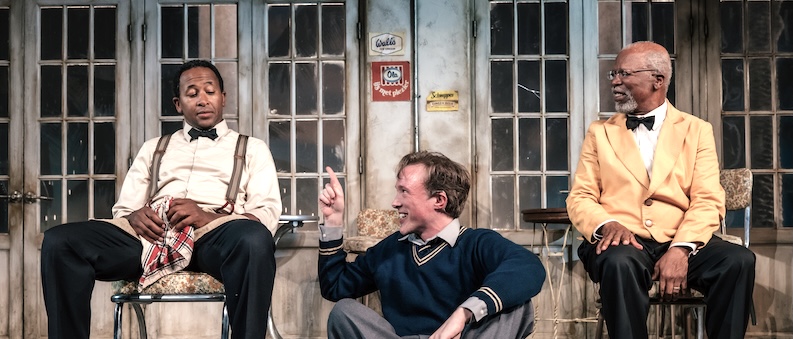


Nyasha Hatendi, Ben Beatty and John Kani (Photo by Jeff Lorch)
Reviewed by Deborah Klugman
Geffen Playhouse
Through May 17
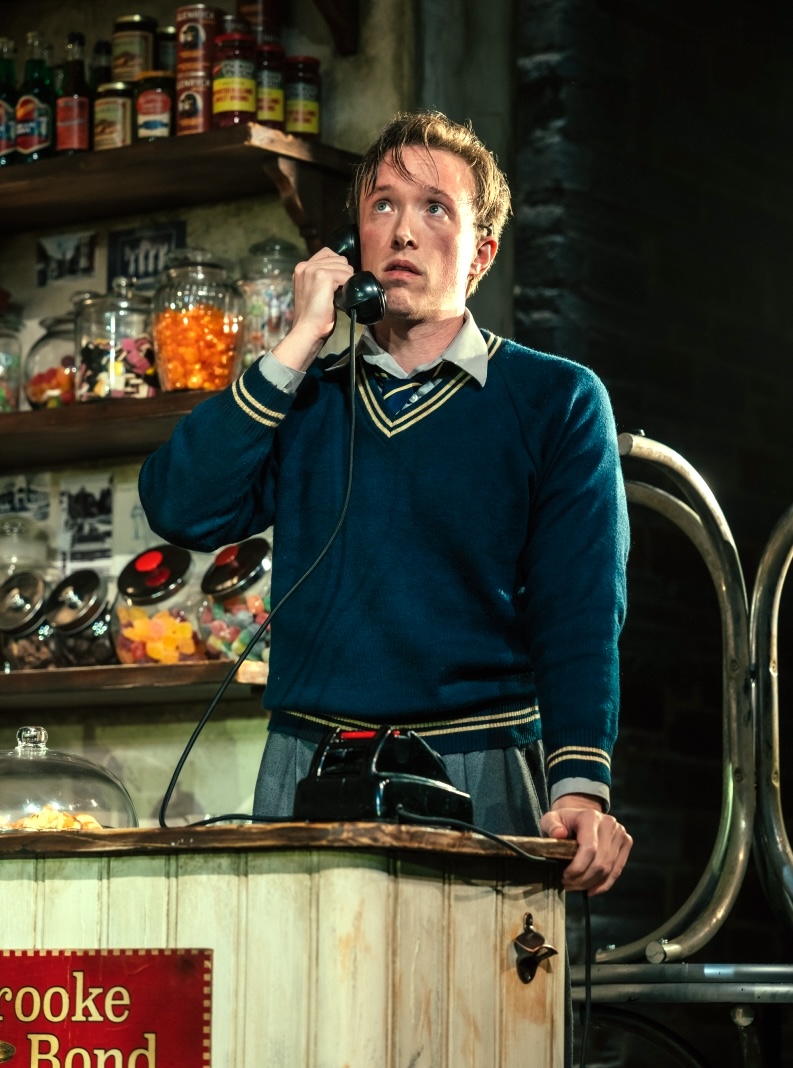
Ben Beatty (Photo by Jeff Lorch)
When Athol Fugard’s Master Harold . . . and the Boys premiered on Broadway in 1982, New York Times theater critic Frank Rich predicted the play would remain “an enduring part of the theater long after most of this Broadway season has turned to dust.”
“[It} may even outlast the society that spawned it — the racially divided South Africa of apartheid,” Rich continued. And of course — sadly — he was right.
A three-character drama set over a couple of hours in a shabby South African café on a rainy afternoon, Fugard’s deceptively simple masterwork homes in on the ubiquity of systemic racism, demonstrating how relentlessly it can destroy the bonds between people that are the fount of a just, humane world. So illustratively does the play make this point (and others) that even a show that misses the mark deserves to be seen and appreciated for its many embedded truths.
By Fugard’s own account, Master Harold is autobiographical; it’s drawn from an incident from his childhood that involved two black men who worked for his parents, helping to run the café that was part of the family’s source of income. Even the names of the characters — a 17-year-old adolescent named Hally, the playwright’s nickname as a youth, and the two black adults, Sam and Willie — are unchanged — duplicated from the real-life incident that, according to the playwright, was to shame him for the rest of his days.
The play opens with a scene between the two men, with Willie (Nyasha Hatendi) practicing his moves for a dance competition and the savvier and more adept Sam (John Kani) interrupting with pointers to improve Willie’s performance (while counseling him not to mistreat his lady friend and dance partner, now “mysteriously” MIA). Their varying personalities are immediately displayed; Willie is a genial fellow, full of life but not notably bright, whereas Sam is a thoughtful dignified man who thinks before he speaks, and who over the years has acquired a familiarity with Western literature and history, despite the limitations imposed on him by his status as a Black man in apartheid South Africa.
Enter Hally (Ben Beatty), with his schoolbooks. We learn through their dialogue that Hallie, Sam and Willie have spent many hours together, beginning when Hally was a child. For years the boy has sought out the companionship of the two men as he escaped from a home life dominated by a disabled alcoholic father, a neurotic mother, and a host of guests to their little hotel that included prostitutes and rowdy sailors.
But more than companionship, it’s evident that Sam has filled in for Hally’s abusive biological dad, acting as a mentor and a source of emotional support for the lonely boy. So when a conversation they are having somehow veers out of control, the emotional stakes are high and the loss to both of them is immeasurable for Hally, a knife in the heart for Sam.
Co-directed by Emily Mann and Geffen artistic director Tarrell Alvin McCraney, Master Harold turns on the premise of a longtime trust between these two individuals, one that has transcended the political and social strictures of the racist society that dictates their lives. In the current production at Geffen Playhouse, this dynamic is never convincingly established, however; for it to function as the script seems to indicate, Hally must be perceived at the start as a democrat with a small d, a youngster who has spurned the bigoted attitudes of his parents and peers. But Beatty’s Hally (who, at 31. also appears to mature for the role), registers as something of an arrogant elitist from the get-go; the character reeks of the bearing so commonly adopted by young men educated at British public schools and their imitators abroad, an unfortunate choice that sabotages the arc of the character and the play.
Kani, who’s won Tony awards for his performances in The Island and Sizwe Banzi Is Dead, as well as a special Obie award last summer for his extraordinary contribution to theater, radiates dignity along with all the qualities of a gentleman with a fine mind and a discriminating moral compass. (Sidenote: He played Willie in the play’s 1985 televised adaptation.) But here too, his casting raises questions; the part is written for a man in his 40s, and while the elderly Kani exudes all of Sam’s finest qualities, the matter of his age becomes a factor in the falling out between Sam and Hally, and the nature of the insults that Hally levels at his mentor.
As Willie, Hatendi projects warmth and empathy; if he’s a bit of a fool, he’s also a finely-tuned human barometer for what goes down between the other two. The actor is pleasurably on point from beginning to end.
Most memorable about the tech is the sound — and glimpse behind the backdrop — of teeming rain (sound design by Uptown Works – Noel Nichols, Bailey Trierweiler and Daniela Hart); it envelops the space where the drama plays out. Beowulf Boritt’s befitting set, a spartan café constructed of wood, is made brighter with Susan Hilferty’s costumes, especially Sam’s blazing yellow jacket, along with the bowties, suspenders and white shirts that both waiters wear. And the dance sequences (choreography by Koko Iwasaki Nyemchek and Kiki Nyemchek) are a joyful component of the story, symbolic of a striving for grace and beauty in a world that’s in short supply.
Geffen Playhouse, 10886 Le Conte Ave., Westwood; Wed.-Thurs., 7:30 pm, Fri.-Sat., 8 pm, Sat., 3 pm, Sun. 2 pm and 7 pm; thru May 10.www.geffenplayhouse.com Running time: approximately 95 minutes with no intermission.