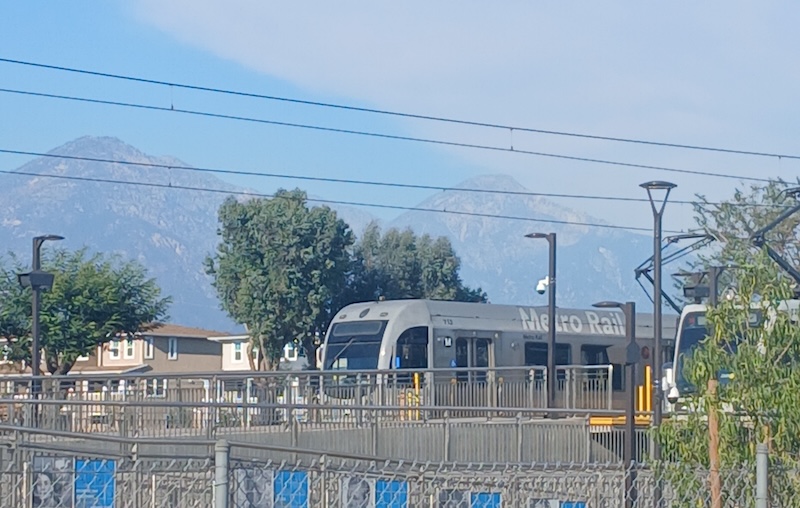


Pomona (North Station) terminus for the Metro “A” Line.
Roads Less Traveled
Riding the Rails to Theatre West (My Uterus: A Womb with a View) and Boston Court Theatre (Octopus’s Garden)
 On the train ride home from Theatre West on Saturday night, following a performance of Dina Morrone’s solo show, My Uterus, A Womb with a View, Metro’s “A” Line light rail late night service was a bit, how to say, grubby. This is not to rag on what is, at this point, the best and most affordable public transportation network Southern California has seen since I arrived here in 1969 as a child. Our train service resembles a still largely underutilized, little known and little acknowledged micro version of the New York and London train systems. Yet to be candid, Saturday night on the “A” Line was not one of Metro’s shining moments.
The carriage I found myself in reeked of a chemical blend of urine and industrial cleaner. My fellow travelers, men mostly, looked like they’d stepped onto the train from the apocalypse, with hollow eyes staring into their laps, or heads bundled within hoodies so that few facial features were discernible. One man was stretched out on three-adjoining seats that formed a bench for him to sleep on. This was not the only reason I felt I’d been thrust into purgatory. Being long past sundown, there was little to see out the windows, except for the glare of headlights, the glow of street lamps and neon signs splattered across the landscape like coconut sprinkles on a donut.
To be clearer about our “A” line: It extends from the Pomona (North) Station, which is where I embarked on Saturday afternoon, before rolling west through San Gabriel Valley burgs, along what used to be Route 66. One of these towns was made famous by a song recorded in 1946 by both Bing Crosby and The Andrew Sisters
“It hasn’t got big a big population, It hasn’t got a Grand Central Station.
“No buildings so tall that you think you might fall,
“But it’s got what just I need to make Heaven guaranteed,
“Leaving the big town flat for Azuza,
“AzuAzuAzuAzuAzuza.”
“Leaving the ballyhoo and the who-are-you-for the how-de-doo of Azuza.”
Indeed, after all these years, the downtown areas of La Verne, San Dimas, Azuza and Glendora remain quaint, in an early 20th century, wood-framed Western and stucco style, as one can see out the train windows.
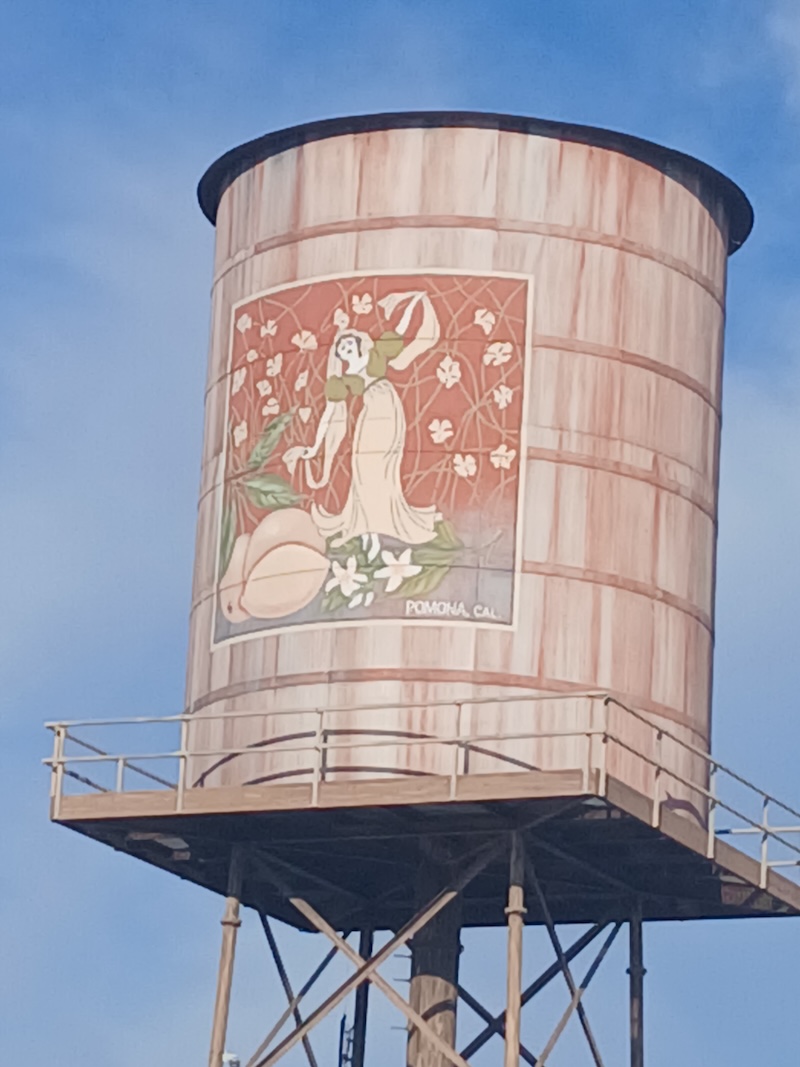
Overlooking the Pomona (North) station
The inbound train I took on Saturday afternoon had five cars. In one car, the seats all faced forward. In the next, they faced backwards, and so on. The cars appear to have been linked this way by design. And so, passengers can choose whether to view where they are going, or, conversely, where they have been. People under 40 are inclined to the former. Those over 40 see the world unfold, framed by where they have been, both recently and in the distance. In both cases, the lurching trajectory forward, towards some destination, is inexorable.
There’s a train departing from Pomona every 10 minutes. Broken-car graveyards and trailer parks aside, it also offers daytime vistas one simply can’t access from the nearby 210 Freeway. For instance, there is a series of lagoons in Irwindale and the white foam of water crashing over boulders cascades into a clear-water creek that snakes through the dusty chaparral, both feeding and being released from the Santa Fe Dam. You can observe out the same windows the expansive rose garden of City of Hope in Duarte, a hospital specializing in cancer treatments for children.
If one has the fortitude to ride this line for two hours, the “A” line will take you westbound, eventually rolling down the middle of the 210 Freeway through the heart of Pasadena before turning south, into South Pasadena. From there, the train rumbles through Highland Park and Lincoln Park, soaring to its highest elevation in Chinatown before descending into L.A.’s Union Station. At this point, the journey is only half complete.
Then comes a spectacular departure from Union Station that traverses a towering bridge-way that crosses over the Hollywood Freeway. Vistas of downtown skyscrapers are visible out every window as the train descends to the semi-subterranean Little Tokyo station. Now underground, it cuts west to Grand Avenue/Bunker Hill, turns south once more to the intersection of 8th Street and Figueroa, before re-emerging into daylight near USC to speed south through Compton en route to the heart of Long Beach. That’s not bad for a $10 all-day pass on Saturdays and Sundays (permitting free transfers to all train and bus services in Los Angeles), with a reduced rate of $5 for students and seniors — especially when gas is $6 gallon. In fact, I can think of no city in the world that’s so efficient (almost always on schedule or close to it) and offers public transportation at such a low cost.
Another word of explanation for anybody planning to see theater. For matinee performances on Saturdays and Sundays, I roll into Union Station on a much larger train, part of Metrolink’s San Bernardino Line (same weekend price of $10 unlimited daily travel, $5 for students and seniors). I pick up the train at the University of Redlands, located at the far-eastern end of San Bernardino County. This follows a one-hour car commute from Idyllwild (further east, in Riverside County). There’s a reliably frequent shuttle train called the “Arrow” service that goes from Redlands to downtown San Bernardino, where the Metrolink train is waiting to depart some 10 minutes later. This will cross the Inland Empire and the San Gabriel Valley for the journey to L.A.’s Union Station. Should my destination theater be in Pasadena or Highland Park, I’ll disembark at the same Pomona (North) station, cross two platforms, and jump on the “A” line (light rail), which will depart within 10 minutes for the half hour jaunt to Pasadena.

The Arrow Line, San Bernardino terminal station. The train rolls east to the University of Redlands
However, regrettably, Metrolink’s San Bernardino Line service is next to useless for evening performances, because the last train out of Union Station leaves at 9:38 pm, when most shows start at 8 pm. And this is why I drove in all the way to Pomona on Saturday afternoon, to catch the show at Theatre West on Saturday night. The “A” line was the only viable train option to get me home on Saturday night, as it operates well past midnight. And so, on Saturday afternoon, now stretching into early evening, I disembarked at Union Station and jumped downstairs for the “B” Line subway to NoHo. It took just shy of 30 minutes to arrive at Universal (Studios) Station, which entailed a 20-minute hike up Cahuenga Boulevard to the theater.
Rinse-and-repeat, in reverse, for going home, which leads to the experience, allegorical really, that is not unrelated to Dina Morrone’s performance at Theatre West.
On this comparatively dreary “A” Line train back to Pomona (to be clear, Morrone’s performance was anything but dreary), upcoming stations are announced on an automated system, in conjunction with a digital screen that lets you know the name of the upcoming station, and two stations beyond it. Somewhere outside Pasadena, I realized that the automated system was running one station behind: Triumphantly and with considerable authority, a computerized male-sounding voice announced that we were pulling into Arcadia (confirmed by the digital screen) when, in fact, we were pulling into Monrovia — some seven miles further down the tracks. And it got worse; beyond Irwindale, the system started running (away), falling two stations behind. God help anybody from out of town who relied on such voices of authority. If, for example, they intended to disembark at the Azuza Pacific College station to, say, visit their daughter who is studying there, the information they would receive, by intercom announcement and on screen, is that they have now arrived at the college in Azuza. In fact, they would now have arrived in San Dimas — in this case, over six miles away.
From what I could observe, the people on that train knew exactly where they were, and steadfastly ignored the misinformation being spewed in their direction. And that, I believe, has become a coping (if not survival) mechanism for a brand of chaos that, with the help of A.I., has been slowly and now rapidly escalating ever since 1938, when H.G. Welles played a joke on the nation by telling us on national radio, and in apparent seriousness, that we were being invaded by Martians.
Public discourse has largely devolved into the art of the absurd. Most political and even social speech has become Orwellian nonsense: that you’re rich when you’re poor, that you’re safe when you’re endangered, that you have robust opportunities when you have few. It’s an edifice built on the quicksand of deceit and ignorance. The open question remains: How much of it is believed to be true and how many of us, like the passengers on the “A” Line, have learned to disregard official pronouncements in order to better understand where precisely we are, and where we’re going. Because when you step off the train and look at the cityscape and landscape around you, the empirical reality of where you are is beyond ideology, and gaslighting, and A.I.

Dina Morrone (Photo by Carlos Hernandez)
Dina Morrone’s solo performance, My Uterus: A Womb with a View was presented by Theatre West for two performances over the weekend as part of Women’s History Month. It may ostensibly be about her very explicit and personal medical issues with her uterus (an internal organ that nonetheless contains a kind of flashlight sending out a beam onto the murky pool of gender roles), but her performance is ultimately about that male voice of authority, cavalier and often callous, telling us with confidence that we’re at one train station, when we’re actually at another.
In her show, that voice comes from doctors and faith leaders.
She referenced a mock campaign in the U.S. Senate to “incorporate” (meaning form as a corporation) women’s uteruses; perhaps that’s the only way that Republican men might resist regulating them.
Morrone was raised Catholic and is married to a Jewish man, prompting a discussion with leaders of both faiths (whom she impersonated with facetious aplomb) over which religion “owns” a potential newborn, stemming back to ownership of the uterus. This led to a excursion into the family name, Morrone, which means “chestnut brown,” and was among the names given by Italians, she theorized, to Jews who fled persecution some four centuries ago and converted to Catholicism for their own survival during one of the many anti-Semitic purges of yore. She traced the roots of many of the customs she grew up with as a Catholic, and grew to understand how these were also Jewish rites (observing the Sabbath, certain Kosher practices, etc.), leading her to speculate on whether or not she was/is actually Jewish, from a family compelled to convert to Catholicism centuries earlier. This throws the issue of which faith owns her uterus into some confusion; moreover, the option not even considered is that her uterus belongs to her. Oh, yes, that.
Under Peter Flood’s direction, Morrone is unwaveringly perky, and her show is a wry, bawdy, and expansive view; it’s less about where we’re going along the train tracks, and more about what station we actually belong to. Who has the right to claim ownership over us, our children, our bodies, and even our organs? And despite riffs of indignation at the hypocrisy of those who lay claim to unearned ownership (of us, etc.), and the biases and bigotries that have accompanied that hypocrisy, her show is an exercise in absurdism, which steers clear of stridency, aiming instead, like the work of any good standup, to expose the lunacy behind what we take, and for centuries, have taken to be sacrosanct.
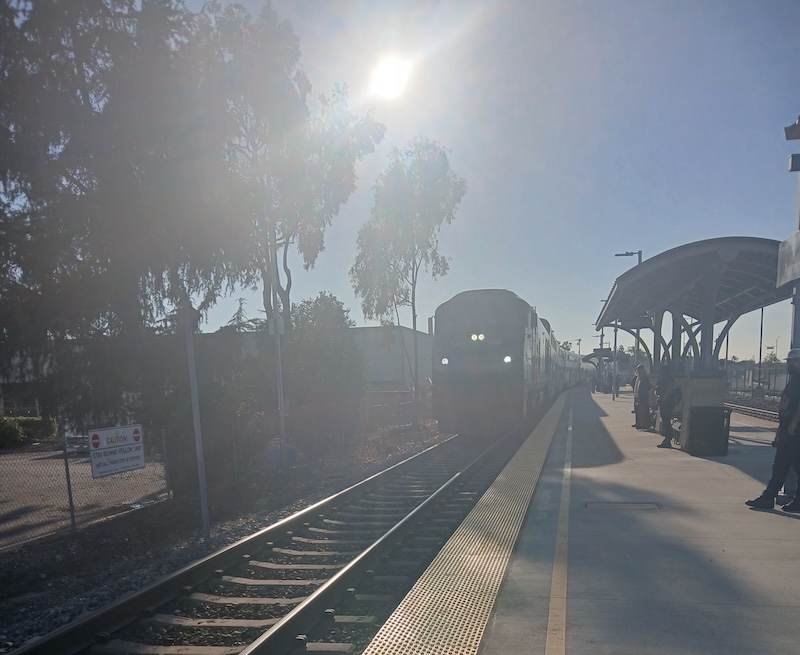
Metrolink, San Bernardino Line, approaching the Pomona platform on Sunday late afternoon.
Before getting to Weston Gaylord’s “Octopus’s Garden” at Pasadena’s Boston Court Theatre, I’d like to impart a brief conversation, Sunday afternoon, on the Pomona (North) station platform while awaiting the east-bound Metrolink train back to Redlands.
There was a group of three or four Latino men, maybe in their 20s, engaging in a boisterous repartee and referring to each other affectionately with the “N” word. I observed a Black man, by himself, maybe 50 to 60 years old, attired in a suit, who actually physically recoiled from them, walking away along the platform. He saw me watching him, and he shook his head.
“That word . . . They use it like it means nothing.”
I shrugged.
“Somebody should tell them,” he continued.
“You can tell them,” I said. Then, referring to myself as a White man, “I certainly can’t.”
“That’s true,” he replied. “I dunno,” he said. “It’ll just start a fight. . .” Then he peered at me more closely. “This must be terribly confusing for somebody like you.”
“Oh, I dunno,” I answered. “I’ve kind of gotten used to it, words that come to mean nothing, or have their meaning reversed, or coopted. It all starts to turn into nonsense.”
He nodded. “Yep. They use it like a term of affection. My father, his head would explode if he heard the way they use it. Back in the 50s, when he grew up, it was no term of affection.”
The train pulled up, carriage doors rolled open, and we boarded separate carriages, not on purpose, but simply because of where we were standing on the platform at the time.
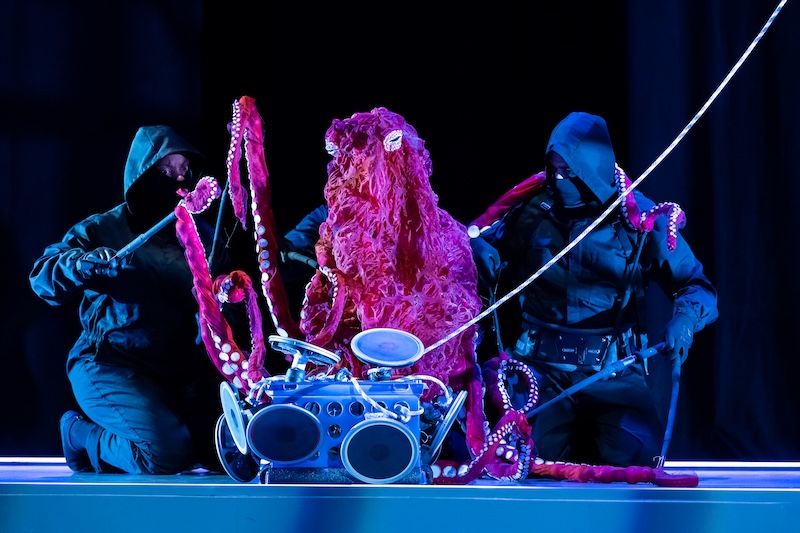
The star of the show, Sylvia: puppeteers Zachary Bones, Perry Daniel, and Danielle McPhaul as Sylvia (Photo by Brian Hashimoto)
I write this in the context of Octopus’s Garden which, among its finest feats, is to take the way we think, in all of its linearity, self-assurance and even belligerence, and upend it through the prism of an octopus — here named Sylvia (a beautiful puppet, made animate by puppeteers Zachary Bones, Perry Daniel and Danielle Paul, under Jessica Kubzansky’s direction). The octopus has a “decentralized nervous system,” meaning that her brain is distributed throughout her body so that she fundamentally “thinks” and even feels differently from us, simply because of the way that we, and she, are differently wired.
In this play, a collaborative effort of Outside In Theatre, Circle X Theatre Company and Boston Court Theatre (where it’s being presented), the focus is on musical composition: Tara (Kacie Rogers) — a biologist/lab assistant promoted to partner — comes up with the idea of inviting/coaxing Sylvia to compose music with a multi pad machine that can be immersed into Sylvia’s tank. (The set design, by Francois-Pierre Couture, places the tank center stage via a massive neon-lit frame, accessible by tall rolling steps, with aquatic effects provided by Karyn D. Lawrence’s lighting and the splish-splash of Noel Nichols’ sound design). It’s a sumptuous production.
The heart of the matter entails a composition, created by Sylvia from rubbing her tentacles on the sound machine’s pads, that’s so heartbreakingly beautiful, it brings Tara and her senior partner, Lars (Tim Cummings) to tears. The music is such a potent lament that it also renders Tara’s quasi-boyfriend, composer Lucas (Vincent R. Williams), into a blubbering and then blabbering mess, to such an extent that he advocates for destroying the recording of Sylvia’s work. Why? First, because Lucas has lost the confidence to compose anything more himself — being merely human, he can’t compete with Sylvia. And second, because all music written since, say, the 16th century, has been blown into hollow irrelevance by Sylvia’s composition. Perhaps if Sylvia’s creation is destroyed, the history of our human music can be restored, Lucas postulates.
It’s a stupid argument, which Tara points out, refreshingly: “Get over yourself.” And yet, the play/production still treats it as a viable thesis, which we’re invited, though with skepticism, to consider seriously. As though the likes of Arnold Schoenberg, Steve Reich, Erik Satie, Avro Pärt, and John Cage could wipe away the legacies of Bach and Beethoven because they came up with something new that reinvented the way music itself was structured. As though Sylvia could eviscerate the audience for Mozart.
This is where I checked out, from sheer incredulity.
There are ancillary themes of ethics: Lars promoted Tara because she knew of his petty corruption in a published study, and now she aims to hold it against him if she can’t continue to exploit Sylvia, though the octopus is possibly dying — leading to the issue of personal ambition circumventing professional responsibility.
This is a different and more commonly themed play. We’re all governed by our own tastes, and, frankly, I really, really liked the play that Gaylord started, the one about the heart of creativity, and how constrained we are because of the way we’re wired, and how we can be outdone by a primal creature with a lifespan of four years. Speaking from a linear perspective, I wish he’d finished that play instead of veering away from it.
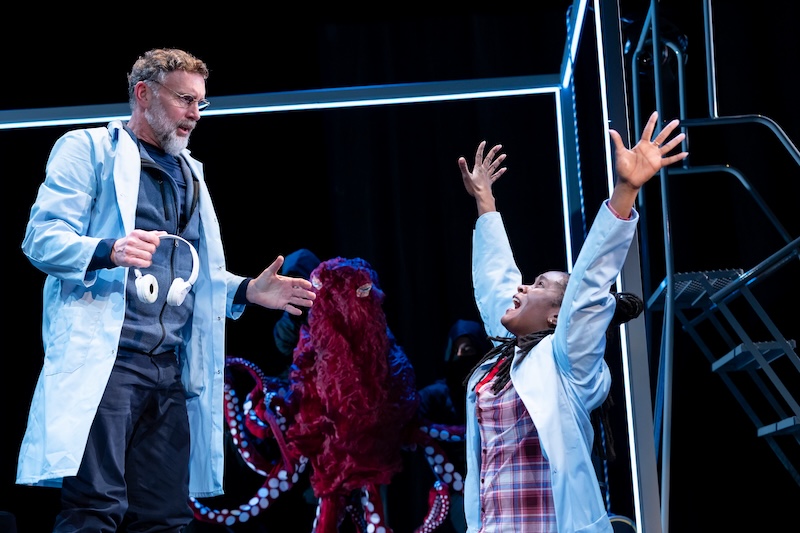
Tim Cummings and Kacie Rogers (Photo by Brian Hashimoto)
This play’s potential lies in the writings of the late neurologist Oliver Sachs, who spent a career documenting the disconnect between his neurodivergent patients (inexplicably compensated with creative gifts that are neither acknowledged or known by the “normal” people around them). One of his works, Musicophilia, specifically chronicles ways in which music impacts neurodivergent patients, some of whom are composers. It’s a revelation, and I’m feeling this is where Octopus’s Garden abandons its premise: Sylvia creates one composition, a shattering expression of her distress, and then playwright Gaylord all but leaves her to wither away, while focusing his drama on on her human caretakers, whose concerns are much less interesting than hers.
Regretfully, I had to leave 10 minutes before curtain call in order to catch my train home — the downside of relying on public transportation. I will say that, though the play deserved to be at least 10 minutes shorter, it is well-worth repairing. It’s evident that Gaylord has a truly expansive, inquisitive, and theatrical mind.
MY UTERUS: A WOMB WITH A VIEW Written and performed by Dina Morrone. Theatre West, 3333 Cahuenga Blvd. W. LA. Closed.
OCTOPUS’S GARDEN Written by Weston Gaylord and directed by Jessica Kubzansky, presented by Outside In Theatre, Circle X and Boston Court, 70 N. Mentor Ave., Pasadena; Fri.-Sat., 7:30 pm, Sun., 2 pm, on., arch 23, 730 pm; thru March 29. https://bostoncourtpasadena.org/events/octopus/