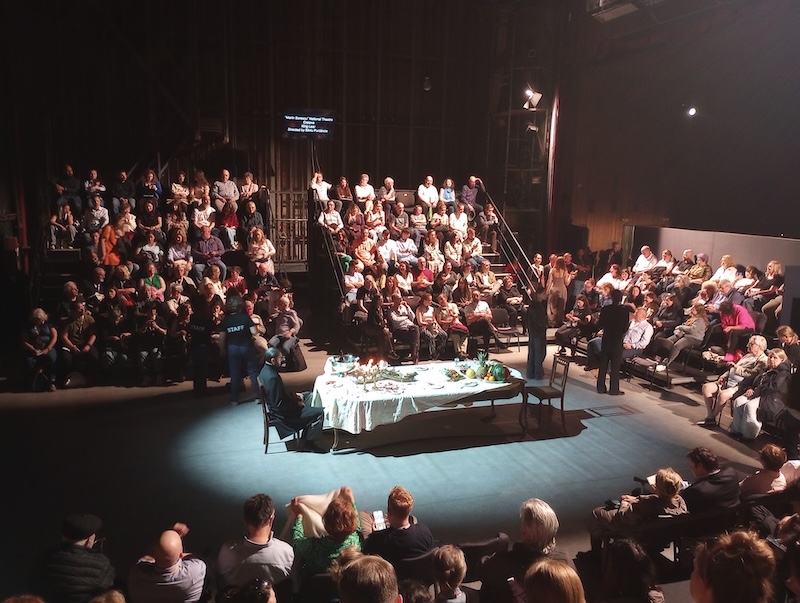
Photo courtesy of the International Shakespeare Festival, Romania
Riffing on Shakespeare
An international theater festival in Romania
By Amanda L. Andrei
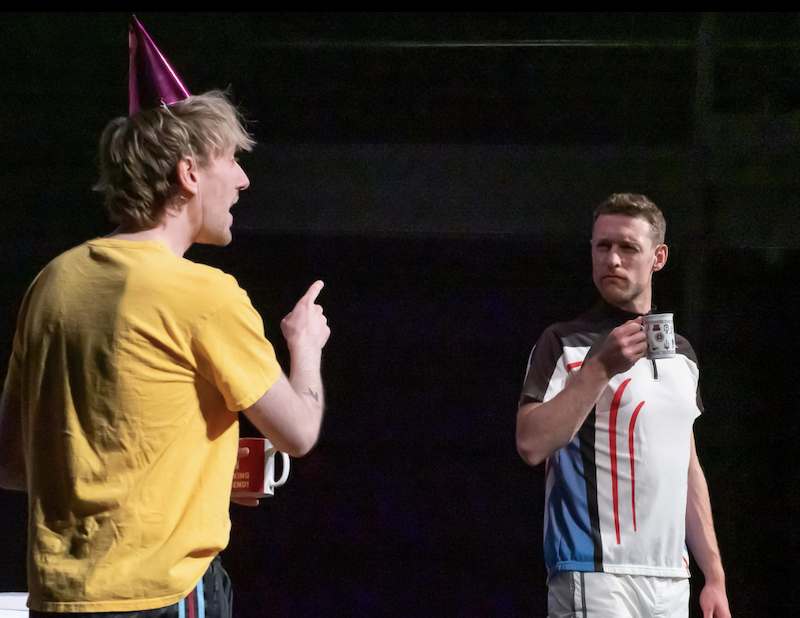
Adam Goodbody and John Chisham as “understudies” in Buzz Studio’s (UK) “Petty Men” – a spin on “Julius Casesar” (Photo by Olivia Spencer Photography)
In a performance of Petty Men, a riff on Julius Ceasar, an actor in a theater’s green room cast as an understudy for Cassius asks his fellow understudy cast as Brutus, “Do you remember the first day of rehearsal?” His voice is colored by dreaminess and hope as he continues: “The first day of Rome?”
Petty Men was one of many performances during the ten days of the International Shakespeare Festival in Craiova, Romania, earlier this year. Cassius’s comparison between theater and empire is not only fitting, but also a running theme across the festival. Many of the global reinterpretations of the Bard’s work at this festival made it clear: Glory and ambition come at the price of depravity and betrayal. The festival’s motto — “Will Matters”— layered puns on both the playwright’s name and the concept of self-determination. Especially when it came to tragic figures, various shows offered remixed takes on Julius Caesar, King Lear, Titus Andronicus, and Macbeth.
Directed by Julia Levai and presented by UK-based Buzz Studios, Petty Men featured Adam Goodbody and John Chisham as understudies for Cassius and Brutus, respectively, passing the time in a theater’s green room while Julius Caesar was performed on an unseen stage. The two understudies rehearsed, exercised, bantered, played guitar, fantasized about being onstage — but then took an uncanny turn when their words seemed to conjure violence to fulfill their desires.
This is a theater-maker’s play. Any artist who has ever struggled — either with deciding whether to leave the field or stick around in case their big break is around the corner — will empathize with the understudies’ impatience, longing, and remarkable ability to turn an empty space into entertainment. And when one’s big break comes at the expense of friendship, is theater a game or a job? In Petty Men, the answer is not easy — here, it’s sinister — and as the two understudies lose their emotion bearings, so does the physical world around them.
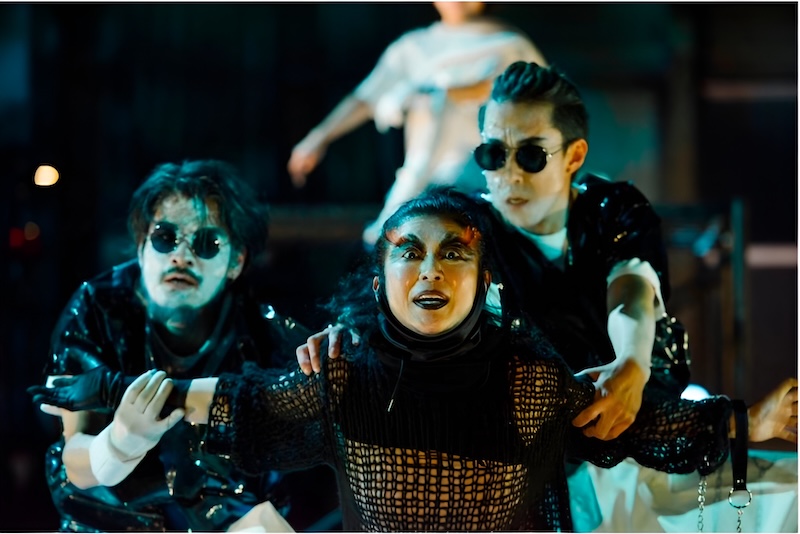
“Titus Andronicus” (Photo courtesy of Kakushinhan Theatre)
Japanese theater company Kakushinhan’s Titus Andronicus: Reborn was the festival’s opening performance, bringing the duplicitous nature of theater and ambition into a lavish yet disturbing foreground.
As Shakespeare’s first tragedy, Titus Andronicus follows the revenge cycle plays of its day: the Roman general Titus delivers a Goth queen as a war prize to a new Roman emperor who takes her as his wife. Gratuitous violence ensues.
Director Kyunosuke Kimura broke the fourth wall in this adaptation to repeatedly to critique the original text, with an outside character asking, “Why is this audience watching a play like this? . . . Am I also going to live in a world like this when I grow up?”
The play’s finale transformed into a striking Noh performance (gorgeous mask design by Hisato Iwasaki and costumes by Maya), with the Noh Titus (Tsunao Yamai) and his wronged daughter Lavinia (Fūka Haruna) gliding across the stage with exquisite deliberation towards the inevitable deaths of the queen and emperor. Although this blend of imperial cultures —the Roman story, the English poetry, the Japanese remix — provided a sumptuous visual tableau, the violence and terror that the characters underwent could not be redeemed by visual beauty. Lavinia, with red scarves flowing from her hands and mouth to indicate mutilation and rape, deserved better than having audience members laugh or pull out their phones to snap pictures of this moment of pain.
Titus was reborn at the end, presumably as a supernatural figure. However, it wasn’t clear that the outside character’s question had been answered by the play, and that the audience should, in fact, be watching a play filled with senseless sexual violence and unresolved revenge.
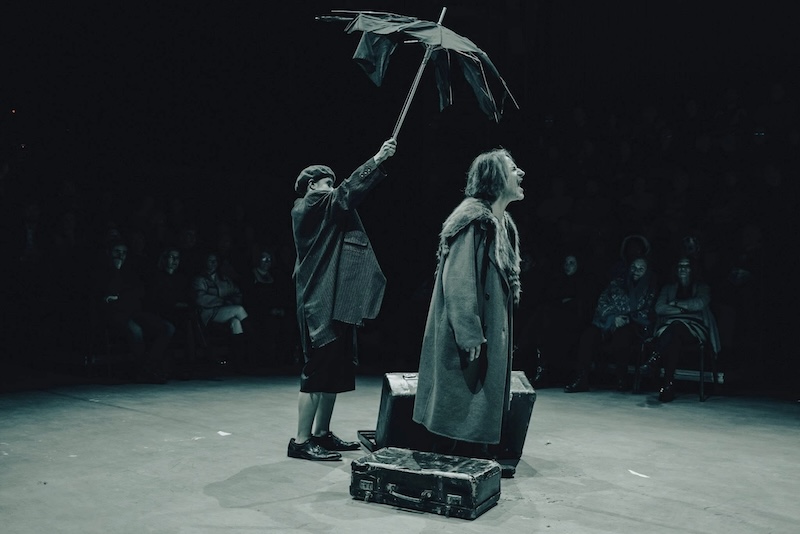
“King Lear” at Marin Sorescu National Theatre of Craiova (Photo by Albert Dobri)
The tragedy continued in full force with Romanian director Silviu Purcărete’s version of King Lear (translated into Romanian by George Volceanov), Shakespeare’s political tragedy of an aging ruler who tests his daughters’ love, with dire consequences for the entire kingdom. Led onto the cavernous stage of the Marin Sorescu National Theatre of Craiova, audience members settled into scaffolded seats and peered down at a half-eaten feast presided over by a glowering Edmund (Ovidiu Cârstea), the illegitimate son of a nobleman and the main antagonist.
Watching Purcărete’s vision unfold felt like passing through a series of elaborate paintings that combine powerful postures with meticulous detail: Less catharsis, more admiration and curiosity for the haunting images. For instance, at a party where Lear (Claudiu Bleonț) used his sword to slice a multi-tiered cake into three pieces for his daughters, and Cordelia (Costinela Ungureanu) told him that she cannot love him above her station, Lear shoved the dessert into her face. The pink frosting and shock spread across her face, her sequined gown now stained. The classic double-casting of Cordelia as the Fool also gave Ungureanu a chance to showcase her dark comedic range and Bleonț to run deeper into gritty madness.
Montreal-based La Fille Du Laitier’s Macbeth Muet took its source tragedy and turned it upside down. Through mime, puppetry, masks, and clowning, this rapid, hour-long adaptation of the Scottish Play retained the original’s darkness while also rendering it utterly hilarious. Directed by Marie-Hélène Bélanger Dumas and Jon Lachlan Stewart, Dumas played Lady Macbeth (and puppeteered various roles) along with Jérémie Francoeur as the doomed king (and other side roles). Silently standing before a table draped in a plastic sheet as if about to conduct a laboratory experiment or prep for a cooking show (set design by Cédric Lord), the two wrestled and glared, slept and stabbed, and soaked the stage in fake blood and broken eggs.
The simplicity of the objects was a delight. Origami fortune tellers (also known as “cootie catches”) represented the Three Witches, emanating a snakelike quality from Dumas’s and Francouer’s wrists. The general Banquo (Macbeth’s best friend) and his son were represented by masks made of white paper plates with black circles for eyes. Pop songs such as “Just the Two of Us” (for Banquo and his son) and “The Sound of Silence” (for Lady Macbeth’s insomnia) scored scenes and sparked laughter in the audience. This humor made it all the more tragic when characters were needlessly murdered — the white paper plate slashed, the eggshells smashed, the everyday objects turned into people now turned into a heap of trash onstage.
Such are the consequences of imperial greed. Whether Rome, the Scottish forests, the Noh stage, the celebratory feast, worldly glory diminishes as the theater lights dim. Will for unbridled power can only matter for so long.