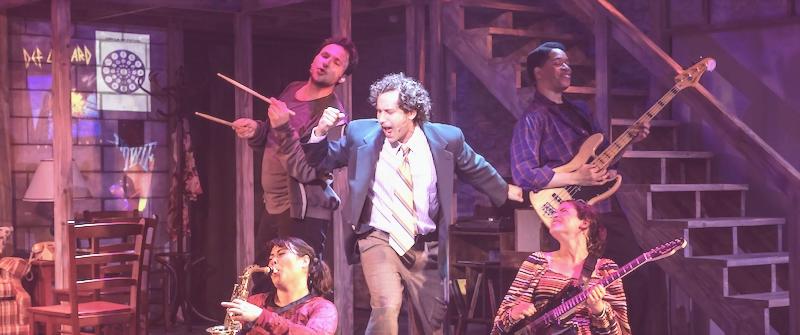
Back Row: Jesse Graham, Donovan Mendelovitz, & Desmond Newson; Front Row: Kayla Christine Quiroz & Molly Kirschenbaum (Photo by Lore Photography)
Reviewed by Philip Brandes
Rubicon Theatre in Ventura
Through April 19
RECOMMENDED
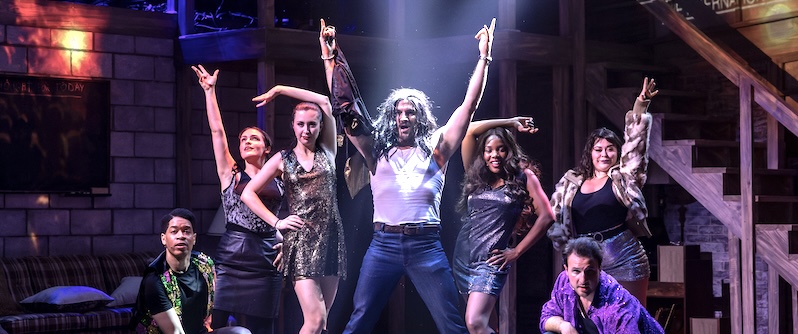
Desmond Newson, Molly Kirschenbaum, Presley Nicholson, Rustin Cole Sailors, Mea Wilkerson, Jesse Graham and Kayla Christine Quiroz (Photo by Lore photography)
When a new jukebox musical credits its score to “The Bands We Listened to on Vinyl in Our Basements,” it’s already told you everything you need to know about the guests of honor invited to the party — and that the suggested dress code is lived experience. The Rubicon Theatre Company’s world premiere of “Somebody to Love” confirms that co-writers Robert Sternin and Prudence Fraser know exactly what they’re doing.
Where the typical jukebox formula pre-selects a catalog and reverse engineers enough plot to thread the songs together, Sternin and Fraser started with four fully imagined characters and a dramatic structure tracing the adult arcs of a generation that came of age partying to the music of the ‘70s and ‘80s — then cast a wide net through the classic rock canon for songs that do specific dramatic work at specific moments in the story.
In the opening number, Sly and the Family Stone’s “Dance to the Music,” individual instruments combine in a celebration of collective joy and inclusion. That’s exactly what’s happening dramatically, as four Columbia freshmen meet each other in 1973 and form a study group that becomes the core of the show. The lyrics have been lightly adapted so the characters literally call each other into the song, instrument by instrument.
At their height of optimistic faith in their own limitless possibilities, the four principals — Nick (Rustin Cole Sailors), a charismatic rock guitarist; Cynthia (Sophia Alawi), a gifted dancer and Nick’s college heartthrob; Gerianne (Gizel Jiménez), a pre-law student destined for political activism; and Joe (Donovan Mendelovitz), a flautist with a more modest aspiration to teach music to high schoolers — swear a vow of lifelong friendship.
Life proceeds to thoroughly test that vow over the next 35 years.
While Nick’s pursuit of rock stardom supplies the show’s dramatic spine, Sternin and Fraser are generous enough to give each of these four characters a fully realized arc, with enough substance to make even the rockstar-meets-redemption trajectory feel earned rather than formulaic.
Sternin and Fraser’s most theatrically inventive use of a familiar song for fresh dramatic purposes comes with Blondie’s “Call Me,” which arrives at the moment the Nick-Cynthia relationship is fracturing under the weight of his rising fame. Director Sean Daniels splits the stage between Cynthia alone in a cheap motel room somewhere in Texas, desperately trying to reach Nick through a box office switchboard, and Nick performing the same song at the Fillmore in San Francisco, surrounded by adoring fans and his label’s groupie backup singers (Presley Nicholson and Mea Wilkerson). The song plays simultaneously in two completely different emotional frequencies — longing and abandonment on one side of the stage, seduction and spectacle on the other — making the heartbreak land more viscerally than any dialog could.
Nick’s meteoric rise through the L.A. music scene, amusingly shepherded by his loyal manager Walt (F. Michael Haynie), plays out against the further erosion of the friendship vow, as the other three build quieter but more fulfilling lives. Cynthia cedes her artistic career dreams to the pragmatic realism of marriage and motherhood. Gerianne’s E.R.A. activism unexpectedly lands her in a committed relationship with traditionalist ROTC recruit Stella (Alexis Semevolos-Velazquez) at a time when coming out was a career-ender. Having decided not to join Nick in pursuit of stardom, Joe finds quieter validation turning a wayward student’s life around with the right inspirational pitch and a pair of drumsticks. Engaged in learning for the first time, the kid (Jesse Graham) launches into an air drumming solo that stays in perfect sync with offstage drummer Emiliano Almeida as it builds with increasingly wild fury.
Under music director Brett Ryback, the live six-piece band is as dramatically integrated as it is musically tight — shifting from reflective nuance to hard-driving rock hedonism as needed in service of the story rather than despite it.
Jethro Tull’s “Locomotive Breath” arrives at the end of Act One as Nick’s decade of rock stardom collapses into cocaine and isolation. Ian Anderson’s lyric — a man on a runaway train, no way to slow down, watching everything he valued disappear — fits Nick’s situation with a precision that feels less like song selection than dramatic inevitability. Director Sean Daniels stages it as a full theatrical breakdown, Nick’s demons literalized in nightmare choreography while the song’s relentless momentum carries him toward the blackout that ends the act.
The show’s two-act structure roughly divides the song list into two emotional registers. Act One is dominated by harder, more electric songs — KISS, Jethro Tull, Blondie, Bad Company — mirroring Nick’s ascent and the decade’s energy. Act Two softens considerably — Little River Band, Earth Wind & Fire, Orleans, the Doobie Brothers — tracking the story’s emotional work of repair and reckoning. The Jefferson Airplane title song’s three appearances function as chapter headings: the question posed, the question deferred, the question finally answered.
That’s tighter musical dramaturgy than most jukebox shows manage; it situates “Somebody to Love” closer on the theatrical spectrum to “Merrily We Roll Along” than to “Mamma Mia.” Instead of engineering story to justify moving from one beloved song to the next, Sternin and Fraser deploy each song as the precise dramatic instrument for a specific emotional moment that dialogue alone cannot reach.
The pre-existing nature of the material means the seams occasionally show — a Christmas medley sequence feels constructed around a production number rather than the reverse — and Sternin and Fraser’s sitcom roots occasionally surface in dialog delivery that leans further into banter than emotional truth. The show is fortunate to have a cast with the vocal and dramatic chops to deliver that truth where it lives most naturally — in the songs themselves. This is a promising launch of a jukebox musical that thinks like a book musical.
Rubicon Theatre Company, 1006 East Main St., Ventura. Check website for schedule; thru April 19. www.rubicontheatre.org. Running time: Two hours and 15 minutes with intermission