
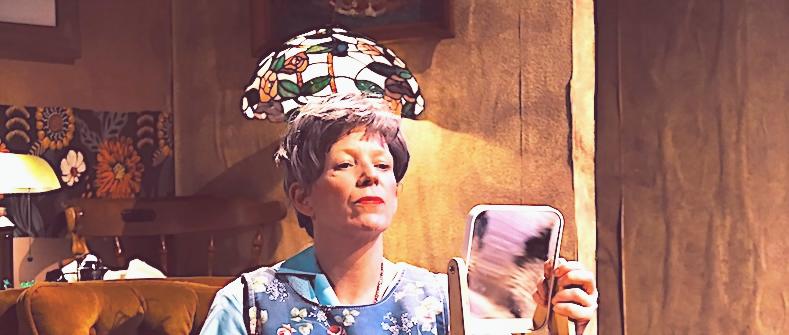


Heidi Sulzman (Photo by Gus Frank)
Reviewed by Deborah Klugman
The Electric Lodge Theater
Through April 11
RECOMMENDED
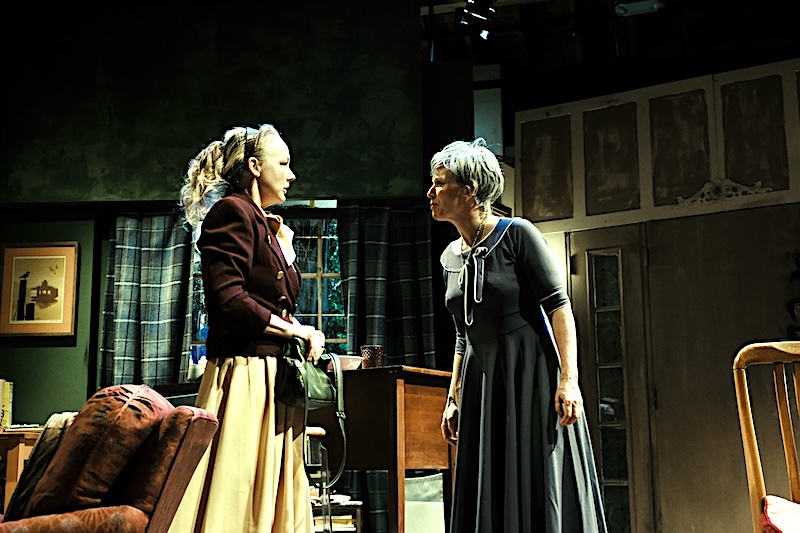
Jessie Warner and Heidi Sulzman (Photo by Gus Frank)
“The boundaries which divide Life from Death are at best shadowy and vague. Who shall say where the one ends, and where the other begins?” – Edgar Allan Poe, The Premature Burial
“The life span of any civilization can be measured by the respect and care that is given to its elderly citizens.” – Arnold Toynbee
These two quotations preface the text of Marja-Lewis Ryan’s new play, The Best Boarding House in Delaware. The first, by Edgar Allan Poe, reflects on the vagueness of the boundary that exists between life and death. The second, from Arnold Toynbee, observes how the respect and care awarded elderly people says much, if not everything, about the society they dwell within. The first quote is central to this gothic, character-driven comedy; the second, more peripheral, is nonetheless relevant in a play whose central characters are two lonely women reaping comfort and a sense of self from each other’s company.
The mechanics of the plot are inspired by the story of the Dorothea Puente, who operated a boarding house for the elderly in Sacramento in the 1980s. Puente became one of the most notorious female serial killers in American history when it was discovered that she’d been murdering her tenants and burying them on her property — after which she would collect their Social Security checks. This went on for a while. The uncovering of her homicidal behavior was all the more shocking because no one had suspected her of being capable of them. To the world, she appeared a kind, grandmotherly sort of person whose sole motivation in operating her facility was to assist and nurture her vulnerable tenants.
Ryan’s storyline pivots around a woman who maintains such a boarding house, but there are differences. Whereas the historical Dorothea convinced every one of her kindness, Ryan’s proprietor, Deedee {Heidi Sulzman), last seen by this critic in 2014 in a mind-blowing performance in One in the Chamber, an earlier Ryan play) convinces almost no one. As crafted by Saltzman, Deedee is a living breathing example of a cryptic curmudgeon, and not a lovable one at that. She’s rude, short tempered, unfriendly and clearly distanced from the reality most of us share. When the niece (Michelle Gardner) of one of her tenants (actually, her only tenant) comes to visit, intent on taking her aunt home and caring for her in her own house by the sea, Deedee snaps at her suspiciously, spouting hyperbolic lies about the quality of care her aunt receives in her own domicile (a trash-strewn rat-infested dwelling arrestingly depicted by scenic designer Michael S. Fitzgerald ). Sulzman’s rendering is comic, intense and utterly persuasive; her Deedee is an igneous mass of righteous indignation who keeps you both entertained and appreciative of the fourth wall shielding you from her.
But one person finds DeeDee not so much fearsome as loving and supportive — her lone ward, Mrs. Grick (Leigh Taylor-Young), a person given to flights of fancy and as cut off from the real world as DeeDee — but with a rosy view of life that allows her to perceive Deedee as a friend and protector. And in her own way, the cantankerous Deedee returns Mrs. Grick’s affection, one reason she so defensively warded off the effort of her visitor to spirit her away.
The notion which has obsessed Mrs. Grick lately is the entering of Deedee’s board and care facility in a local contest for the best small business — a competition in which the winner garners a financial prize, much needed (far more than Mrs. Grick is aware) to rescue Deedee from insolvency. To their visitors (there will be one other before the play ends), and to the eye of the audience, this notion is, put politely, farfetched. The place is unkempt and unsanitary, notwithstanding the vase of artificial flowers Mrs. Grick has placed on the table to pretty things up.
Running an economical 72 minutes (including an intermission) The Best Boarding House in Delaware, which the playwright also directs, is a fun ride that has potential to go further than it does. Ryan opts for an inky comedy that is short, sweet, and powered by the comedic acting chops of its lead performer. The polished tech includes Fitzgerald’s detailed set, a comic rebuttal to the women’s aspiration to prize-winning excellence. Diane Herrera’s lighting design underscores the boarding house’s shabby environs. Cricket Myers’ sound design is apropos.
Beneath the laughs, however, is a story of two lonely discombobulated ladies that might be explored for greater depth and richness, both in writing and performance. As Mrs. Grick — she segues to “Fiona” before play’s end — Taylor-Young delivers a flighty airhead in a mannered turn that could use layers. Gardner’s character, it turns out, isn’t everything she says she is; this plays a little too obviously at the top. But Jessie Warner as the contest judge whose visit has been so long anticipated is spot-on as she makes every effort to be polite and respectful in the face of Deedee’s madness.
The Electric Lodge Theater, 1416 Electric Ave., Venice; Thurs.-Fri., 8 pm, Sat.-Sun., 3 pm and 7 pm; thru April 11. www.electriclodge.org