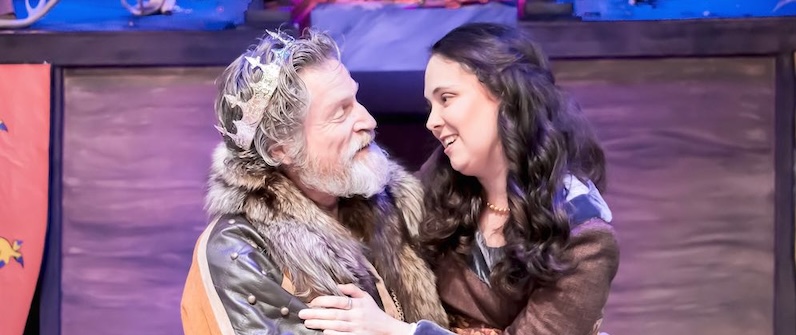


Noah Wagner and Lauren Velasco (Photo by Mike Hardy)
Reviewed by Joel Beers
Long Beach Playhouse
Through June 13
RECOMMENDED
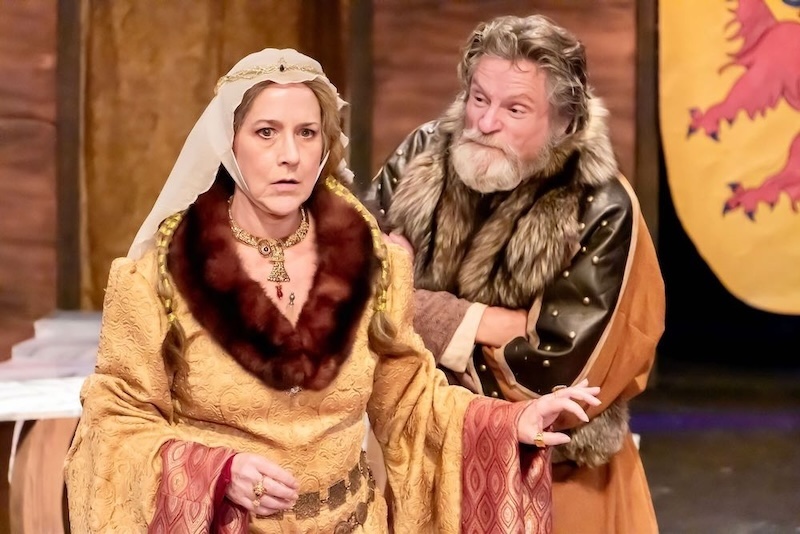
Amanda Karr and Noah Wagner (Photo by Mike Hardy)
In the program notes, director James Rice compares the family power struggles and ambition in James Goldman’s 1966 play to the real-life saga of the Murdochs and the fictional strife in Succession.
Those are apt comparisons. Goldman’s heavily embellished saga of 12th-century dynastic succession pivots around two towering historical figures, England’s King Henry II and his wife Eleanor of Aquitaine, and their three sons vying to be named heir. It contains all the venomous insults, castle intrigue, caustic taunts, desperate power grabs and emotional dysfunction of any prime-time or headline-generating contemporary soap opera.
That’s why Winter remains one of the strongest period dramas of the 20th century, even without the canonization ensured by the 1968 film starring Katharine Hepburn and Peter O’Toole.
But this production adds something to the already potent mix: a surprising warmth beneath the dry, biting barbs, and a sense of humor that feels as much discovered in the characters as written into them. It’s Shakespearean tragedy played with the timing of a savage sitcom.
Much of that comes down to the two central performances: Noah Wagner’s Henry and Amanda Karr’s Eleanor. Wagner is a commanding Henry, obsessed with securing his legacy as the “greatest conqueror since Charlemagne” and determined to shape his empire on his own terms. He moves through the court like a strategist already several steps ahead, yet remains an earthy, sharply funny master bastard — and a man capable of genuine affection toward both his mistress, Alais (Lauren Velasco), and his wife Eleanor, even as he moves the former around the board with ruthless abandon, and has locked the latter in a well-appointed stone prison for 10 years.
Karr’s Eleanor is more than a match for Henry’s plotting and cutting bon mots. What makes her performance so compelling is that, while her intelligence is razor sharp and her emotional armor formidable, the cracks in her complexity are always visible, making her even more human.
The dynamic of this play hinges on how well Henry and Eleanor’s political machinations mesh with their personal feelings, and that drawbridge rises and falls effortlessly thanks to both of these masterful performances. Every interaction between them becomes a negotiation between strategy and intimacy, power and memory — all played with a rhythm that makes each exchange feel like both battle and confession.
With two such richly drawn characters — and two such commanding performances — it’s inevitable that the other characters feel like useful pieces. but ultimately just that. It’s not that Giovanni Navarro’s Richard lacks defiance, or Trevor Hart’s Geoffrey lacks scheming intelligence, or J. Henrik Nielsen’s French king Philip lacks political finesse, or CJ Switzer’s John lacks petulance and neediness (actually, here, there’s too much of both. Each of these characters is given moments to land blows and stake claims within Goldman’s verbal battlefield, but they remain pieces on a board ultimately defined by its monarchs.
The production makes that hierarchy clear from its opening montage: This is a game of chess, one in which the king must be protected at all costs while the queen is the most powerful force in motion. That balance defines the evening. Wagner and Karr dominate the board, shaping nearly every move the production makes.
Long Beach Playhouse, 5021 E. Anaheim St., Long Beach. Fri.-Sat, 8 pm. Sun., 3 pm.; thru June 13. www.lbplayhouse.org Runtime: approximately two hours with an intermission.