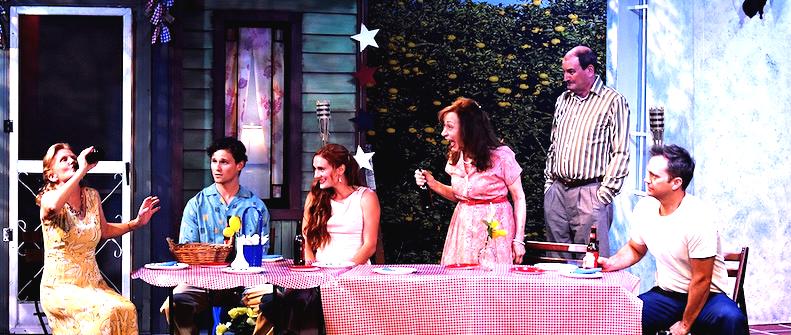
The cast of “How High the Moon” (Photo by Gary M. Kluger)
Reviewed by Joel Beers
Theatre West
Through August 16
RECOMMENDED
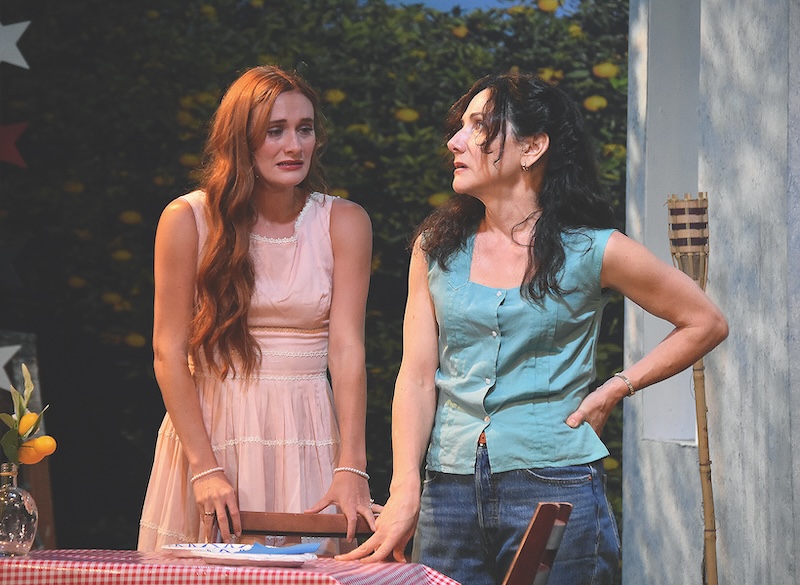
Caroline Quigley and Anya Profumo (Photo by Gary M. Kluger)
Mark Twain wrote in 1874 that “History never repeats itself, but the kaleidoscopic combinations of the pictured present often seem to be constructed out of the broken fragments of antique legends.”
Or as more economically minded thinkers would eventually put it: history does not repeat, but it rhymes.
There is plenty of rhyming in Barbara Nell Beery’s world premiere play How High the Moon, from the personal — cross-generational sibling rivalries and father-son conflicts — to the political. Seven years after helping defeat fascism, America is at war again, this time in Korea.
The play has a Janus-like perspective: It is set in 1952, but one eye looks toward the not-so-distant past, most notably World War II, while the other peers into the future. That future includes the housing boom that would transform the San Fernando Valley, where the population would increase nearly tenfold by 1960, turning once-rural citrus groves and farms into a sprawling symbol of postwar American suburbia.
The action unfolds over the Fourth of July weekend, as two neighboring families celebrate both the nation’s birthday and the birthday of Amy (Caroline Quigley), who is married to, literally, the boy next door, Russell (Matthew Gademske). We learn early that neither is happy. Millie feels their marriage is falling apart, while Russell, though he has recently graduated from dental school and is poised to inherit his father’s practice, faces two problems: the sight of blood makes him nauseous, and he is not certain he wants to be a dentist.
Their struggles confuse both Amy’s mother, Violet (Jennifer Ashe), and Russell’s father, Walter (David Nathan Schwartz), who share a worldview remarkably narrow even for the era. Violet insists that a wife’s primary responsibility is keeping her husband happy — a task made easier, she believes, because she is married to a dentist. Meanwhile, Walter is a practical man who urges, if not demands, that his son abandon fantasies of quick riches, like those pursued by his own brother Carl (John Posey), who has made a fortune developing real estate, and follow the respectable, responsible path laid out for him.
While the parents are nose-to-the-grindstone pragmatists — get a steady job, choose a practical career, marry, have children and be responsible — their four grown children are struggling with navigating that route.
Violet’s oldest daughter, Allison (Anya Profumo), a high school valedictorian and embodiment of postwar achievement, has rejected the model embraced by the older generation. She has moved to the Bay Area, where she has built a successful career as an advertising copywriter, pursuing an independence that would have been difficult for many women of her generation.
Amy, meanwhile, has embraced — or perhaps been confined by — the suburban ideal. Denied higher education and a meaningful career path, she is left wondering what opportunities might have been available had she been given the same choices as her sister.
Russell, expected to follow his father into dentistry, finds himself increasingly uncomfortable with that future — not only because of the profession itself, but because the realities of the job repel him. Instead, he dreams of building homes in the booming real estate market reshaping the Valley.
The most complicated figure of all is Harrison (Lane Compton), Russell’s older brother, who shows up from Berkeley on a motorcycle, the first time he has been home since leaving for the war in 1942. Why so long? He was wounded in the Battle of the Bulge, earning the Silver Star, but was also misidentified as dead. Six months later, his brother married Amy, who happened to be his high school sweetheart, and instead of returning home Harrison took advantage of the GI Bill and became an instructor at an unnamed college, where he specializes in historical recurrence.
But Harrison is still reeling from his brother’s marriage to the woman he loved. He is also caught between personal fulfillment and the security of a respectable career, which is itself complicated by his having to sign a loyalty oath mandated for California public employees.
Together, the siblings embody the contradictions beneath the surface of the postwar American dream: the tension between duty and desire, security and self-discovery, conformity and reinvention.
Beery’s research is evident throughout. The play is filled with carefully chosen details that ground these family conflicts in a specific moment of American transformation. References to the booming auto industry, including the massive General Motors plant in Van Nuys, capture the Valley’s rapid shift from agricultural landscape to industrial and suburban powerhouse.
Even the smallest details carry historical weight. The beer the family drinks on the Fourth of July is not just a prop but another reminder of the world being built around them: Budweiser, whose Van Nuys brewery had become part of the region’s postwar expansion.
These details aren’t perfunctory; they quietly establish the forces shaping the characters’ lives — the industries, consumer culture and economic opportunities that promised prosperity while also defining what success was supposed to look like.
Tightly directed by Asaad Kelada and clocking in at under 90 minutes, the intensity of the family drama never feels forced or telegraphed. The performances are finely textured and nuanced, with one exception: Kathie Barnes’ Millie, Walter’s wife. But that is less a reflection on Barnes’ performance than on the fact that Millie is the least fully developed character on the page.
The play tidies up many of its loose ends. The housing industry, the very force reshaping the Valley, becomes a source of opportunity for those who embrace it, even if it threatens to drive a wedge between father and son.
The future is less certain for those who reject the suburban dream of prosperity. Russell’s refusal of his father’s plea, if not command, to not jeopardize his career as a dentist suggests a hunger for freedom, but freedom brings its own uncertainty. And Allison, while convincing Russell to follow his own path rather than betray the ideals he fought for by signing a loyalty oath, also happens to work in the one industry most responsible for transforming ideals into commodities: advertising.
Whether these characters become the kind of disillusioned dream merchants later portrayed in “Mad Men,” wrestling with the culture they helped sell, turn up a few years later at San Francisco’s Six Gallery when Alan Ginsberg first dropped Howl, or simply find their own imperfect versions of happiness remains unresolved. But wherever they end up, the road they take, and the personal histories they make, will be their own.
Theatre West, 3333 Cahuenga Blvd. West, Los Angeles. Fri.-Sat., 8 pm, Sun., 3 p.m. www.theatrewest.org. Runtime: approximately 90 minutes with no intermission.