

Oqalile Tshetshe (Photo by Thomas Alleman)
Reviewed by Steven Leigh Morris
Open Fist Theatre Company and Circle X Theatre Company at Atwater Village Theatre
Through May 3
RECOMMENDED
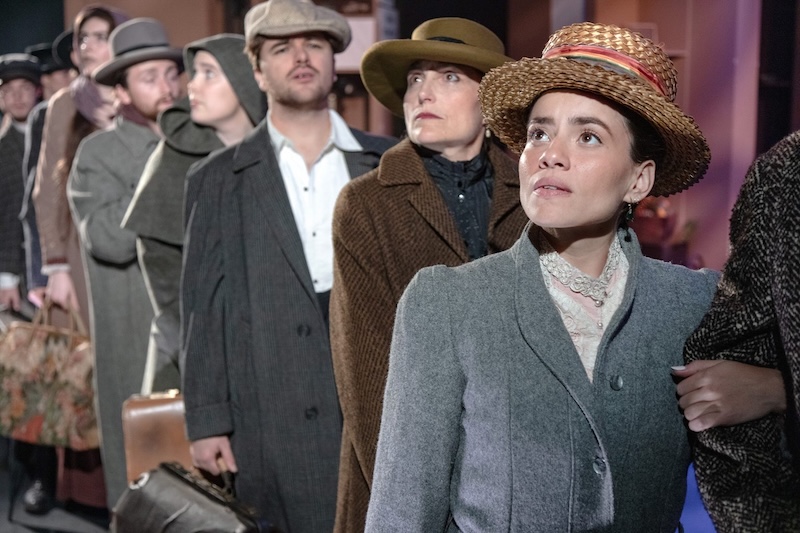
Jade Santana, Maria Mastroyannis, Matthew Goodrich and Ensemble (Photo by Thomas Alleman)
Director Dietrich Smith’s adaptation of Franz Kafka’s Amerika Or, The Man Who Disappeared returns to Atwater Village Theatre with cast changes after a premiere run at the end of last year.
Running almost three and a half hours, with two intermissions, it may test one’s patience — yet ultimately it passes that test.
The production is a picaresque romp that depicts the adventures of a German immigrant named Karl Rossman (Oqalile Tshetshe) through the Byzantine worlds, ethics, and morals of early 20th Century America. The story grows canines that sharpen with each passing act. (There are three acts.) This is a world of robber barons and their servants who are desperate to cling to their rotten and humiliating jobs. Much like in the current White House, even obsequiousness isn’t sufficient to ensure employment.
Rules of engagement – the rules of law if you will – are invented willy nilly, so “criminals” don’t even know they’ve broken them. ICE, anyone?
Kafka penned his novel in the early 20th century having never set foot in the United States. His Amerika is actually a projection of his delicate mental state, based on what he was feeling about World War I Europe. And yet, and yet. In the book, as Rossman arrives at Ellis Island, he passes the Statue of Liberty, holding up not a torch, a beacon, but rather a sword, an emblem of dominance and vengeance. Does such prescience really need to be explained?
Kafka intended his novel to be Dickensian, and that madcap Victorian flavor permeates the story. Meanwhile Smith’s adaption, and his production, employing 12 marvelous actors in multiple roles, has vapors of the Royal Shakespeare Company’s 1980 eight-and-a-half-hour (in two parts) production of Nicholas Nickleby. The major difference between them is that Dickens, in his display of social cruelty, was a sentimentalist, whereas Kafka was a nihilist. (Think Alfred Jarry’s Ubu the King.) We’ve had plenty of sentimentality on our stages. Perhaps the 21st century calls for at least a small dose of untethered lunacy that reflects the current world beyond our theaters’ walls, where even international laws and standards are now being treated as words on a contract that got torched years ago.
Nicholas Nickleby had a sense of humor. Smith’s Amerika has one too: There’s Tambrie Allsup’s psychotic, dominatrix daughter of an industrialist (Jeremy D. Thompson). She seduces men by batting her eyelashes before kicking her suitors in the shins and the ribs. (Sleek fight choreography by Allsup). Grace Soens pulls off a draw-dropping portrayal of a needy and self-loathing housekeeper, while Jade Santana’s Italian lift boy shows her mastery of physical comedy. But director Smith’s prevailing tone is the surreal horror of Alice’s Adventures in Wonderland, in its awareness that promises mean nothing, that the rules for holding society together are permeable and arbitrary. This place, much like our world, is run by the capricious and sadistic Queen of Hearts.
In the lead, Tshetshe plays a wide-eyed naïve newcomer with a clear moral compass that lands him in a tenement slum. This transpires after he’s repeatedly beaten up, before and after some brief employment in a swanky hotel. The actor’s South African heritage takes on its own meaning here, as Kafka felt particular empathy for Americans of African descent. That his character is also Jewish spins all the accompanying tropes on their head and places the play’s ideas firmly in the land of symbolism.
Pat Towne relishes the comedy of imperiousness in various roles, which range from an industrialist to a head waiter to a washed-up opera diva (off-stage, but we hear in treble clef her crooning and stream of demands).
Credit also actors Emma Bruno, Matthew Goodrich, Maria Mastroyannis, Elliott Moore, Jack Sharpe and Julien Thompson for their satirical and sometimes delicate gifts of characterization.
But the heart of the production beats with Smith’s production design – a netherworld anchored by Frederica Nascimento’s set: the stage perimeter comes decorated with a model of a steamship, various nautical clocks (a nod to Salvador Dali, perhaps) and baggage trunks. Within that perimeter, narrow cloth strips unfurl from the sky — screens containing, for example, the aforementioned Statue of Liberty, screen after screen closing in on that sword, like a flipbook depicting jagged animation.
Another larger backdrop screen contains animations (designed by John R. Dilworth) altogether different — stick figures, for instance, racing up and down the stairwells of the steamship to depict the offstage motions of the characters, meticulously punctuated by Gary Rydstrom’s sound design. (And if you imagine this steamship is a labyrinth, just wait until Karl Rossman arrives on land.)
In Dickens, there’s the coal stone of hope in the burner that something might turn out well – and on occasion it does. That’s the core difference between Dickens and Kafka, or seems to be, until Act 3, which lands upon a bizarre company named The Theatre of Oklahoma, whose recruiting services appear as a kind of gateway to Heaven. They seem to be hiring for everything and will accept almost everybody. They’re a little tough, but good-hearted. And herein lies Kafka’s American Dream, and his sliver of hope in the otherwise toxic stench of early 20th century coal smoke. We see and hear angels with trumpets — sort of an early 20th century Angels in America. Theatrically, it’s gorgeous, and worth the wait for it to arrive.
Open Fist Theatre Company and Circle X Theatre Company at Atwater Village Theatre, 3269 Casitas Ave., Atwater; Fri., 7:30 pm, Sat., 7 pm, Sun., 2 pm, Mon. April 6, 7:30 pm; thru May 3. openfist.org Running time: 3 hours and 20 minutes, including two intermissions.