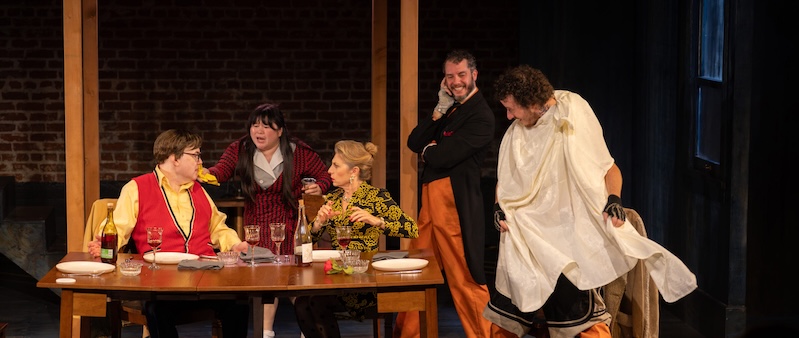
Brian Wallace, Jazelle Villanueva, Tessa Auberjonois, Liam Rhodes, Trevor Jonathan Lown (Photo by David Esquivel)
Reviewed by Steven Leigh Morris
The Skylight Theatre
Through Sept. 20
RECOMMENDED
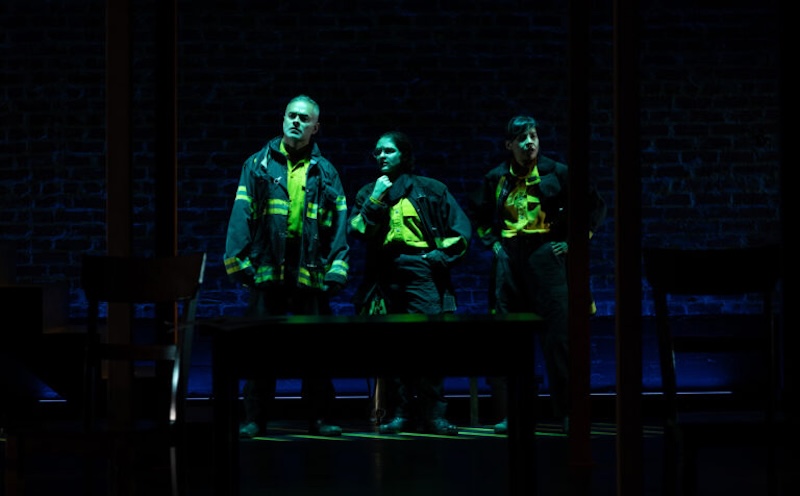
Moneer Yaqubi, Molly Kirschenbaum, Flor de Maria Chaua (Photo by David Esquivel)
Okay, so it’s pouring rain outside when Stephen Miller and Pete Hegseth swing by and knock on your front door. They do what they do best: pretend to be victims, homeless maybe. Golly, you’re a decent person, empathetic to a pair of lost souls down on their luck, so you let them in, feed them — true, they quibble about the quality of the food, which is annoying, yet you offer them a place to stay, shelter from the storm. They can sleep in the attic. You’re a nice person.
There have been news reports of people just like this, feigning to be cast out, finding sanctuary in attics, when their ulterior motive is to set fire to the homes they occupy, to the town, to everything — as seems to be happening now to the values and institutions and laws within the U.S. that we’ve held sacred (kind of) for decades. But no, you will not succumb to this kind of fear mongering: “They’re eating the cats, they’re eating the dogs.” Your impulses are humanitarian — to see the decency in people. Even these people. It’s a matter of principle and of faith. Friendship. Anything less than that is nihilism. (What’s that old joke, a liberal is someone who has never been mugged.)
This, to me, is the only way that Swiss playwright Max Frisch’s 1953 absurdist comedy, The Arsonists (a.k.a. The Firebugs) makes sense to the United States of 2026. Because it is, in its heart (if it has a heart) a nihilistic play that offers a cautionary tale not so much about trusting people, but about accommodations everyone makes to power-mad governments that are run by thugs. In theme and style, the play is a direct ancestor of Eugene Ionesco’s Rhinoceros (1959), which took aim at Vichy France and the way the French were so willing to collaborate with the German Nazis. Frisch’s original target was deference to the Soviet regime. Communists, fascists: Their calling card is the same once they knock on your door, interchangeable: One for all and all for me. In fact, The Arsonists is often treated not as an anti-Communist satire but as an anti-Fascist one.
Luke Harlan directs an impressive production for a producing company named The Firebugs at The Skylight Theatre. The show is meticulously executed in style and tone by a very strong company of actors and designers. It’s only 90 minutes, and yet I did find myself tapping my toes for about 10 of them, the final ten, by which time the play had made its point, and made its point, and made its point again, just in case you didn’t get it the first two times around.
To be fair, Rhinoceros wields the same kind of sledgehammer. It’s the genre, positing to be abstract while pounding away at our collective, willfully blind capitulation to bullies. Frisch was entitled to this. He lived through the terrors imposed by the Soviets. Ionesco was similarly entitled, having lived through the terrors imposed by the Nazis. We, however, are in the midst of this same kind of terrorist experiment. It’s in the making. And unlike the conciliation of the Vichy French, and the submission of the Soviet satellites, our fate is yet to unfold — our capacity to push back against bullies and conmen is a capacity still to be determined by a fragile election process unfolding in a whirlwind of lies and deceits. For this reason, I found Frisch’s throw-in-the-towel cynicism about both human nature and governmental corruption/abuse to be so pedantic and unforgiving (“a morality play without a moral” —his own words) that I couldn’t quite forgive it. Then again, at the time he wrote it, the Soviet Union appeared unbreakable. Well, you just never know. You just have to live long enough to see tyrants fall and probably rise again. Putin emerged from the wreckage of Soviet Russia. The Far Right is once again on the move in Germany. Contrast this to the closing of Rhinoceros, wherein the slovenly protagonist Bergenger, having borne witness to everyone he knew and loved transformed into Nazi rhinos, shouts from on high, “I will not capitulate!”
Ionesco’s play-closing sentiment is either a rallying cry or a quixotic fantasy, perhaps both, but it contains a glimmer of hope. Not so The Arsonists. This makes me question its usefulness as we head into a tempestuous election in a few weeks, and in summoning the collective energy to repel further tyrannies should that plebiscite go south.
But what a terrific cast! Brian Wallace’s burly, bald homeowner Gottlieb Biedermann comes packed with squeamish defiance — squeamish not because he’s defying what is clearly (to the audience) the nefariousness of his two houseguests, but because he’s defying the evidence of the gasoline barrels they store in his attic, the fuses and detonators that he sees them installing in front of his own eyes. This isn’t a play, or a production, that invites us to question whether or not these houseguests are arsonists, but rather to question how anybody, including ourselves, can be so compliant before kidnappers holding the entire place hostage. As the pair of arsonists, Liam Rhodes and Trevor Jonathan Lown relish their characters’ diabolical intentions, throwing obfuscation and mockery into the path of anyone who challenges them.
It’s not plausible, one might argue, that nobody can see what they’re up to when it’s so obvious to the audience. How can (almost) everyone be so blind? Well, counterargument: that’s the point.
Tessa Auberjonois makes for Biedermann’s strikingly befuddled hausfrau while Jazelle Villanueva’s housemaid grows steadily more despondent as the invaders proceed with their scheme. Unlike everyone around her, she sees what’s going on. Underscoring the absurdity, in Villanueva’s performance, it’s as though her very soul is slowly taking in sewage.
Molly Kirschenbaum capably takes on the role of an academic, a Ph.D. who — with the embodiment of too little, too late — takes a stand only after the damage has been done. (Ionesco made much the same joke against academics and logicians.) In our current time and place, it feels like a cheap shot: I kept thinking of historian Heather Cox Richardson, and her relentless and often brilliant critiques of current government policy based on her prodigious knowledge of trends dating back to the American colonies. Richardson has been invited to run for public office, but she says she’s not qualified for that. She’d rather use her expertise for a higher purpose, at which she is qualified: History. Frisch’s satire of academia is a mockery of Richardson’s brand of expertise and, frankly, her humanity, humility, and purpose. Given who’s running the federal government right now, I find any diminishment of expertise to be misplaced.
Kirschenbaum is also part of a Chorus consisting of firefighters, lead in a marvelously haughty and slightly maniacal portrayal by Seamus Mulcahy.
Stephen Gifford’s two-tiered set transforms the space into an elegantly bifurcated arena, supplemented by Drew Sensue-Weinstein’s ominous sound design and Jared Sayeg’s lighting.
“Woe unto us” the chorus chimes in repeatedly, poking fun at Ancient Greek tragedy, from which this winking comedy, as presented by director Harlan, is as far removed as Earth from Jupiter.
I admired this production, despite parts of the play annoying me, because its presentation is so artfully conceived; watching skillful actors is never a waste of time; the production design is of a piece; and the event had me brooding and mulling it over long after the lights went down. Yes, that’s worth the effort, for them and for me.
The Skylight Theatre, 1816 ½ Vermont Ave., Los Feliz. Thurs.-Sat., 8 pm, Sat., 5 pm, Sun., 2 pm; thru Sept. 20. https://www.skylighttheatre.org/the-arsonists. Runtime: 90 minutes with no intermission.