Victoria Davidoff, Zaya Kolia, Edward Hoke and Frank Demma
Reviewed by Joel Beers
Frank’s at the Echo Theater Company
Through May 13
RECOMMENDED
Keith Stevenson, Michael Redfield and Jennifer Pollono
Given the collective title of these five one-acts, part of the ninth short-play installment of the Frank’s short play Project, you might brace for diminishing returns.
Fortunately, the title is a feint. What these plays lack in tidy resolution they make up for in nerve. Yes, several end abruptly or dodge neat conclusions — but that’s hardly a flaw. Who goes to the theater for clean endings? (Answer: people buying tickets to the boffo box office smashes). These artists aren’t interested in safe. They flirt with the edge, then shove past it.
Consider the terrain: murder plots hatched and paused for a celebratory crack binge. A modern art institution blown to bits while its devotees pivot seamlessly into gender play. A couple trapped in a looping reality with the wrong partner. A man circling the Woodland Hills home he grew up in, stalked by something he can’t quite name.
There are laughs — sharp ones. There are shocks. But best of all, there are gaps. These plays trust you to sit in the ambiguity, to connect what they refuse to spell out.
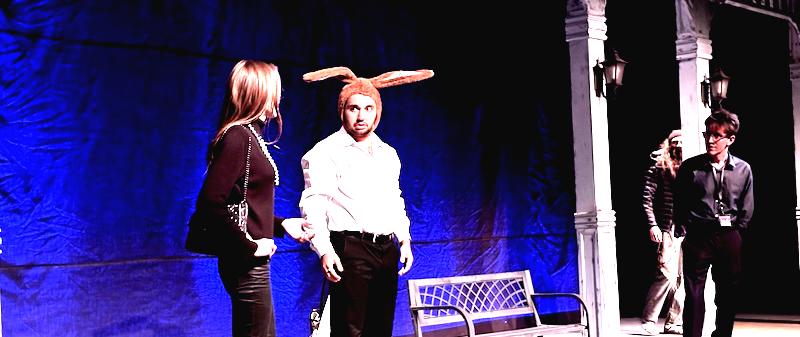
Three pieces orbit masculinity — or what’s left of it. In Marlette Meyer’s Rabbit Hole, an investigative journalist disguised as a homeless, shopping-cart-dragging drifter seems less interested in reporting than in proving to his friend that his Eastern European wife is cheating on him. Odd, since said friend believes she’s safely locked inside the house. The play escalates with gleeful absurdity toward violence — detouring first into a celebratory crack binge.
Benjamin Weissman’s Harriet & Keith at the Whitney Biennial is the strangest of the lot. Keith, a visual artist (a funny and complex Conor Murphy), meets Harriet (a wonderfully sadistic and hedonistic Suzanne Fletcher), who is somehow both stranger and muse. They trade art-world banter until an anarchist with a bomb interrupts. They run. The museum explodes. Harriet revels in the rubble, treating destruction as artistic renewal. Keith hesitates, but that uncertainty about the future of art gives way to something more intimate once they reach her apartment, where gender dissolves and reforms.
Sharon Yablon’s Matador is the longest and most haunting. Silas Weir Mitchell anchors it as a successful businessman marooned in his Woodland Hills past. Who he is, what he does, whether he’s even on the phone is all slippery. What’s clear is the haunting and loneliness. Mitchell’s performance is so charged, so kinetic, that you feel carried along with him, even if the destination never resolves.
Frank Demma’s Muir Woods is hypnotically powerful. Him (a superb Wes Welker, acting almost entirely with eyes and voice) drives through the redwoods with Her (a steady Shawna Casey). Except she isn’t his wife — she’s an ex, or a memory, or something in between. The play never settles on hallucination, time loop or liminal afterlife, and it doesn’t need to. The tension lives in the not knowing.
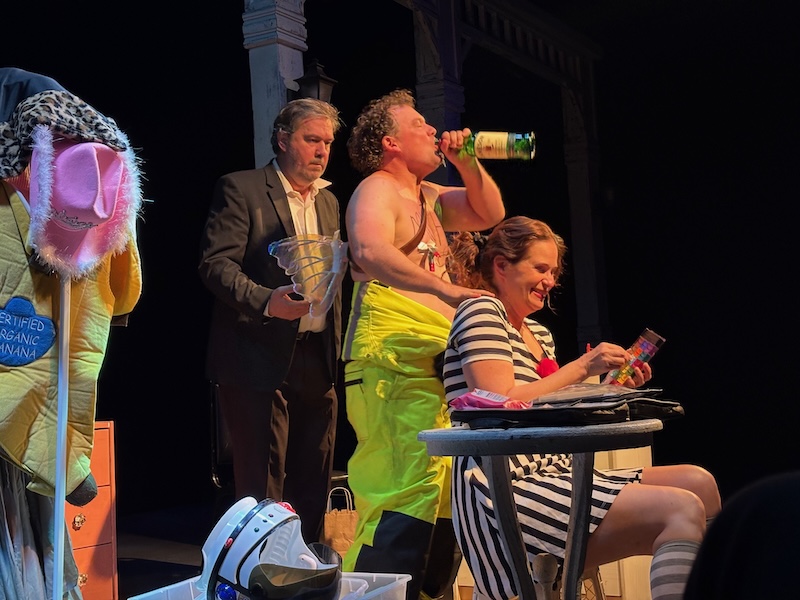
The final piece, John Pollono’s Illuminati, is the most grounded — despite unfolding during the intermission of a willfully unhinged play. Billy (Keith Stevenson), a stoic, salt-of-the-earth Bostonian, arrives in Los Angeles to see his sister Candace (Jennifer Pollono) perform. He wants answers: What is this play about and why has she seemingly abandoned her family? She wants recognition for pursuing her artistic life. Both are stuck dealing with Roger (Michael Redfield), a high-strung theater auteur (and Candace’s boss) who stages a fever dream of self-absorption — needles, self-administered abortions and men in tutus.
The most realistic of the five pieces, Illuminati is also the most relatable in terms of its portrayal of a familial battle between brother and sister and its debate over what is art. Stevenson turns understatement into a weapon — glances doing most of the heavy lifting — as art and family grind against each other. And then, a small grace note: A cheap Hollywood Boulevard trinket lands with more weight, more honesty than all the avant-garde excess surrounding it.
While there are thematic threads — the erosion of masculinity, the slipperiness of identity, the nature of art — it’s the dark humor and the spaces between the dialogue that make this a satisfying evening. That, and a group of theater artists willing to go all in on work that refuses to play it safe.
Atwater Village Theater, 3269 Casitas Ave., N. Hollywood; Wed., 8 p.m. Thru May 13. https://echotheatercompany.ludus.com/index.php. Running time: 100 minutes with no intermission.