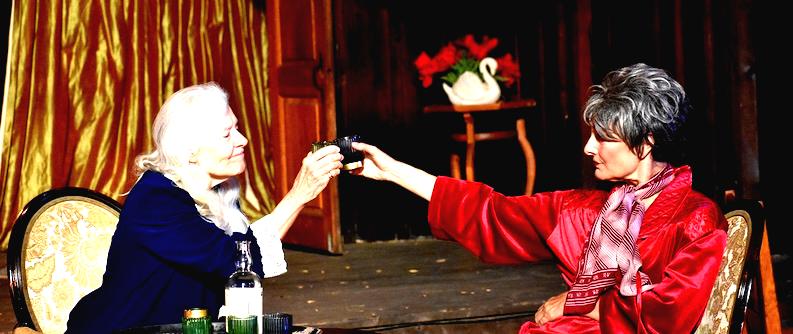
Jan Wikstrom and Susan Angelo (Photo by Ian Flanders)
Reviewed by Philip Brandes
Will Geer Theatricum Botanicum
Through October 3
RECOMMENDED
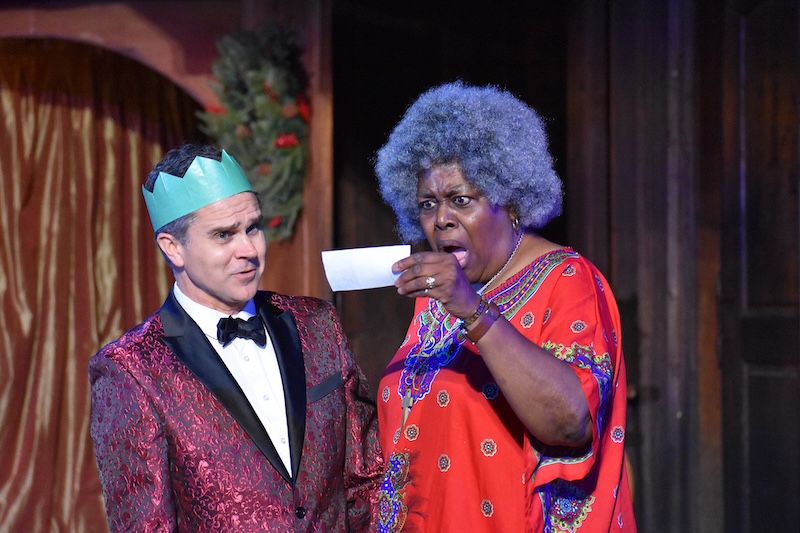
Will Collyer and Earnestine Phillips (Photo by Ian Flanders)
Substantial roles for older actresses have been in notoriously short supply for so long that Noël Coward built an entire play out of that scarcity with Waiting in the Wings in 1960. Among his more seriously intentioned works, Coward’s late-career comedy-drama profiles nine retired stage divas gathered under one charity-home roof, and makes each of them a character worth our acquaintance. That opportunity is rare enough on the scripted page — it’s rarer still to find a theatre company positioned to seize and run with it.
Turns out it’s a fitting challenge for the Will Geer Theatricum Botanicum. Founded in the 1950s as a Topanga Canyon refuge for artists purged during the Hollywood blacklist, the company might have been expressly destined to one day stage a play about a refuge for performers discarded by the pitiless profit-minded profession of show business.
“The Wings” of the play’s title is a retirement home in southeast England reserved for actresses who were once stars but now, at sixty or older, find themselves unemployed and destitute. The residents squabble over canasta, wrestle a temperamental television, and mount a quixotic petition to the home’s remote management for a glass-enclosed solarium that would let them enjoy the sun without battling the chafing winds. Amid the scenic Theatricum, beneath an open sky as daylight drains from the canyon, their campaign acquires extra resonance: we’re sitting in the solarium they long for, watching the metaphorical twilight of the title deepen in literal real time.
Anyone expecting vintage Coward — a flamboyantly self-obsessed Garry Essendine holding court in a silk dressing gown, say, with epigrams volleying at cocktail hour — needs to recalibrate. These are characters for whom the times of present laughter have long since passed, and Coward’s writing gives them an unaccustomed mix of comedy and pathos — rueful, sometimes rowdy, occasionally devastating. The mostly female ensemble’s depth is the play’s double edge: 18 characters rendered with genuine specificity is both a gift to the performers and a workout for audiences. Coward organizes the sprawl like a variety bill — each resident stepping forward for her turn while the principals carry the through-line. If the shape sounds familiar, it should: this is the formula Follies would later follow, right down to the faux period songs Coward included as the aging has-beens’ career back catalogue, eleven years before Sondheim built an entire musical on the same trick.
First among the three anchoring roles is Lotta Bainbridge (Susan Angelo), the new arrival whose entrance disturbs the home’s equilibrium: Thirty years earlier she’d married the fiancé of resident grande dame May Davenport, who has not spoken to her since. Angelo — a Theatricum mainstay for decades — plays the personable, socially adept newcomer, while the role of imperious, no-nonsense May, the most entrenched resident, goes to Jan Wikstrom in her Theatricum debut (a sly inversion, whether or not by design, that gives both performances an added undercurrent for longtime Theatricum patrons).
Bucking linear narrative convention, Coward stages the feud’s culmination nearer to the play’s midpoint than its finale, with their edgy private dialogue taking place in the small hours after a household emergency, over another woman’s abandoned whisky. And the quarrel resolves not through apology but through revelation: A third party, it emerges, whom neither knew was the one to blame.
What the reconciliation cannot repair is the deeper asymmetry that still remains after a year has passed: their attitude towards the hand that life has dealt them. Lotta embraces her fate, declining her estranged son’s belated rescue attempt and declaring herself, after serving time in this genteel prison, “suddenly free.” May’s hostility towards her situation remains magnificently intransigent: A very charitable meal still chokes her with humiliation. Same home, same charity, opposite verdicts — and Coward’s psychological honesty refuses to let hard-won friendship patch over their final-act circumstances.
The play’s third narrative linchpin is Sarita Myrtle (Ellen Geer), the home’s gentle ghost reliving her past roles — drifting through the corridors doing Lady Macbeth’s sleepwalking scene or sliding with no warning into The Scarlet Pimpernel — and fatally drawn to playing with matches. Her removal to a nursing facility after setting her room on fire is the production’s most delicate, heartbreaking transaction — an asylum exit as tender as Streetcar’s Blanche DuBois’s is brutal.
Coward’s ensemble closes ranks to protect the very illusion that Williams mercilessly strips from his heroine. No good-byes are said or implied. A housemate — Jane Macfie’s Maudie, the home’s perpetual piano accompanist — covers the silence with Chopin; recognizing her old exit music, Sarita departs without a flicker of self-awareness, as if simply closing another engagement. With nothing left to them but their craft, the women draw on it to collectively stage Sarita’s protected exit as the household’s kindest act of mercy.
Around the central trio, the ensemble dramatizes variations on the play’s slyest recurring theme — none of these actresses can quite locate the line between authentic life and performance, because fifty years in the profession has erased it. It’s the same foible Coward played for laughs in his drawing-room comedies, but viewed from old age the joke inverts. In Hay Fever the performing family drives the sincere people out of the house; in Wings the performing family is all that’s left. When the theatrical reflex outlives their career, what was once vanity becomes the sincerest form of authenticity. The change isn’t in Coward’s philosophy, it’s in the stakes: at 30, the theatrical self is a costume, at 75, it’s the skeleton.
Jokes about mortality are the brightening veneer over the anxiety shared by everyone onstage (“Excuse me while I slip into my shroud,” quips Katherine Griffith’s impeccably comic Bonita). Earnestine Phillips, shrewdly recast as an American Deirdre O’Malley with no attempt at the script’s brogue, instead brings thunderous oratory to the resident doom-monger’s glowering histrionics — rage as a recreational art form; Tim Sabourin’s Osgood Meeker, 70 years old and still delivering Sunday violets to the 95-year-old star he loved from the pit in 1906, carries the play’s purest heart. Miranda Heath’s unflappable Miss Archie, the ex-Army resident superintendent who commands the residents like troops and dotes on them like family, holds the practical world together so the residents can keep living in their theatrical one. And Will Collyer’s sympathetic Perry, the residents’ liaison and only ally among the charity’s aloof offsite management, walked away from the stage at 33 — the one performer in the house who quit the profession before it could quit him.
Though not a musical per se, Wings indulges Coward’s lifelong fondness for threading songs through his plays, from a wistful new ballad to the counterfeit vintage numbers the residents revive as their own. The company renders them with more affection than polish — musical theatre isn’t its strongest suit — but Marc Antonio Pritchett’s sound design floats them gently through the canyon.
The episodic structure demands a fair amount of patience. Coward wraps up his nominal central conflict well before the denouement and lets a year’s worth of epilogue unspool around it. At a running time of nearly three hours, keeping track through the sprawl poses a real challenge — today this material would be pitched as a streaming limited series. But it’s also the point: This is a play about duration — about what fills a life after the plot of it has ended — and its format follows the shape of its subject. What makes it work is the production’s theatrical finesse: sharply focused direction by Willow Geer and performances that make even the connective tissue matter.
The story’s unlikeliest benefactor is an intruder: Zelda Fenwick (Isabel Stallings), a tabloid columnist who talks her way into the home and profiles the residents in a feature article over their unanimous objections (at last, a character in a play doing my job). Coward’s slyest irony is what Zelda’s dreaded exposé ultimately delivers: a guilty tabloid publisher’s check for the solarium, and a son who learns from a newspaper cutting where his mother has landed. However self-serving, Zelda’s intrusion proves providential. For Coward, nobody’s principles stay clean, which is one more way this play is tougher than its sentimental reputation.
That toughness is the true test of Willow Geer’s staging, which generally leans warm — her program director’s note speaks of friendship and “the simple truth of not being alone” — but renders the sharp edges at full force. Wikstrom’s May is permitted the full measure of her final-scene bitterness. The Christmas party stops like a dropped glass when Deirdre’s heart gives out mid-Twist — Chubby Checker swapped in for Coward’s Irish jig, the professional mourner felled by the very craze that made her generation obsolete. And Sarita’s exit is played for grace, not sentiment. The warmth is earned because the vinegar is undiluted.
On the page, the script can read as deceptively slight. Nearly every emotional peak is under-written — Coward’s craft honed to its purest late articulation, where the deeper the feeling, the more banal the words permitted to carry it. Two women end a 30-year war with a clink of glasses and “Happy days!” A fading actress sums up her life in the toss of a prop rose that “always brought the house down.” And at the final curtain the brand-new resident, recognizing a tune from 1915 that drifts across the lounge, says simply: “Why, that’s my song.”
This newbie is also played by Ellen Geer, who minutes earlier made her exit as Sarita and now returns to the same stage to renew the cycle. Departure and homecoming paired in a single body, with the play’s circular year closed by the Theatricum’s matriarch on the stage her father built.
For Theatricum’s longtime audiences there’s a further perk: five of The Wings’ resident actresses are played by women with decades of collective Theatricum history, on a stage where several of them have spent the better part of their careers. It’s the company’s enduring answer to the question Coward’s play poses — what do we owe the people who gave their lives to this art? Hold them close as family, and keep casting them.
Will Geer Theatricum Botanicum, 1419 N. Topanga Canyon Blvd., Topanga; check website for schedule; thru Oct. 3. https://theatricum.com Running time: 2 hours and 50 minutes with an intermission