
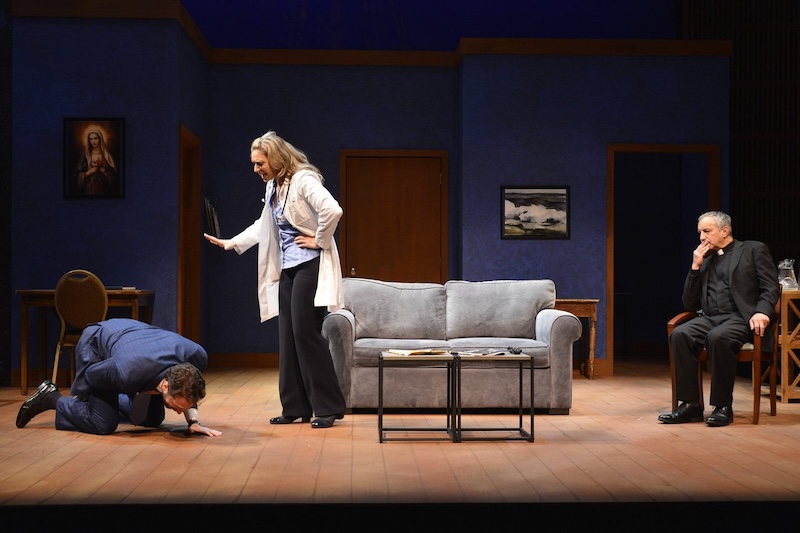
Elias Scoufaras, Anna Van Valin, Bruce Nozick (Photo by Jordan Gohara)
Reviewed by Steven Leigh Morris
International City Theatre
Through May 17
RECOMMENDED
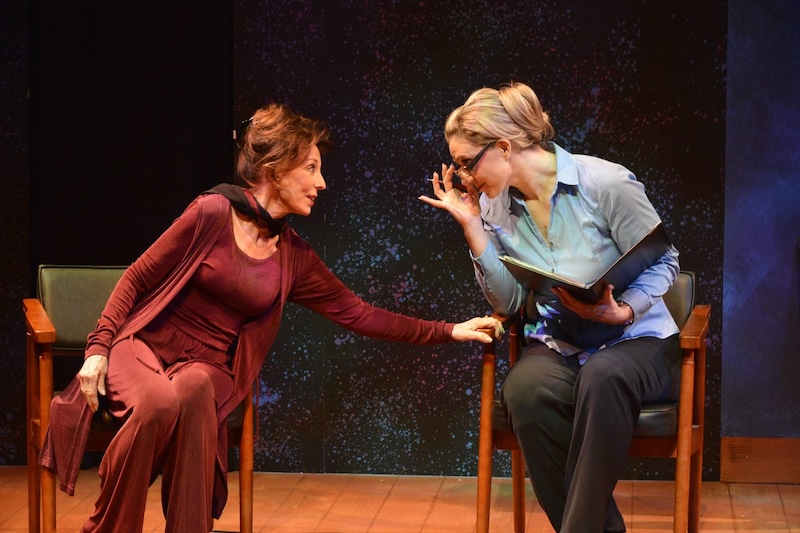
Suzanne Ford and Anna Van Valin (Photo by Jordan Gohara)
Centering on the theme of forgiveness, Paul Webb’s new play casts a very wide net, starting with the testy interpersonal dynamic between a hospital’s physician-in-residence, Rachel (Anna Van Valin) – she’s Jewish, working in a Roman Catholic hospital where the drama is set – and her ex-fiancé, David (Elias Scoufaras), who, to her annoyance, will not let her go. He regards his own behavior as devotion; she, as stalking. The seed within this pit is Rachel’s brother, who ended his own life for reasons that (this being a new play) I’m not at liberty to disclose. She, however, blames her ex, who counseled against giving her own money to her charismatic, generous, yet dissolute brother. She followed that advice, and now she blames David for her brother’s death. The dynamic is a familiar yet important one: Those who feel self-loathing take it out on those closest to them.
David has had a privileged life as a kind of investment broker, which Rachel now connects to the corrupt American medical industry in which she’s employed. She’s blind to the distinctions between people’s often sordid professions and their sometimes-redeeming qualities – in David’s case, a public-minded generosity that Rachel has failed to recognize. Playwright Webb’s determination to slice into the thick skin of stereotypes is what gives his play its character and redeems it in much the way that it redeems David.
The play unfolds mostly but not entirely within the reception area of the hospital in Brooklyn, in 2001, where Rachel is tending to a 72-year-old woman from Poland, Krystyna (Suzanne Ford). While driving, Krystyna’s car was struck by a massive semi-truck and she was rushed to this hospital’s emergency room. Rachel prescribed medication designed to stabilize Krystyna’s vital signs by putting her into an induced coma. The doctoring happens mostly off-stage, since Krystyna is comatose, yet there are dream sequences involving the unconscious Krystyna and a shrink named Doctor Corcoran (also, by design, played by Van Valin), wherein Krystyna recollects the German Nazi occupation of her homeland and her native city of Warsaw.
She eventually emerges from the coma, to be greeted by the guilt-laden truck driver bearing flowers for her – a gay man named Nicolas (Spencer Del Carmen). The gay truck driver is another example of a stereotype upended. Though it would likely be argued on Newsmax and Fox that because of the accident, gay men shouldn’t be driving large trucks – the kind of reasoning that’s drummed up by bigots and pedants. And, to be fair, on the other end of the political spectrum, Rachel’s capacities for such conflation are not so different.
Nicolas is so forlorn by what he did, Krystyna winds up comforting him. Talk about forgiveness.
The play’s one remaining character, Klaus (Bruce Nozick). who appears throughout, is the hospital’s Catholic rep, a would-be priest who studied in a seminary but was never ordained; still, he got a pass by the Church and hospital admin to wear “the collar” in this hospital situation. Klaus is 80 and looks 20 years younger – that’s in the play – which raises the specter of Klaus having been in Warsaw in 1945, and having known Krystyna in that time and place, and having treated her poorly. Upon her emergence from her coma, she recognizes him instantly. Forgiveness?
The sheer coincidence of all this is a bit hard to swallow, albeit remotely possible. It is a small world, after all. And, until recently, New York was always a destination for the persecuted. If Klaus can get a pass for his would-be priesthood, playwright Webb deserves one for this somewhat contrived meeting of a pair from another continent and an earlier century.
He does not get pass, however, for the cloying sentimentality that closes his drama. I won’t dwell on that.
Director caryn desai (sic) stages a production so serviceable that engagement in the unfolding story never wanes. The production’s highlight is Ford’s distinguished performance as Krystyna, a woman who comports herself with elegance, kindness and the wisdom of somebody who has grown spiritually from a life of travails. Also, Scoufaras conveys David’s exasperation and, to a lesser degree, his masochism in his relationship with Rachel, whom he treasures, despite her unrelenting expressions of contempt for him – until, that is, she comes to her senses. Forgiveness. Were they to wed, I have no idea how their married life would unfold. And that mystery is a credit to Webb’s writing, in conjunction with the performances.
Destiny Manewal’s set features an icon of Mother Mary, who watches the play from a hospital wall as we do from the theater’s seating banks, with a kind of wistful sadness and lingering hope.
International City Theatre, Long Beach Convention & Entertainment Center’s Beverly O’Neill Theater, 330 East Seaside Way, Long Beach. Thurs.-Sat., 7:30 pm, Sun., 2 pm; thru May 17. InternationalCityTheatre.org. Running time: Two hours and 15 minutes, including intermission.