
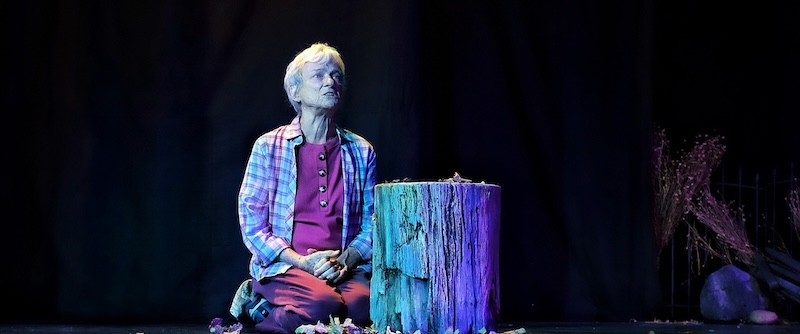

Anne G. Byrd (Photo by Cooper Bates)
Reviewed by Madison Mellon
24th Street Theatre
Through October 25
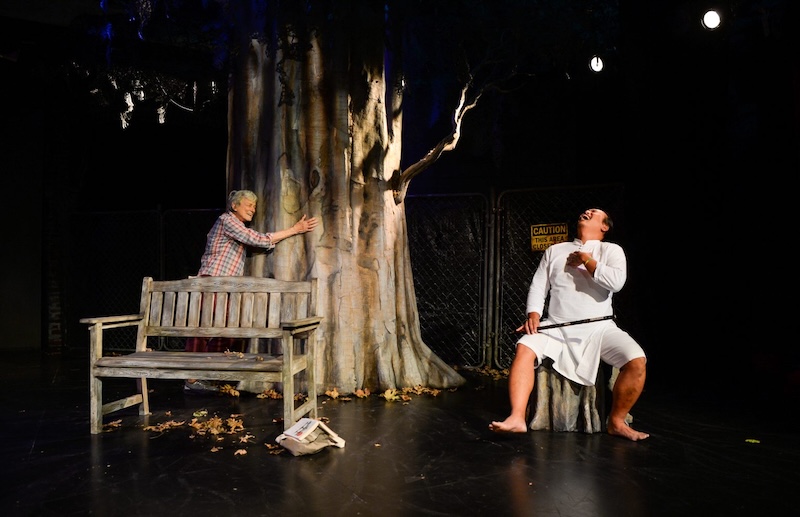
Anne Gee Byrd and Shih-wei Wu (Photo by Cooper Bates)
It can often be difficult to find stories that are truly “family theatre”—appealing to younger audiences without talking down to them, while remaining thoughtful and engaging enough for adults. In this regard, Winter’s Bench, Mike Kenny’s new play at 24th Street Theatre, does succeed. It is a meditative piece focused on memory, aging, and the cycle of life and renewal, with poignant moments and an excellent central performance by Anne Gee Byrd. However, much like its central character, who spends most of the play sitting in a park, Winter’s Bench seems content to present ideas without truly going anywhere with them, leading to a somewhat static experience.
Directed by Debbie Devine, Winter’s Bench follows Gladys (Byrd), an elderly woman who returns to an abandoned park to visit the tree she believes spoke to her in childhood. Sitting beneath its branches, she recounts memories of her difficult upbringing, hoping to once again hear the tree speak to her.
Byrd’s performance truly anchors the piece. At 88 years old, she is remarkably dynamic, creating a Gladys who is prickly and curmudgeonly but also someone you deeply want to listen to and empathize with. When she gets lost in recounting her past (falling from the tree as a child, or terrorizing her brother with the story of Hansel and Gretel), Byrd makes these memories feel immediate, allowing glimpses of the strong-willed child Gladys once was to emerge through the older woman.
But even Byrd’s compelling performance can’t overcome the slowness of Kenny’s script. The play repeatedly suggests avenues of inquiry without fully pursuing them. The park appears closed and the tree marked for removal, but this is never confirmed or elaborated on. Gladys has been absent for some time, yet we never learn why she stopped coming to the park or what prompted her return. We hear of her consistently rocky relationship with her brother without ever learning what became of him. When her mother returns from a stay in a mental hospital and the family briefly unifies beneath the tree, it suggests a possible turning point, but we never discover whether anything really changes in their dynamic.
The issue isn’t whether or not all of these questions demand answers. Rather, the number of unexplored paths creates a sense of dramatic stasis: the play seems poised to dig deeper into Gladys’ memories and how they might complicate her understanding of her life, only to transition to another recollection. Gladys begins the play with a fairly clear-eyed understanding of her childhood, and that understanding remains largely unchanged.
The production elements are strong. Keith Mitchell’s scenic design and Dan Weingarten’s lighting create an atmospheric park, with the tree serving as a compelling central image. Shih-Wei Wu’s live flute performance representing the spirit of the tree, is beautifully played and gives the production a unique aural texture. The graphic and video design (Eve Mazarra and Matthew Hill, respectively) is less successful: its constant movement is distracting at times, while imagery illustrating Gladys’s stories often feels overly literal.
There is a satisfying moment of catharsis near the end, wherein Gladys has a sense of closure and rebirth. But that doesn’t entirely compensate for the sameness of the journey there. While Winter’s Bench is a sensitive character study that
examines how people process the complexities of childhood as they age, it remains at one tempo for too long — almost on the verge of a transformation or discovery that never fully occurs.
24th Street Theatre, 1117 West 24th Street, LA. Sat., 8 pm, Sun., 2 pm, Monday Sept 7 and 14. 8 pm; through October 25th; www.24thstreet.org. Runtime: one hour with no intermission.