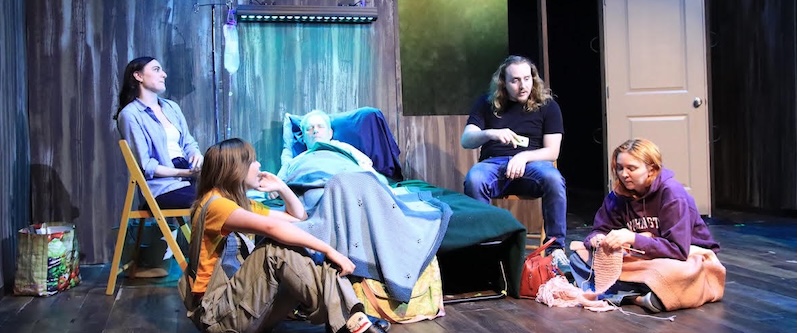
Sam Jones, Lauren Miscioscia, Bill A. Jones, Dakota Klein and Shawnee Badge (Photo by James Hall Photography)
Reviewed by Joel Beers
The MAIN, Newhall
Postponed due to fire damage
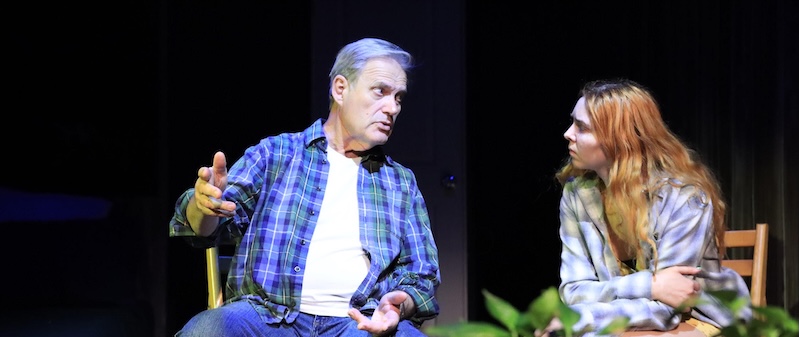
Bill A. Jones and Shawnee Badger(Photo by James Hall Photography)
The Monday following opening weekend of a theatrical production is usually a time to exhale and begin recharging for the performances a few days to come. For the cast and crew of You Got Older there would be little time for either. Less than 10 hours after Sunday’s matinee ended, a three-alarm fire tore through historic downtown Newhall, destroying The MAIN theater and several neighboring businesses.
The show has been postponed until another venue can be found.
While nothing in Clare Barron’s 2015 Obie Award-winning play has to do with disasters (unless they’re the emotional kind) — and nothing in a theatrical production can match the real-world heartbreak and devastation of an arts center and adjoining small businesses being burned to the ground, there is cruel irony in the connection between the play’s ending and the disaster that followed its opening weekend.
At the end of the play, its central character, Mae, who has spent much of the story thoroughly unhappy, steps into her Minneapolis apartment and tells the audience that, for the first time in a long time, she feels happy.
And then the world suddenly turns upside down again.
By Monday morning, the people who had just told that story were living through their own version of it in a way none could have imagined.
“You Got Older” follows Mae, a 32-year-old Minneapolis woman whose life has fallen apart after losing both her job and her boyfriend. She returns to her small Washington hometown to help care for her father, who is undergoing treatment for aggressive throat cancer. As Mae navigates her father’s illness, her sibling relationships, and her own desperate need for intimacy, reality begins to blur, segueing into bizarre dreams and fantasies, including encounters with a mysterious cowboy. Darkly comic, tender and frequently unsettling, the play explores family, illness, loneliness, sex and the messy process of figuring out how to move forward when adulthood doesn’t turn out quite as planned.
The play received rave reviews when it opened in 2015, earning Clare Barron an Obie Award for playwriting, and it has continued to attract praise, including a 2026 revival. But while its tonal shifts can be effective this production — never quite generates the necessary oomph.
Some of the problems are inherent in the play and can’t be solved by direction. Foremost among them is Mae herself. Shawnee Badger has good comedic timing, makes Mae interesting and gives us a genuine sense of her struggles. But she also has a difficult assignment because, despite being the protagonist, Mae isn’t particularly likable. She is super-horny but twice sabotages potentially promising sexual encounters for reasons that aren’t entirely clear. She also gets into a shouting match with her father shortly after he has undergone major throat surgery, and spends much of the play combative, unhappy and seemingly determined to remain miserable. It’s difficult to pull for her, which makes her eventual revelation that she is finally happy feel more forced than earned.
Renato Biribin ‘s staging also has its issues, most notably several scene changes that are accompanied by lengthy blackouts that interrupt the momentum and could stand to be shorter.
The real strength of Barron’s writing isn’t the plot or even the characterization so much as the accumulation of strange, specific details: Mae’s father’s observation that the family’s gum problems may have something to do with the clan’s mouth acidity; a character’s peculiar fascination with bodily pus and scabs; the comic interplay surrounding the family’s odor. These details are funny, occasionally grotesque, and oddly revealing. They suggest a family that has become so accustomed to the indignities of the body that even disgust becomes a form of intimacy.
More interesting still is the dichotomy between Mae’s external and internal realities. On the surface, she seems to be anything but a control freak. Her father (Bill A. Jones) is somewhat doddering but fundamentally kind. Her siblings appear to have no great grudges against one another and get along fine. Even Mac (Kyle Sparks), the man Mae hooks up with, seems like a decent guy, despite his rather unhealthy fascination with pus.
Yet Mae’s fantasies are about being dominated and controlled by a cowboy, played with considerable effectiveness by Ryan Shrewsbury, who looks and sounds as though he wandered out of a Sam Shepard play. The obvious explanation is that someone who fantasizes about surrendering control must be tightly controlling in real life. But Mae doesn’t really fit that description.
Maybe that’s not the point. Mae’s problem may not be that she needs to relinquish control, but that she feels she has so little of it. Her career is adrift. Her romantic life is a mess. Her father’s illness has upended the family. She doesn’t know what comes next. Her fantasies offer a place where, paradoxically, surrendering control might finally allow her to feel in control of something.
That’s a much more interesting character than the one the play sometimes gives us — and it’s one reason You Got Older lingers even when its larger dramatic machinery doesn’t quite click into place.
The MAIN, 24266 Newhall Blvd., Santa Clarita. Production postponed until alternate venue found. www.atthemain.org.