

The Stresses of Aging
Taylor Swift, Alretha Thomas, and the Art of Remaining True to Oneself
By Avery Eletto

This essay is part of the Stage Raw/Unusual Suspects Youth Journalism Fellowship
I’ve always loved Taylor Swift.
Her authenticity no matter the cost, the role model she became for young women, and, most of all, her utter lack of care for men’s opinions of her.
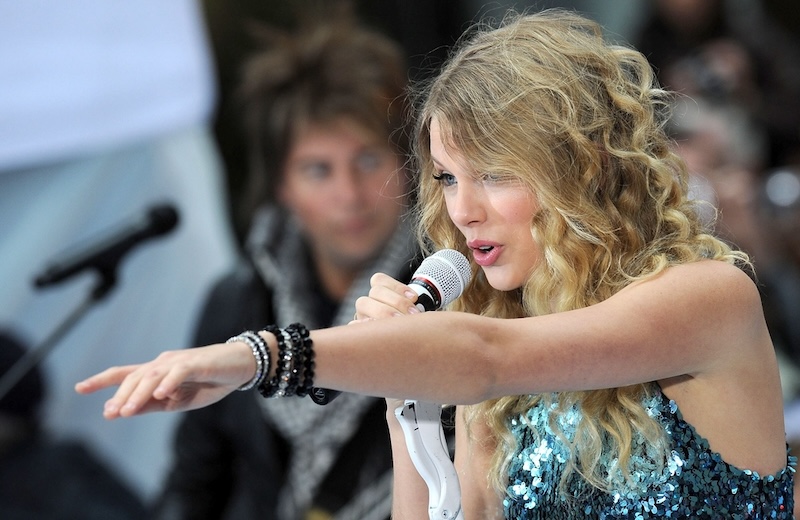
A year ago, if you’d asked some guys what they thought of Taylor Swift, they’d have launched into a monologue with all the wrath and righteousness of Othello’s soliloquy just before he kills his wife. But if you stopped to wonder where these men’s anger came from, you’d realize it’s rarely the music they took issue with. It was the fear of accountability she represented. There were middle school boys and grown men alike who squirmed as she narrated her own story. This discomfort prompted them to slut-shame her with mean-spirited (à la Kanye West) mansplained corrections that never stopped her from creating powerful art.
That is. . . until the last album, The Life of a Showgirl, when she proved them all right.
This formerly independent woman, now commonly known for her relationship to football star Travis Kelce, has replaced her once-nuanced lyrics with faux sexually liberated clichés. She has gone from profound storytelling of early songs like “Cold as You” in 2006 (“You come away with a great little story / Of a mess of a dreamer, with the nerve to adore you,”) to this year’s hollow provocation of “Wood” (“His love was the key that opened my thighs.”)
I attribute aspects of this shift to the rise of celebrity Sabrina Carpenter – featured on Swift’s album – who, much like Swift once did, has equally entertained and enraged audiences everywhere. But Carpenter’s hypersexualized lyrics come from a place of genuine liberation and self-aware humor. When Swift attempts this style, though she claims it’s experimentation, it feels like an anxious attempt to keep up with a younger generation, even at the expense of her previous passion.
This isn’t the only trend Swift lags behind in Showgirl. She also attempts to implement Gen Z slang (“fire,” “girlboss too close to the sun,” “trolling”) which sorely sticks out among stronger lyrics which echo her earlier work. These tonal shifts not only clash but compromise her rare flashes of authenticity.
Swift fears going out of style (pun intended) now that younger artists have taken the stage. This awakens a persistent concern in me as a young creator: Is there space for more than one generation of successful female artistry in the harsh entertainment industry?
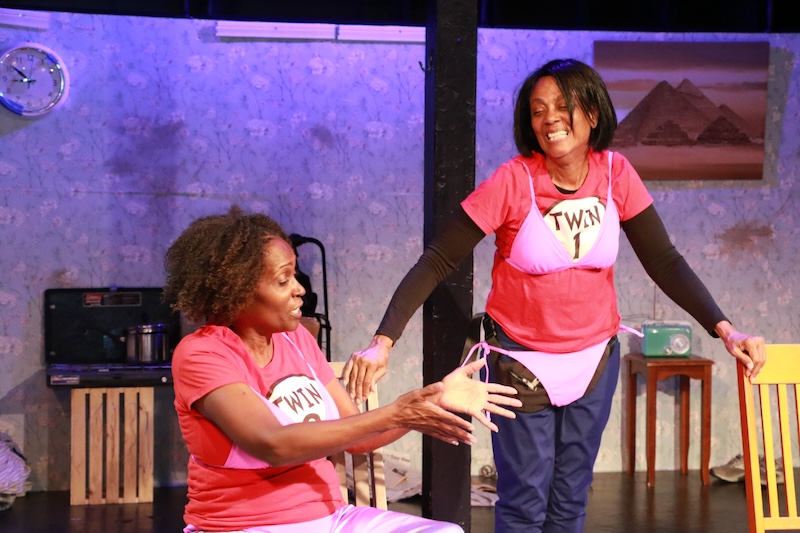
Marlynne Frierson Cooley and Alretha Thomas (Photo courtesy of Alretha Thomas)
My question was answered weeks ago while watching A Girl’s Guilt Trip at the Hudson Backstage Theatre (recently closed). The play centers around childhood friends Yolanda (played by Alretha Thomas, also the playwright and director) and her childhood best friend Roberta (Marlynne Frierson-Cooley). When we meet the pair, they have run away from Roberta’s abusive husband to squat in an abandoned house, but dream of going on vacation to see the pyramids in Egypt. The play marks the return of Thomas —seen on Tyler Perry’s Assisted Living— to the stage after a 32-year absence. The lead actors are both well above 50 and use their age as fuel for their performance rather than a weakness.
The terrific performances by Thomas and her counterpart, Cooley, are raw and real. Years of craft, life experience and an earnest acceptance of their identity ground the show and help the audience not only follow but truly connect with the characters.
A major part of the story is a character’s struggle with mental health. In pop culture, when mental health issues are brought up around older women they are made into crazy people and sympathy is crippled by this perception. But by humanizing these women and showing that resilience remains throughout maturity, the production was able to reveal the depths of humanity that surface-level stereotypes gloss over.
The show itself was not perfect; it contained sudden tonal jumps throughout a single conversation with little segue. Still, the heart of the play was undeniable: You could feel passionate love behind every word. It reminded me that even if something isn’t perfect, audiences will adjust their expectations-or their hearing aids-to your style so long as your art is made with love.
This lesson brought me back to Swift. She has years of experience and infinitely more resources than this low-budget play in a small North Hollywood theatre. The Life of a Showgirl is ultra-commercialized and built for profit like a dollar-store medley of today’s Top 40. A Girl’s Guilt Trip is passionate, not for the money but for the love of the work-a creation for creation’s sake. And that’s exactly what art should be.
Art was never meant to be measured in ticket sales, streams, or dollars made. Art is meant to make us feel and connect. If your truth as an artist is packaged in the fabricated branding of who the industry wants you to be, you will never achieve that recognition. It is impossible to relate to a lie.
This article is not an attack on Taylor Swift, nor male critics, nor singers such as Sabrina Carpenter. It is a critique on the idea that female artistry has an expiration date. That once a woman reaches a certain age or level of fame, she must put herself at the mercy of the male gaze or reinvent herself for profit.
Actually, I love Taylor Swift. Her submission to social norms will not change that. Her magic has always been embedded in her hunger to create and her ability to connect women through shared stories. Despite all of my criticism of the album, I loved going to the album’s debut at an AMC movie theater and watching the girl across from me radiate smiles as she saw her hero perform.
I do not require perfection-only honesty. No matter the age, the one thing the world shall never strip from our celebrities is the love of creation that got them where they are today.
I am only a fan encouraging an artist to sing her story again. There is room for all women and all experiences, and I look forward to hearing her old tunes of honesty on the radio again.
“Being true to yourself never goes out of style” — Elle Woods, in Legally Blonde