
Unsaid Words and Unsung Heroes
A Teen Responds to a Play about a School Shooting
By Maribelle Hoffa
This essay is part of the Stage Raw/Unusual Suspects Youth Journalism Fellowship
I saw GUAC by Manuel Oliver (co-written by James Clements) with my mom. She was the perfect companion; squeezing my hand, sharing giggles, calming my pre-show anxiety about not being let into the theater because I was convinced the box office most definitely lost my tickets. (They most definitely did not.) After the show, she asked what she assumed would be a simple question.
“What did you think?”
And I couldn’t speak.
I couldn’t possibly muster any words to appropriately communicate the pure importance of that show. I, who always took pride in my ability to interpret art, could only stammer and sputter unintelligible consonants before blurting out the truth:
“I’m speechless.”
But I knew I couldn’t leave it there. Deep down, I knew my lack of words was more dangerous than if I had said literally anything else. History has shown time and time again what happens when words go unspoken, when issues are deliberately avoided. So, I decided to sit with my thoughts, however heavy they may be, for a few hours. Soon, I came to the conclusion I should try to start with the only thing I was 100% certain about: my astonishment.
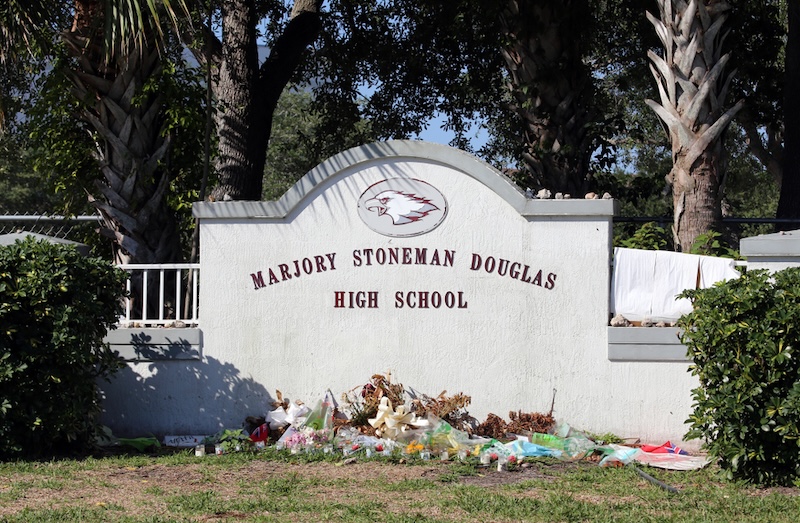
Playwright Manuel Oliver played himself in this one-man show as he recounted and remembered the tragic loss of his son, Joaquín “Guac” Oliver, who was killed in the 2018 Parkland mass shooting. He made it clear from the very beginning that this wouldn’t be your typical night at the theater. In fact, he invited audience participation and… get ready for it… the use of cell phones. He encouraged the audience to take as many photos and videos as they wanted, especially if they shared them with the world. That was his mission. To share Joaquín’s story.
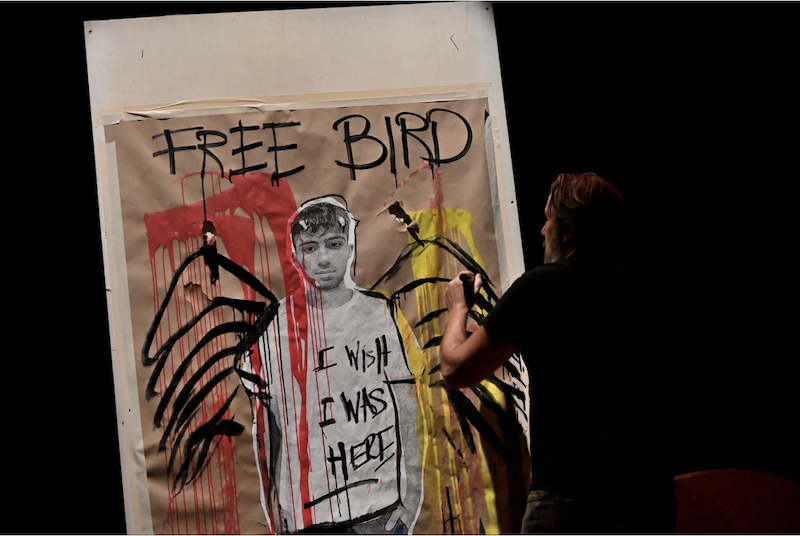
Manuel Oliver in “GUAC” when it was performed at the Public Theater in New York (Photo by Donna Aceto)
One of the most touching moments of the show was around midway through, when Oliver recalled the last conversation he had with his son. It involved Oliver shouting out of the car as Joaquín walked into school, reminding Joaquín to “call him.” As Oliver described this interaction, he urged the audience to take out their cell phones and call their loved ones, right there in the theater. The audience hesitantly took out their phones and called their mothers, fathers, spouses, and children. My mom and I looked at each other and smiled before we took out our phones and texted each other “I love you.” At that moment, I felt so close to her — and to the strangers behind me, as I overheard their phone calls. It’s not often enough that we call our loved ones to merely tell them that they are loved, and Oliver reminds us the importance of doing so because after all: time is fleeting.
His performance resonated so powerfully with me because it was barely a performance. His charming, vulnerable personality made a scripted piece feel more like a tragically honest conversation with a close friend. Oliver even admitted out loud that he really isn’t an actor, as he pointed to the cue lines taped to the ground beneath him and laughed. “Missed that one,” he joked. “Don’t tell my director.” His director was Michael Cotney, whose confident leadership shaped thebeautiful authenticity of the performance.
Manuel Oliver made me laugh. He made me cry. He made me feel so much, so fast, and so explosively. So why couldn’t I just say that when my mom asked for my thoughts? Why did I have to sit alone in a Starbucks for an hour, staring at a blinking cursor to know that’s how I felt?
Maybe because it was much easier to say, “I’m speechless,” and assume that the rest of my thoughts were automatically accounted for. That way, I could excuse myself from the difficult conversation I didn’t have the energy for while still remaining apparently sympathetic. I know I’m not the only one guilty of this. Our tendency as humans is to summarize. To take the human experience and try to encapsulate it in one sentence. We see injustice so we “send hugs!” and repost statistics on Instagram instead of having the difficult conversations necessary. We think our lack of words somehow speak for themselves. The truth is, they don’t. And in the environment that Manuel Oliver reminded us we live in, it’s getting harder to pretend like they do.
If you live anywhere in the United States and have stepped outside once within the last ten years, you know about the continuous, looming threat of gun violence in our country. You know that most public institutions have heavy security and metal detectors, you know that stores like Jansport or Target sell bullet-proof backpacks, and you know that there are far too many people that have had to suffer the consequences of such atrocities.
It’s gotten to the point where we receive bad news about gun violence so frequently that we have become desensitized to it. Many of us simply receive the news on our social media pages and have the option to just scroll past it and carry on with our lives. So we do. Because yeah, it’s easier.
But what would happen if we lingered on that video, even for a moment? Well, then we’d have to face the unbearable truth of the situation: that these victims are innocent people, that they are often children, that their parents are grieving, and that, somehow, our country allows this to keep happening. And then we would feel sad and angry at the world, and that’s an awful feeling to have, so why not just save ourselves from that feeling and scroll?
It’s not thoughtful. I know it’s not. But you’d probably be lying if you said you’ve never done a similar thing. I know I have. And the worst part is that half the time we don’t even realize we’re doing it. But the truth is that every tasteless “thoughts and prayers!” thrown at a crisis only gets us further away from honest feelings and legitimate solutions. Shows like GUAC remind us of the true villainy of such solutions being ignored by our government; that until we are blessed with such solutions, we can do our part as humans and as artists to help mend each other through our deeds and through our art.
According to his father, Joaquín was a skilled air-guitarist. It was a recurring theme throughout the show, and it made its final appearance at the end. Rock music started blaring, and before I knew it, Oliver was urging the audience to stand up and do their own air-guitar playing. As this was happening, videos of Joaquín started playing on the projection behind Oliver. Candid, beautiful videos that showed a kind soul and such a shining smile. And yes, of course, it was sad. How could it not be? But it was also restorative. I couldn’t help but beam and shred my air-guitar as hard as I could, especially as I watched Oliver do the same thing on stage, below his beautiful, beautiful son. Soon, the audience dropped their air-guitars and clapped for Oliver as he took a final bow and left the stage.
And for at least five seconds, nobody moved. He wasn’t even on stage anymore. But we all kept clapping, staring at his now-empty spotlight, and that video of Joaquín. Nobody looked for the exit, nobody bent down to pick up their belongings, nobody wanted to leave. And listen, I generally hate to make blanket statements like the one I’m about to make, but it filled me with such hope. Because one person was able to unite a room full of people by simply sharing a story. His story.
Manuel Oliver’s GUAC was performed earlier this year at the Kirk Douglas Theater in Culver City