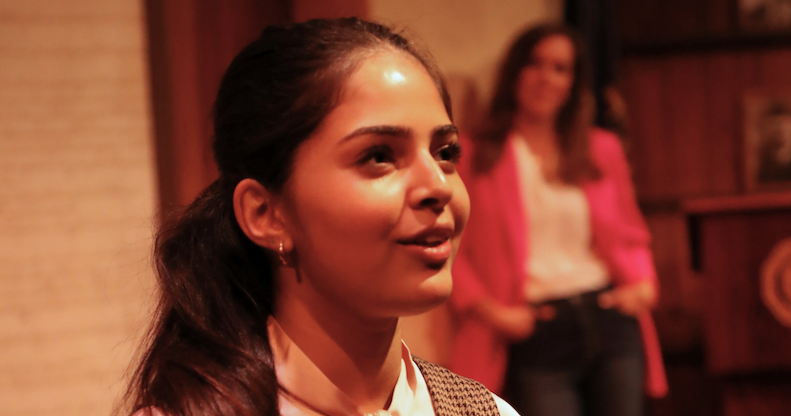

Reya Shah and Aubrey Saverino in “What the Constitution Means to Me” at Chance Theater. (Photo by Doug Catiller)
Whose Business Is the Constitution?
A teenager reflects on Heidi Shreck’s play about one of our founding documents
By Mar Mar Hernandez
This article is part of the Stage Raw/Unusual Suspects Youth Journalism Fellowship
Stepping out of the Chance Theatre after seeing What the Constitution Means to Me, a chill washed over me. Not due to the cold, but because I was frozen. Since my first interactions with live theatre, I have noticed that most of the shows I attend allow me to forget the world and the life I left behind the lobby doors. To quote the Emcee from Cabaret, each performance seemed to tell me to “leave [my] troubles outside.” They whisked me away from the world I once knew, where problems seeped into the crevices of everyday activity, overshadowing the other aspects of my life. This seemed to be a reoccurrence, until that night.
Playwright Heidi Schreck’s autobiographical, semi-one-woman show brought life and perspective to an otherwise overlooked federal document: The Constitution of the United States. Schreck’s story, related in monologues by her zealous 15-year-old self (Aubrey Saverino) paints the information like a picture to be seen through the lens of child-like enthusiasm. Through these monologues, though lain with numerous digressions, Shreck delivers the unacknowledged history behind such issues as women’s reproductive rights with vibrance digestible to the average audience member. She connects her own experiences with abortion and personal family history to different amendments and sections of the Constitution. In using these perspectives, Shreck enlightens the audience on issues concerning other minority groups, such as immigration policy, that were otherwise excluded from the original draft of the federal document.
Saverino, the powerhouse of an actress she is, is willfully supported by two other characters: the Legionnaire (Robert Foran), who, outside of Heidi’s dream-like sequence of the debate hall, brings to light the effects of toxic masculinity on his childhood in a sincere, raw monologue. Later on, a debate is held between Saverino and youth debater Maria Wang (Reya Shah). The story behind the debater, a teenager, is illustrated in her speeches and statements, expressing elation when talking about the possibility of making change in her community and her country.
Both characters usher in their own perspectives and understandings of the environment they inhabit, as well as giving the audience insight as to their future capabilities.
I especially enjoyed the tight-knit community of theatergoers at the Chance Theater. Following the performance, a Q&A session was held, with immigrants and visitors from out of state, and locals and regulars from all walks of life seemed to unanimously open to discuss what the Constitution meant to them. They seized the opportunity to voice their own opinions and perspectives about what they liked and wanted to know. Though the actors remained onstage and the audience in their seats, as the conversation went on, the partition of the fourth wall ceased to exist. This served as a reminder that we collectively and individually have voices that deserve to be heard, and perspectives that deserve to be taken into consideration.
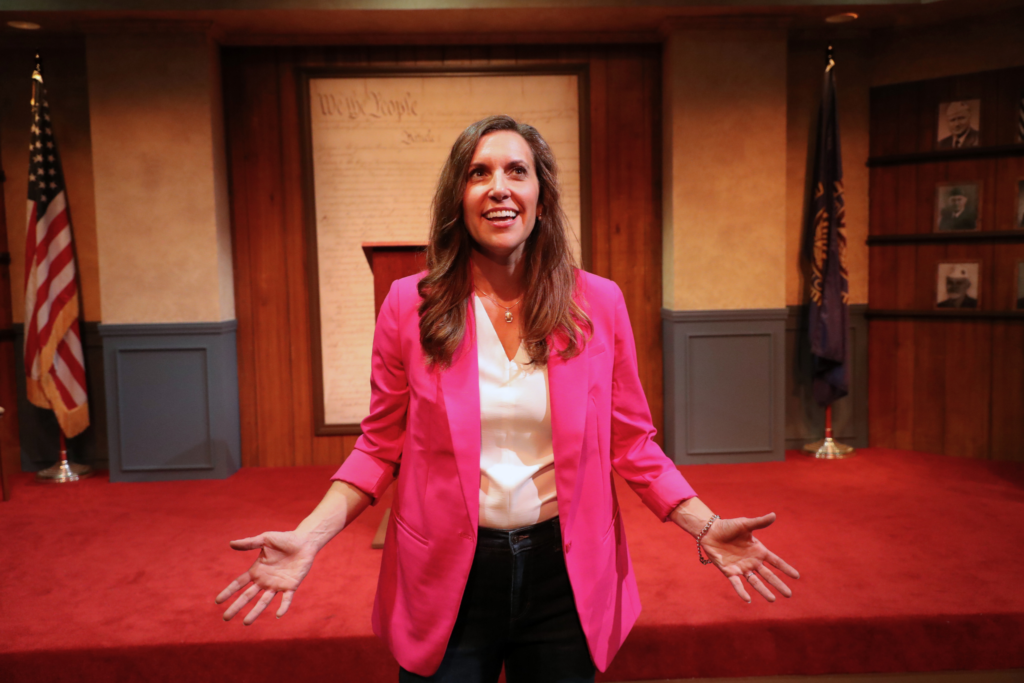
Aubrey Saverino in “What the Constitution Means to Me” at Chance Theatre(Photo by Doug Catiller)
What the Constitution Means to Me leaves us with the insight of how much our lives are directly affected not just by federal documents and laws, but of their current effects. For example, when simulating the constitution-centered debate competitions she had participated while younger, Schreck’s character details Section One of the Fourteenth Amendment, which states that “All persons born or naturalized in the United States … are citizens of the United States and of the State wherein they reside.”
She heavily emphasizes the use of the word persons as opposed to citizens, granting birthright citizenship to the children of immigrants. It’s no secret that the ruling on birthright citizenship is being attacked by the current administration, nor is it a secret how the people in said administration feel about immigrants as a whole. This very detail is precisely what disallowed me to “leave [my] troubles outside,” but rather bring them in with me and better understand them.
A crucial detail I failed to mention: Attending with a friend holding differing politics, the production opened up a conversation for the both of us. Though our divergent beliefs never got in the way of our relationship, after seeing this show, freezing up in the cold of the night, I could not contain my excitement over what I had just seen.
The way I explained the feeling to my friend included how “[Saverino] made politics and social justice feel like I could do something about it.” These words, being the only thing I could think of at the time, put her off. For context, a constant argument we found ourselves coming back to involved the question of whether the issues we heard about on the news or that are being ruled on affected us, and if they did, whether we could do something about it or not. Being teens, we understood our limits in having a voice, seeing as we couldn’t vote or run for office. Whenever this subject was discussed, we always circled back to whether it was our problem or not. My friend couldn’t understand why it should be our problem if there are elected officials who get paid to “have it be their problem.”
“Not necessarily like it’s my problem,” I explained to them, “but more like I had a voice. [The play] made it feel like I had an important perspective that I shouldn’t be shrugged off. Like, I can say something and have it matter.”
“So what does the Constitution mean to you?”
This question, like the show itself, made me freeze up again. I didn’t know where to begin, or what to say to sound educated enough to hold up my end, so I instead said nothing, which I still regret to this day.
In truth, I’ve put off writing this article because of that: I never really knew what to say. I had the thoughts, I had an idea, but the execution, the phrasing, these are things which I believed couldn’t be perfectly produced. I admit that I had been afraid to say something out of my own words, without posting somebody else’s repost because I felt it was more effective than anything I had to say. I feared it wouldn’t be perfect, or that I’ll say something wrong. I remembered fearing nobody would see it, that nobody would understand how much it hurts to see what’s happening out there, knowing that all these innocent people are dying because of something they cannot control.
All of this to say, in a time when everything felt confusing, where I felt like my voice and my actions had no power, being in attendance at What the Constitution Means to Me changed my perspective. It taught me that not only does what I have to say have value, but our different perspectives, our different stories can make us stronger. With its perfect balance of comedy and truth, Schreck, both the playwright and the character, informs us that our most human experiences are worth protecting, much like the rights that our Constitution grants us, or is meant to. I think it’s imperative to share this story now, especially when the freedoms the Constitution grants are threatened by people currently holding office. Even so, it’s important to remember that even the smallest bit of covert resistance can make the biggest difference if we fight for it.