
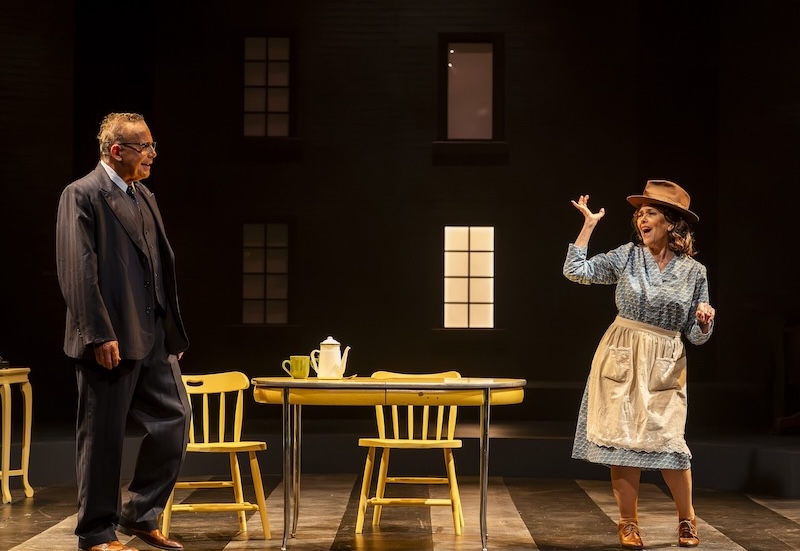

Geoff Elliott and Deborah Strang in “Death of a Salesman” at A Noise Within (Photo by Craig Schwartz)
Company Town
“Death of a Salesman” at A Noise Within; “Uncle Vanya” at City Garage
 A pair of companies emerged in Southern California when the 1980s were sliding into the 1990s: In Santa Monica, a troupe largely but not exclusively devoted to European classics, City Garage, opened its doors in 1987. Four years later, a classical repertory company devoted to all manner of theater classics, A Noise Within, set up shop in a 99-seat theater four flights up a stairwell inside Glendale’s empty Masonic Temple. Their challenge was to build a stage around the venue’s church pews.
Both troupes have shuffled around their respective regions: City Garage, at a few Santa Monica venues before settling into a 40+ -seat theater at Bergamot Station, where it’s been headquartered since 2010, with company members, many of them novices, recruited from local burgs.
Meanwhile, A Noise Within, restlessly seeking a venue that was perhaps on some ground floor rather than four flights up, tried to set up something symbiotic at the Luckman Fine Arts Complex on the campus of Cal State, Los Angeles in East L.A. This turned out, for them, something akin to swilling a heady brew of piss and vinegar. After bouncing back to Glendale, they engaged in a successful fundraising drive culminating in the building of their current digs, a sumptuous 324-seat regional theater on the eastern edge of Pasadena. Their actors, some of whom have been with them through the decades, hailed from American Conservatory Theatre in San Francisco, the Oregon Shakespeare Festival, and South Coast Repertory.
Both companies are headed by married couples: City Garage’s executive team consists of Frederique Michel and Charles Duncombe; meanwhile, the husband-and-wife team at A Noise Within, Geoff Elliott and Julia Rodriguez-Elliott have built an evolving, enduring institution, or at least as enduring as any theater can be in the 21st century.
There isn’t a single production at City Garage that I can recall that wasn’t directed by Michel. This is not necessarily a good thing, given the singularity of directorial vision; after all, they’re doing plays by an array of scribes, living and dead. It’s not as though she’s an interdisciplinary artist in the mold of the Wooster Group’s Elizabeth LeCompte, or, locally, Critical Mass’s Nancy Keystone, or Ghost Road Company’s Katharine Noon, where the plays themselves are extensions of, and sometimes written by, the director. Michel (Company Director) also designs all of the costumes, while Duncombe (Producer and Production Designer) designs the sets, and the lights, and the sound design, and almost always runs the lightboard — at least for all of the productions I’ve seen there.
Over at A Noise Within, Geoff Elliott appears as an actor in most productions (excluding those written by August Wilson), while Julia Rodriguez-Elliott directs a good number of the company’s productions. Contrasted against City Garage, A Noise Within affords some variations on these personnel tasks, which permits some fresh air to circulate around the rafters. Theirs is a model that mirrors the husband-wife team of David Melville and Melissa Chalsma over at Independent Shakespeare Company, where Chalsma’s main (but not exclusive) role is that of director, while Melville has appeared in almost every show.
It’s healthy when these companies, where leadership is so entrenched, sometimes simply fling open their doors. It’s high risk, given the costs of staging a production, yet if carefully handled, it can add texture to the company’s guiding vision that’s so firmly and sometimes oppressively established.
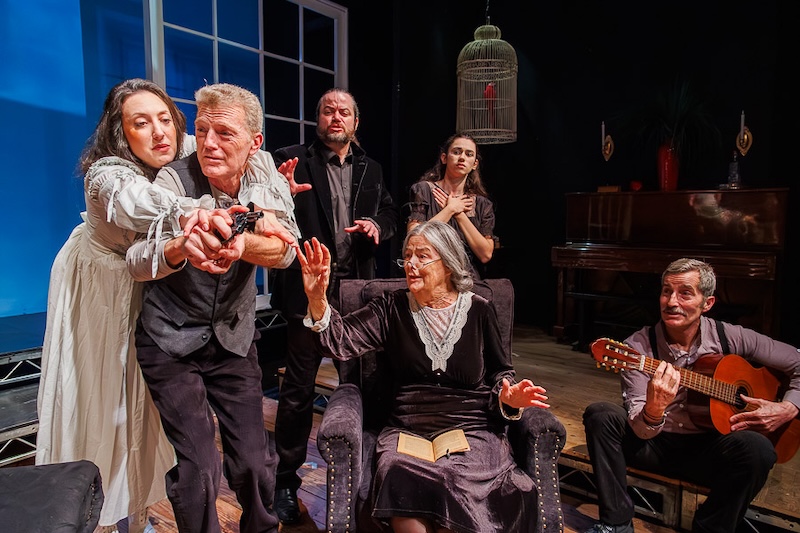
Angela Beyer, Troy Dunn, Taylor Lee Marr, Strawn Bovee, Anabela Nguyen, Ralph Radebaugh in “Uncle Vanya” at City Garage (Photo by Paul Rubenstein)
So here’s a review that contradicts this entire thesis, a just closed production of Chekhov’s Uncle Vanya at City Garage. (The play was capably adapted by Neil LaBute, who staged it himself in Vienna last year). Once again, Michel directed the production with a core of actors (Troy Dunn, Angela Beyer, Andy Kallok and Martha Duncan) who are ever-so-familiar to those who attend City Garage regularly. Yet it was as though Michel had been struck by lightning, a blow which compelled her to abandon her stock-in-trade pervasive production colors of red and black, of actors moving puppet-like with arch synchronized movement when it is often beyond their skill set to make such choreography appear effortless. (Now, to be fair, there has been a smattering of plays, by Eugene O’Neill and Charles Mee for example, where Michel has yielded to a kind of psychological realism, but it’s atypical for this company.)
In Uncle Vanya the production’s focus was on the psychological nuances circulating among the cluster of Russian provincials: Vanya (Dunn, idiosyncratic, unmannered, and as believably tortured as any character I’ve seen him play, struck me as some distant cousin of John Malkovich), Doctor Astrov (the endearing Taylor Lee Marr), and Yelena (Angela Beyer, whose inner flame was singeing her character’s suffocating prudishness). There was almost none of the kind of posing that’s become part of Michel’s house style, as though Michel had simply released the play to Anton Chekhov and to the torment that his characters are suffering. And when the deflated, resident academic, Serebryakov (Kallok) made his parting appeal to everyone in his presence, “Do something!” – rich, coming from a washed-up scholar who had spent his life doing nothing – it wasn’t some bludgeoning joke; the line reading flowed with a kind lunatic humanity, which is Chekhov’s calling card.
I also adored Anabela Nguyen’s Sonya, Vanya’s young, “plain” niece who appeals to everybody to simply stop the war — no, not the brewing Russian Revolution or the current War in Iran, but the war among this cluster of small people living at the edge of the world, and destroying themselves, each other, and their beautiful countryside (this is the first “modern” play that grapples head on with climate change) for no reason whatsoever. It’s not our war in Iran, but it’s a pretty good allegory for it, the pointlessness of the destruction. The impulse to destroy. This is a comedy about the end of the world, written on the other side of the world (Russia) at the turn of the last century. Geraldine Fuentes’s nurse/housekeeper Marina laughed out loud when realizing that the pistol used in Vanya’s murder attempt has gone missing, simply recognizing the absurdity of it all.
This is one of my favorite plays, and I expected this production to grate against my nervous system, because I love this play so much. It did not grate, however. Rather, it embraced with — to quote Sonia’s closing prayer — “the gentleness of a caress.”
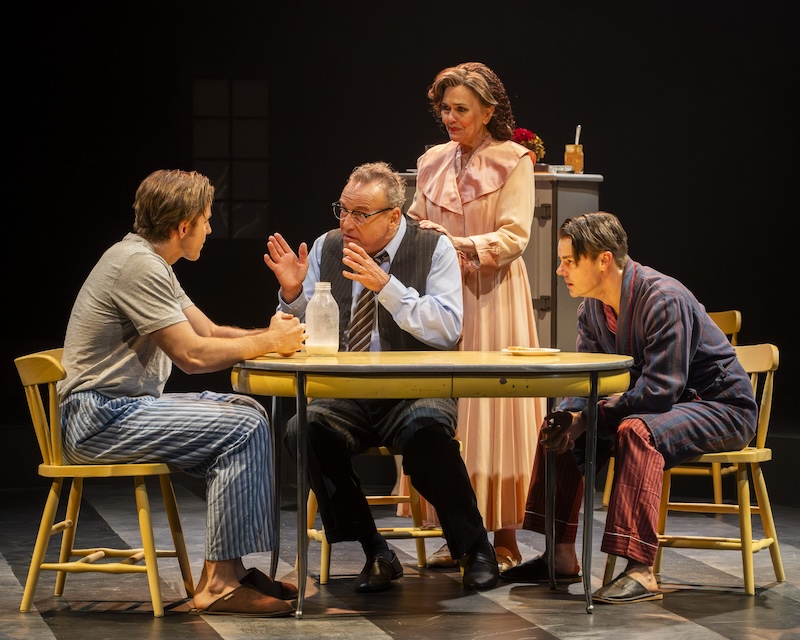
David Kepner, Geoff Elliott, Deborah Strang and Ian Littleworth in “Death of a Salesman” at A Noise Within (Photo by Craig Schwartz)
I defer largely to my colleague Deborah Klugman’s perceptive review of Death of a Salesman at A Noise Within. Yet we differ on a couple of points.
Julia Rodriguez-Elliott’s production comes rolling across the audience’s seating banks with crashing waves of melancholy, despite the horseplay of Willy Loman’s lost-as-sea sons (Biff and Harold, played by David Kepner and Ian Littleworth, respectively, both of whom I found to be excellent). The production also gave a physicality to the play’s hallucinogenic structure, allowing us inside the tormented brain of a salesman aching to persuade himself that his life is adding up, despite all evidence to the contrary, a blend of willful delusion and despondency.
The 1949 economy that playwright Arthur Miller was writing about simply wasn’t working for working stiffs like Willy Loman, who defined their worth by the value of their possessions and bank accounts. It was the robber barons squeezing the working class then; today it’s the tech bros. The shape of inequity is a constant. (Statistically, income inequality is far greater today, with the working poor holding two or three jobs and still unable to afford city rents.) With hope (sometimes called ambition), one strives to buy the stuff that relentless advertising tell us we deserve and are lesser people if we can’t afford it; with despair, one either surrenders or explodes. And that is the torment of the play’s second protagonist, Willy’s prodigal son, Biff, who, through the course of Willy’s 24-hour dream, comes to realize who he actually is, and that’s not “a leader of men.” (“If I strike oil, I’ll send you a check,” Biff taunts his father before leaving forever; “In the meantime, forget I’m alive.”)
And yet, there’s next door neighbor Charley (Bert Emmett); here, a shlub of a presence who does very well financially, while being passionate about almost nothing. (He’s financially generous to Willy, who he can see is tumbling.) Charley’s son, Bernard (Kasey Mahaffy, whom I also found as persuasive in his ingratiating youth as in his sensitive adulthood ) is the mocked school nerd who studies hard and winds up being a lawyer pleading cases before the U.S. Supreme Court. So there is an American Dream after all.
For this play, Miller was accused of being anti-American and a communist for critiquing the cruelties of unregulated capitalism and its firing of workers, however dedicated and loyal, for whom it has no further use. There is a scene showing just that; it’s a scene between Willy and his boss, Howard (Michael Uribes) who is the son of his former boss. “I named him Howard,” Willy later complains to Charley after Howard has fired Willy. “So what,” Charley replies: “You named him Howard but you can’t sell that. The only thing you got in this world is what you can sell. And the funny thing is that you’re a salesman, and you don’t know that.”
And yet, at least in 1949, in Miller’s play, advancement was possible. It can be argued that Miller was actually making a case for the American Dream, his critique of Willy’s two sons being that they didn’t properly apply themselves, or couldn’t. And yet Willy works like a horse, for them, and drowns nonetheless. Was he simply a crappy salesman? (Charley notes that all the other salesman he knows are getting killed in the current economy.) Or is he too busy “chasing the wrong dreams?” — as Biff puts it — dreams such as striking it rich in a diamond mine or working from home at the age of 84, like a salesman named Dave Singleman, whom Willy emulates.
Frederica Nascimento’s set features a backdrop of brick tenement walls that loom, and a center stage playing space with a wooden table and chairs, and a Hastings refrigerator that all emblemize the post-war era, handily complemented by Angela Balohh Calin’s costumes.
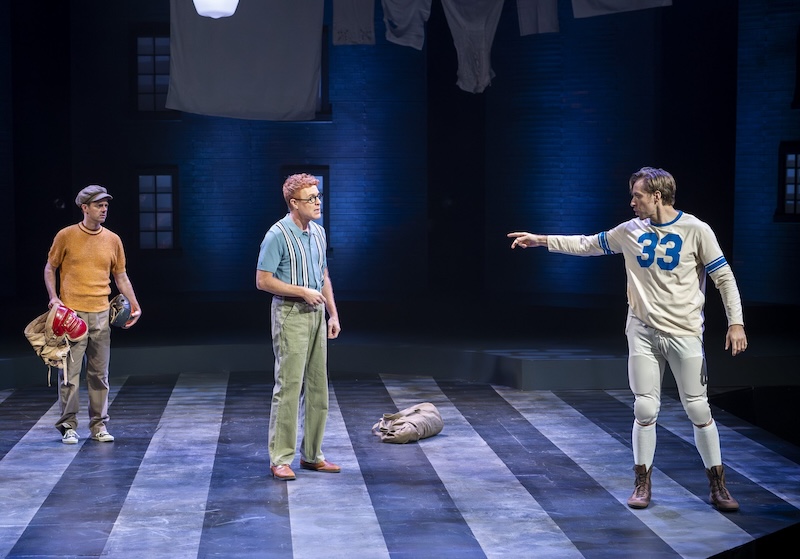
Ian Litttleworth, Kasey Mahaffy, David Kepner in “Death of a Salesman” at A Noise Within (Photo by Craig Schwartz)
But the heart of the matter, and of this production, is Geoff Elliott’s portrayal as Willy Loman. In her Stage Raw review, Klugman notes that Elliot’s prevailing depiction of anger prevents him from being sympathetic. For me, that’s not the case.
When he portrayed Sweeney Todd in this company’s 2024 production of Stephen Sondheim’s musical, I noted that, idiosyncratically, Elliott kept withdrawing, vocally, from the sword’s tip of phrases or musical notes. The tonal effect was to render this diabolical killer passive, when his words and the music intended to propel him in a different direction. These were mannerisms.
Here, as Willy Loman, and to his credit, Elliott is an entirely different presence, almost unrecognizable from the former performance. This is the mark of a fine actor. Yes, that presence is dour, and snappy, far less animated and dynamic than the shadow-boxing performance by Dustin Hoffman in Volker Schlöndorff 1985 television film. And yet I perceived the pain behind that rage. Perhaps it was the way Elliott’s lips twisted, or his eyes grew moist, just a glimmer, which left me feeling an empathy as one would for a person who is cracking up mentally, or emotionally. Yes, he presents himself as a kind of rock, a fortress. Perhaps it was because of Emmett’s tenderly rumpled portrayal of Charley (who, though perennially exasperated with Willy, treats him with kindness nonetheless, in that brusque and arms-length style of mid-century men) that I started to see Willy through Charley’s eyes. Or perhaps it was because of the complaining and dismissive attitudes of both of Willy’s sons, of their cruelty, that I started emotionally to take Willy’s side.
Sometimes, how we react to a character on the stage is more than the product of their mannerisms, or of own heart or nervous system, or even more than a product of our own experience. Sometimes we’re guided there by other characters, who become our lodestar to either repel or endear us to the subject at hand, depending also on how we react to those spirit guides.
This is why the theater, and our reactions to it, are all part of such a subjective, irrational and irascible enterprise.
To close out these comments, I have to sing the praises of Deborah Strang as Willy’s long-suffering wife, Linda Loman.
Almost 20 years to the day, this woman, Strang, portrayed the maniacal Ma Ubu (opposite Allen Blumenfeld’s Pa Ubu, a crazed king) in Alfred Jarry’s nihilistic farce, Ubu Roi. Julia Rodriguez-Elliott directed that one, too. Together they were in a clown show, plotting murder (she planned to murder him) and mayhem — both equally, eye-bogglingly venal and demented, no holds barred. Sometimes, such performances become enshrined.
And here, two decades later, Strang is on the same stage portraying yet another flailing king’s wife, here as ferociously loyal as Ma Ubu was diabolical. And this is when you start to realize, yes, this is what companies are about. And yes, we have local legends. Strang is among them.
As Klugman rightly points out, Strang’s Linda is no mistreated wife. Well, correction, in the play, she’s a mistreated wife, but Strang is having none of that. Willy interrupts her, rudely and repeatedly, men being men, and Biff lashes out at him because of it. Yet there’s no glimmer of indignancy on her part. His insults just wash right over. Playing her as indignant, silent and suffering, the open wound, would be a trope. That’s the way this role is usually played: pre-feminism.
There’s misogyny all through this play. With the exception of Linda, most of the other females on the stage are some kind of sex object, bordering on prostitutes: Buy me stockings, I’ll let you in to see the buyers. You can sleep with me, too. Hey Willy, where are my new stockings?
The young Loman brothers recall bedding their first women. Remember that one, “What a pig!”
Yikes. That line was met with silence from this crowd, raising the question: Is playwright Miller being misogynistic, or is it Miller commenting on the misogyny of that time?
Regardless, Strang rises above it. Like Jean Stapleton’s Edith Bunker in All in the Family, perpetually berated by Carroll O’Connerr’s Archie Bunker as a kind of punching bag, Strang’s Linda is a victim who refuses to be victimized. If her husband had such strength of character, his play would be called Life of a Salesman.
UNCLE VANYA Playwright Neil LaBute’s adaptation of Chekhov’s tragicomedy. City Garage Theatre, 2525 Michigan Ave., Santa Monica; Closed.
DEATH OF A SALESMAN by Arthur Miller. A Noise Within, 3352 E. Foothill Blvd., Pasadena. Thurs.-Sat., 7:30 pm, Sat.-Sun., 2 pm; thru April 19. www.anoisewithin.org Running Time: Two hours and 45 minutes, with an intermission