

David Kepner, Geoff Elliott and Ian Littleworth (Photo by Craig Schwartz)
Reviewed by Deborah Klugman
A Noise Within
Through April 19
RECOMMENDED
Kasey Mahaffy, Bert Emmett, Deborah Strang, David Kepner and Ian Littleworth (Photo by Craig Schwartz)
Arthur Miller was in his 30s when he wrote Death of a Salesman, but he was 17 when he wrote a short story about an aging salesman whose life is filled with failure and desperation, and who (according to a postscript scribbled on the manuscript) eventually throws himself under a subway train. The story was put away in a drawer and forgotten for years, but its inspiration reappeared to Miller some years later when he chanced upon his real life uncle, Manny Newman, outside the Colonial Theatre in Boston in 1947, where All My Sons was having its pre-Broadway run.
Newman, a struggling salesman (in contrast to Miller’s own father, a penniless immigrant who founded a lucrative clothing business), had two sons whom he obsessed over, and with whom he shared his hyperbolic dreams of grand, but implausible, success. This uncle was to become the model for Willy Loman, while his son Buddy, who was a star athlete in high school but never studied and so never made it to college, became the model for Willy’s son Biff. Years before, the gawky adolescent Miller, had been made fun of by Manny and his sons, much as, in Salesman, Willy and his sons make fun of Bernard for being a non-athlete and a nerd.
But on that day in Boston in 1947, things were different. “I could see his grim hotel room behind him, the long trip up from New York in his little car, the hopeless hope of the day’s business,” Miller wrote in Timebends, his 1987 autobiography. When Miller greeted him, his uncle immediately began to talk about Buddy and his “achievements.” without even granting his nephew the courtesy of a hello.
A year later, the playwright sat down to write Salesman. According to Miller’s account in Timebends, he completed the first act in a day and the rest of the play inside of six weeks. [(They say you write best what you know.)]
And the play has held up. Yes, the social landscape has altered — salesmen in the mold of Willy Loman are no more, while the financial establishment, as shark-like as it may have been in the mid-20th century, has since given way to a corporatism even darker and more oppressive, Yet the play’s fundamental human truths abide — insights having to do with hopes and dreams and the perils of self-deception, and an understanding of the bond between fathers and sons — that primal connection that can blight a life on both sides if that bond is corroded or destroyed. (So universal is this last theme that when the play was staged in the People’s Republic of China in 1989, with Miller, directing, it was a roaring success, attributed by one of its actors to precisely that theme.)
The success of a production can understandably rise or fall on the strength of the actor playing Willy, (though I’ve been to one where the performance of the actor playing Biff was riveting beyond all others and elevated the entire show). At A Noise Within, where the play is directed by Julia Rodriguez-Elliott, the pivotal role of the salesman has been undertaken by Geoff Elliott in a crafted portrayal of a personality so demanding that he’s impossible to ignore. More than others, Elliott’s Willy is a very angry man who wreaks his ire freely on those around him. That anger seems to define the character, beyond any vulnerability he might display — and it makes him less sympathetic. Another characteristic which seems embedded into this interpretation is the nature of Willy’s forgetfulness; here, it feels like less of a spiritual malaise, a longing for a more hopeful past from a trodden-down guy, and more of a contemporarily understood problem, namely Alzheimer’s or some other dementia rooted in the body rather than the spirit.
Deborah Strang plays Linda, Willie’s long-suffering and ill-appreciated wife, in a rendering that is also somewhat more modern — more a helpmate than a doormat as she copes with her vitriolic spouse. David Kepner is persuasive as the troubled Biff, a man trying to do the right thing by his abrasive father, even as he struggles to cope with his own demons. Ian Littleworth’s Happy is a bit too oily and short on charm to be convincing as a man who scores with all the ladies he meets. His character needs depth. Likewise, in a rare miss, Kasey Mahaffey’s brainy cousin Bernard, aiming for laughs, is too much a lisping cliché, which doesn’t serve the story. Bert Emmett’s understated Charlie, Willie’s true friend through it all, is a beacon with his straightforward heartfelt delivery.
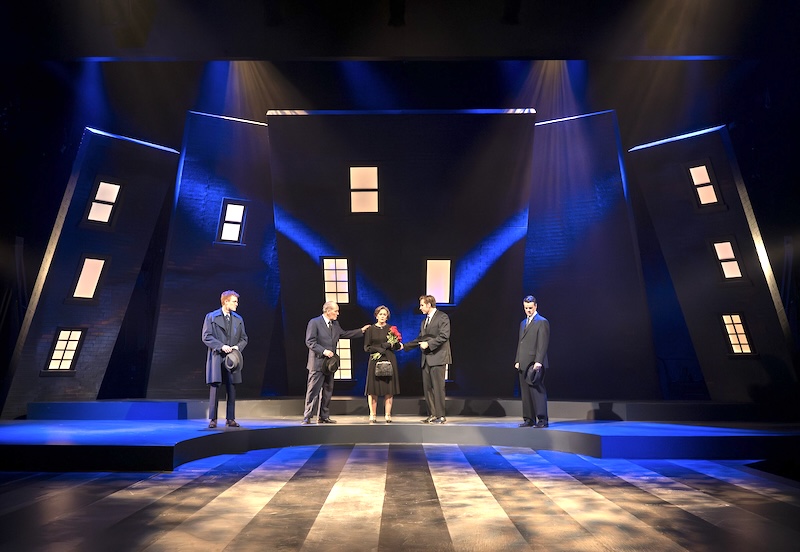
Spare, but impressive, the set (Frederica Nascimento) is dominated by towering flats resembling aged brick, relaying the core experience of life in an urbanized and claustrophobic world. Lighting by Ken Booth relieves this dreariness some, adding color appropriately, while Robert Oriol’s sound and musical composition subtly augments the poignancy inescapably embedded in this universal story.
For another view, see Stage feature.
A Noise Within, 3352 E. Foothill Blvd., Pasadena. Thurs.-Sat., 7:30 pm, Sat.-Sun., 2 pm; thru April 19. www.anoisewithin.org Running time: 2 hours and 45 minutes, with intermission.